Renault and Geely's Engine Maker Comes to Detroit With No U.S. Customers Yet
The Renault-Geely-Aramco venture lists 25 customers, and none of them are American. Its new Michigan office is a bet that Detroit's swing back to hybrids changes that fast.
Horse Powertrain, the engine and hybrid supplier co-owned by Renault Group and Geely, opened its first North American office in Detroit on September 9. It arrives with a catalog of gasoline and hybrid systems, 32 open positions, and, by its own published customer list, not a single American automaker on the books.
That gap is the story. Horse counts more than 25 customers worldwide and names six of them: Renault Group, Geely Auto, Volvo Cars, Proton, Nissan, and Mitsubishi Motors. Every one is European or Asian. The office in Southfield, Michigan exists to change that, and CEO Matias Giannini said as much, calling North America a key strategic market where Horse wants to become a major partner to local automakers.
The timing is deliberate. Detroit is in the middle of a swing back toward hybrids. Ford said in December it will offer a hybrid or multi-energy powertrain on nearly every vehicle by the end of the decade and expects hybrids, extended-range EVs, and EVs to make up about 50 percent of its global volume by 2030, up from 17 percent in 2025. Renault, which owns 45 percent of Horse, already has a separate EV development partnership with Ford in Europe.
Buyers are pulling in the same direction. Cox Automotive expects U.S. hybrid sales to grow about 9 percent in the first half of 2026 while the overall new-vehicle market slips 2.2 percent, and it notes that some nameplates that once came with a plain gasoline engine are now hybrid-only. EVs, meanwhile, held about 5.8 percent of new-vehicle sales in the first quarter, down from a 10.6 percent peak in the third quarter of 2025.
Horse's pitch to that market is pre-integrated hardware: engines, hybrid systems, transmissions, power electronics, motors, and range extenders that an automaker can buy as a package instead of engineering its own. The company argues this cuts capital spending and gets a hybrid variant to showrooms faster. That is exactly the problem Detroit now has after several years of steering development money toward EVs.
What Horse brings to the table
The company is not a startup. It runs 18 plants and five R&D centers, employs more than 19,000 people, and is headquartered in London. Renault and Geely each hold 45 percent; Saudi Aramco bought the remaining 10 percent in 2024 at a €7.4 billion enterprise valuation.
Its newest product, shown the day before the Detroit opening, reads like a brief written for American trucks. The B20 is a 2.0-liter turbocharged four-cylinder built for hybrid, plug-in hybrid, and range-extender applications, rated at 188–248 hp (140–185 kW) and 221–280 lb-ft (300–380 Nm). It is sealed to the IPX8 waterproof standard, can wade through 43 inches (1.1 m) of water, and is aimed at off-road SUVs and pickups, the two segments that carry Detroit's margins.
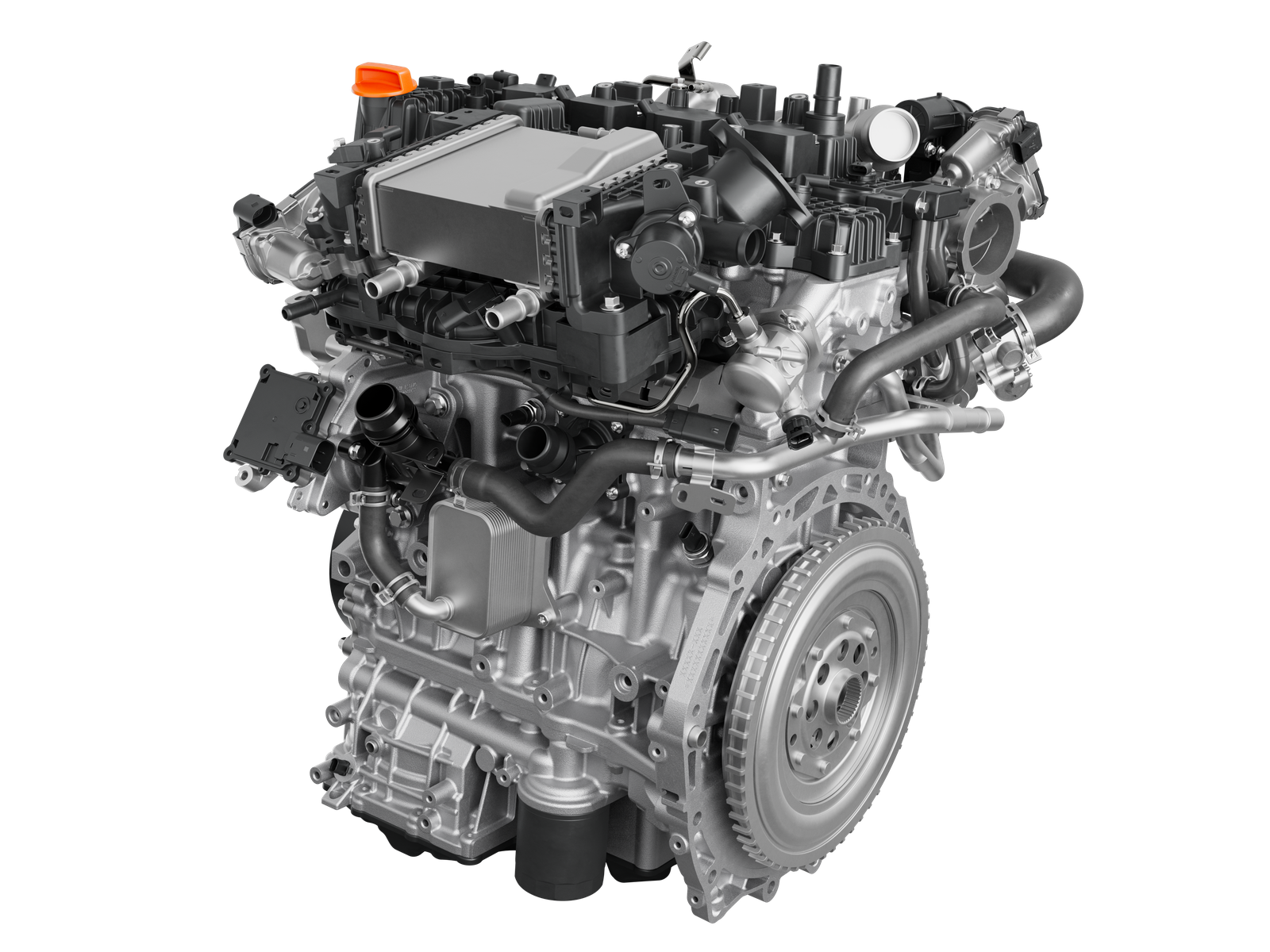
Thomas Lewis, president of the new Horse Powertrain USA unit, is a Michigan native who spent most of his career in the state. The company says his job is to work directly with local automakers on fitting Horse's combustion and hybrid systems into their vehicles.
What's still missing
Horse has not named an American customer, and its announcement does not say whether any deals are in negotiation. It also describes an office, not a plant. The company has said nothing about building engines in the U.S., and Lewis framed the long-term goal as broadening the company's business functions in the country, without specifying which ones or when.
Until a Detroit-area automaker signs, this is a supplier setting up a sales office in a market that suddenly wants what it sells. Given how fast hybrid plans have moved over the past year, that may not be a long wait.