Penske Automotive Is Going Private in a $16.3 Billion Deal — What It Means for Car Buyers
Penske Corporation and Mitsui will buy out the 27% of PAG they don’t own, taking 365 dealerships and six CarShop stores off the NYSE by early 2027. The counter stays the same; the owners don’t.
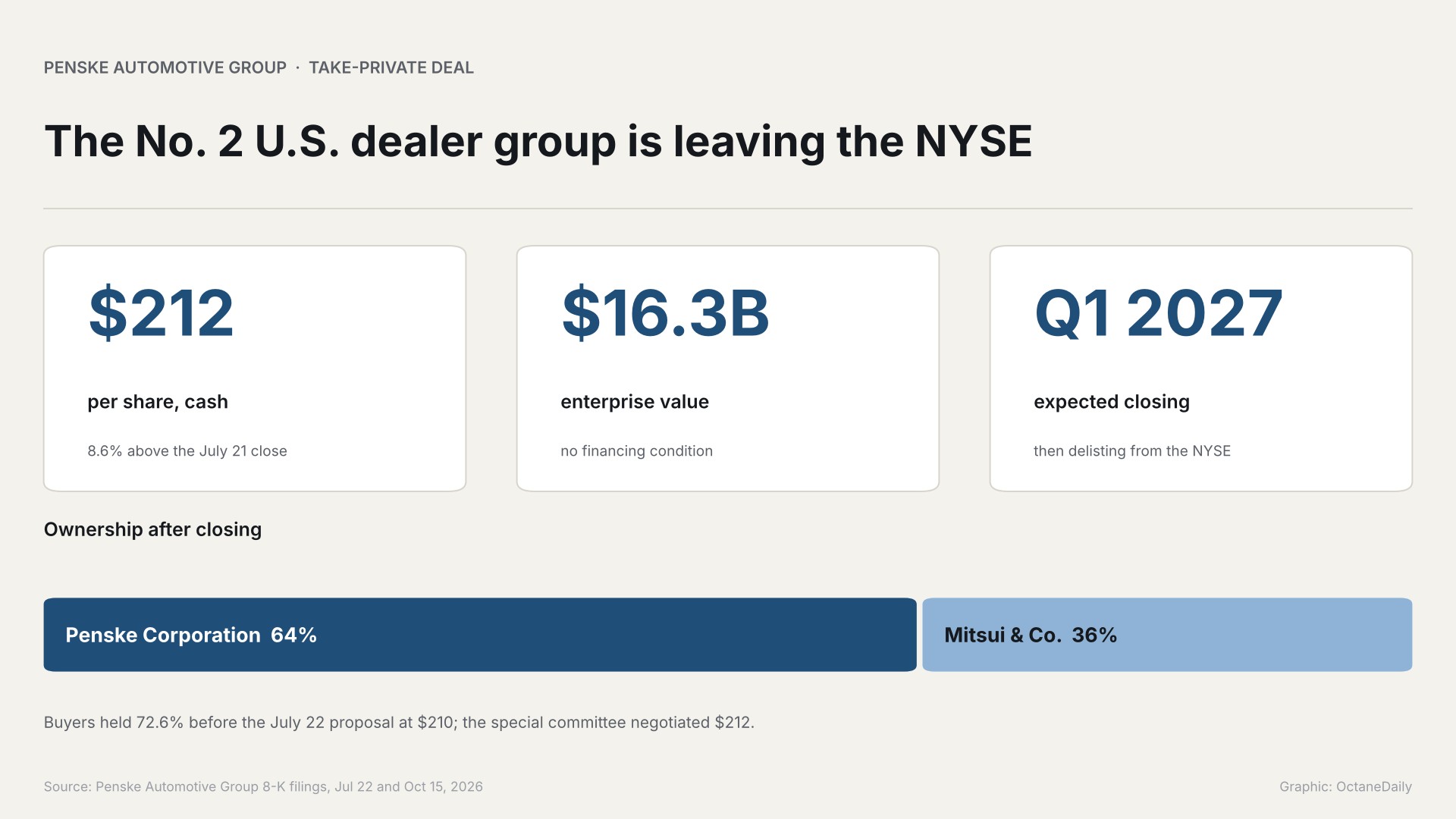
The second-largest dealership group in the United States is about to disappear from the stock market. Penske Automotive Group said Thursday it has signed a definitive agreement to be taken private by Penske Corporation and Japan's Mitsui & Co., which will pay $212 a share in cash for the roughly 27% of the company they don't already own. The deal values PAG at about $16.3 billion including debt.
For anyone shopping at one of PAG's stores, nothing changes at the counter. What changes is who the company answers to. After the closing, expected in the first quarter of 2027, Roger Penske's holding company will own about 64% and Mitsui about 36% — and the group that moved more vehicles last year than anyone except Lithia will no longer have to explain itself to Wall Street every three months, at a moment when the U.S. retail market is splitting into clear winners and losers.
What's actually being bought
PAG is a far bigger business than its name suggests. According to its latest annual report, the company ended 2025 with 365 franchised dealerships — 148 in the U.S. and 151 in the U.K., with the rest spread across Canada, Germany, Italy, Japan, and Australia. It also runs six CarShop used-vehicle stores in the U.S., 45 Premier Truck Group commercial locations selling Freightliner trucks, and owns a 28.9% stake in Penske Transportation Solutions, the truck-leasing giant. Revenue last year came to $31.8 billion, and 71% of its dealership sales came from premium brands.
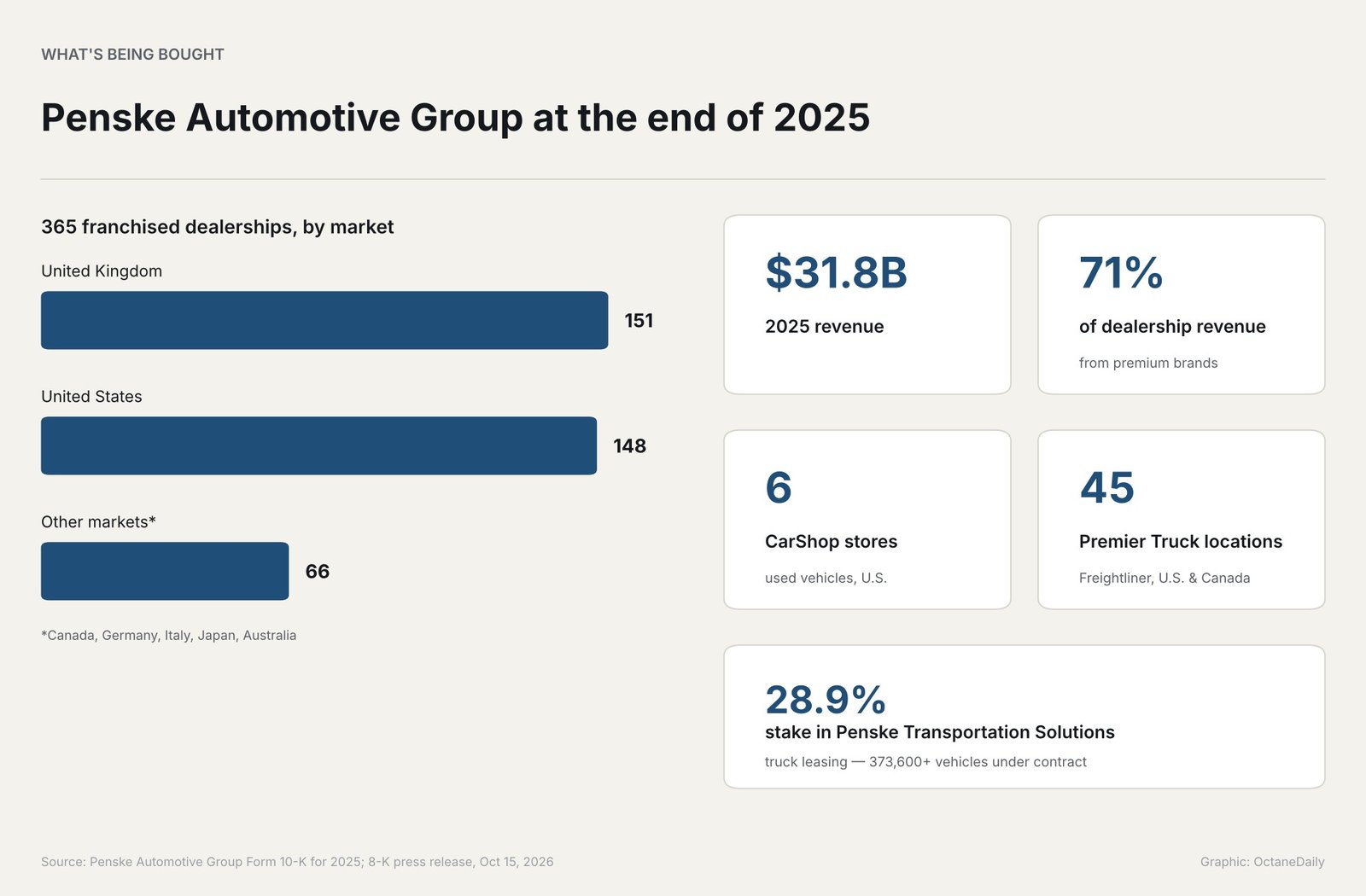
That premium tilt matters for buyers. PAG's stores are the places many Americans go for a German luxury SUV, not a base-trim compact. Automotive News ranks it No. 2 on its 2026 Top 150 list, behind Lithia Motors and ahead of AutoNation and Group 1.
How the price came together
The transaction has been in the open since July 22, when Penske Corporation and Mitsui — then holding 72.6% of the stock between them — made an unsolicited proposal at $210 a share. PAG's board handed the offer to a special committee of independent directors chaired by David Hoogendoorn, who hired Moelis & Company and Paul, Weiss to negotiate. The committee came back with $212, a premium of 8.6% to the stock's close on July 21, the last trading day before the proposal became public, and of about 20% and 26% to the 60- and 90-day volume-weighted averages through that date. Measured against Wednesday's close, the premium is 8.84%.
Hoogendoorn said the committee concluded the deal offered minority shareholders more value than staying public. Roger Penske, who remains chair and CEO, called it the start of a new chapter and pointed to further projects with Mitsui, without naming any.
The buyers have no financing condition to satisfy. What they do need are regulatory approvals and two shareholder votes: a majority of all outstanding shares, which the insiders already control, and a majority of the votes cast by stockholders unaffiliated with Penske and Mitsui, which they do not. That second vote is the real test. Quarterly dividends continue until the deal closes, and PAG will still publish its third-quarter results on October 28 — though it has canceled the usual earnings call.
A retail business in consolidation mode
The move fits a broader reshuffling of how new cars are sold in America. The top 10 dealer groups already own 1,885 stores, about 10% of all U.S. dealerships, according to Automotive News. Carvana, once pitched as the company that would make dealers obsolete, has bought seven franchised Stellantis stores since February 2024, per trade outlet CBT News. Automakers are reworking their networks too: Hyundai just put a new executive in charge of its U.S. dealer footprint, and the used side of the market is in flux as wholesale prices slide while EV values climb.
Going private removes the quarterly scorecard, but not the pressures behind it: PAG still depends on the same automakers for allocation and on the same interest rates that weigh on its floorplan and its customers' loans.
What PAG hasn't said is what the new owners intend to do with the pieces. The announcement doesn't mention CarShop, the U.K. network, or any changes to management or headcount, and it gives no reason for the timing beyond the "next chapter" language. More detail should surface in the proxy statement that goes to shareholders ahead of the vote. Until then, the one date buyers and employees can circle is the closing target: sometime in the first three months of 2027, after which PAG shares leave the New York Stock Exchange for good.