Mercedes Just Placed a Second Solid-State Battery Bet
A joint testing agreement gives the automaker priority access to ProLogium's Gen4 cells — while a different solid-state battery, from Factorial, has already carried an EQS 749 miles on one charge.
Mercedes-Benz has signed a joint testing agreement with Taiwan's ProLogium that gives the automaker priority access to the battery maker's fourth-generation solid-state cells. It's an evaluation, not a supply deal, but it means Mercedes now has two separate solid-state programs running at the same time.
Under the agreement, ProLogium's Gen4 cells will go through electrical, thermal, and safety testing at Mercedes' own facilities and at outside institutes. The results will decide whether the chemistry is a fit for future vehicles, according to the September 24 announcement. Neither company named a model, a volume, or a date.
ProLogium describes Gen4 as a "superfluidized" all-inorganic solid-state design: a non-flammable inorganic electrolyte, a ceramic separator, and what it calls an active safety mechanism. The company says the platform is meant to deliver five things at once—intrinsic safety, performance, energy density, scalable manufacturing, and competitive cost—while supporting fast charging and cold-weather operation.
Those are ProLogium's claims. The release contains no energy-density figure, no charge time, and no cycle-life data for Gen4.
The solid-state battery Mercedes is already driving
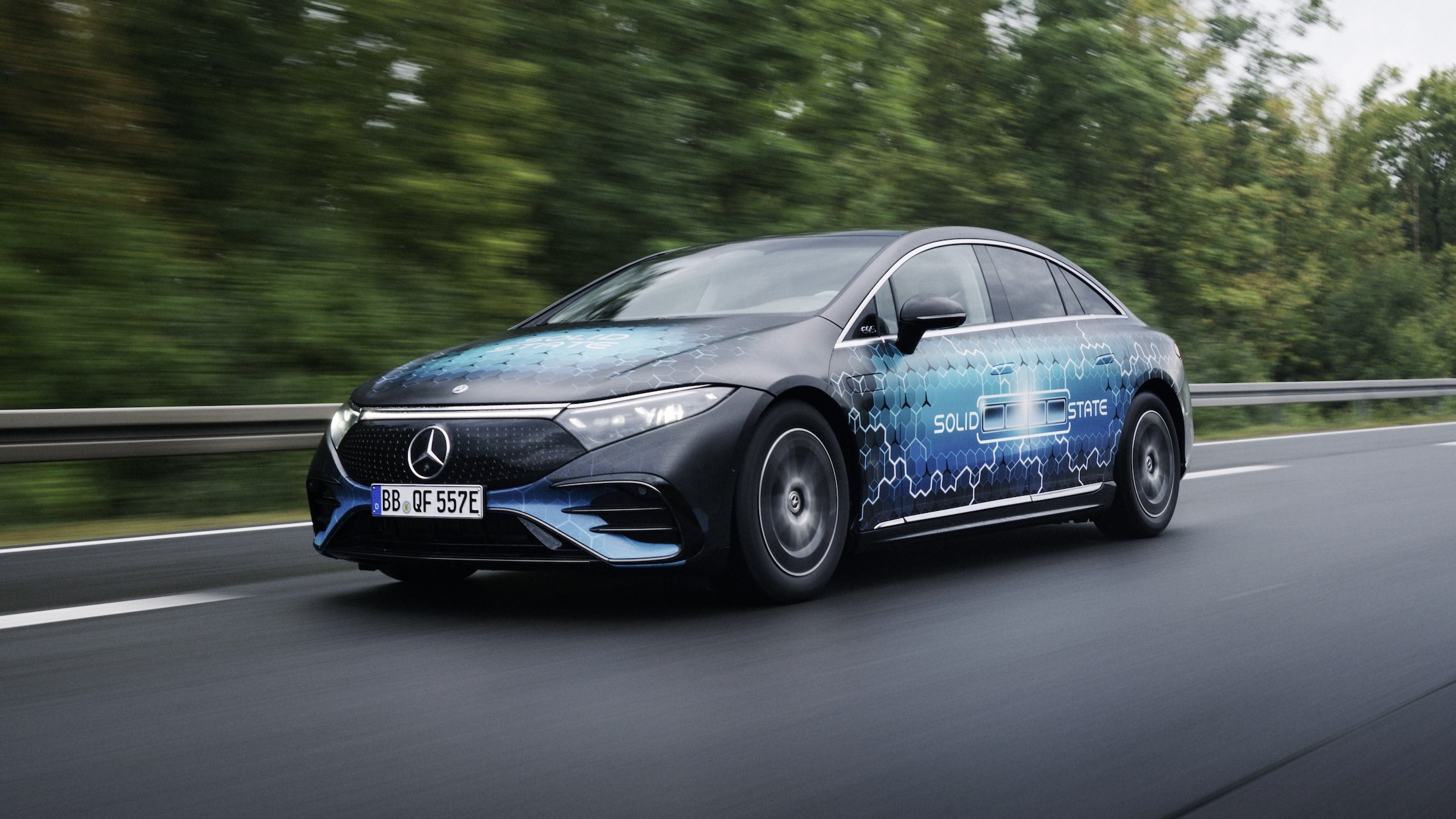
ProLogium isn't Mercedes' first solid-state partner, and it isn't the one furthest along. In September 2025, a lightly modified EQS running lithium-metal cells from US-based Factorial Energy covered 1,205 km (749 miles) from Stuttgart to Malmö, Sweden, on a single charge, arriving with 137 km (85 miles) of range still showing.
Mercedes said that pack, built by Mercedes-AMG High Performance Powertrains in Brixworth, UK, holds 25% more usable energy than a comparable conventional battery and uses pneumatic actuators to manage the cells' swelling as they charge and discharge. Road tests of that car began in February 2025, and Mercedes has said it wants the technology in series production by the end of the decade.
The ProLogium relationship is older but has moved more slowly. The two companies have worked together since 2016, and in January 2022 Mercedes invested a high double-digit million euro sum in ProLogium and took a board seat. The stated goal back then was cells in a range of passenger cars in the second half of the decade.
Four and a half years later, the collaboration has validated pouch and prismatic cell formats, and it is still at the testing stage. That's why the wording matters: this is a testing scheme, and Mercedes is keeping its options open rather than committing to either chemistry.
What ProLogium gets out of it
For ProLogium, a fresh Mercedes endorsement lands at a useful moment. The company is going public on Nasdaq through a merger with Translational Development Acquisition Corp., a blank-check company, and expects to list under the ticker PRLG in the fourth quarter of 2026. The release says Mercedes backs that plan.
ProLogium also broke ground on a gigafactory in Dunkirk, France, in February 2026. The first phase is designed for 4.0 GWh of annual capacity, to be reached progressively by 2030, with a maximum build-out of 44 GWh. Its existing Taoke plant in Taiwan has completed GWh-scale validation and is producing C-samples for demo vehicles.
What Mercedes hasn't said is anything a buyer could act on: how Gen4 compares with Factorial's cells on energy density or charging speed, which models might use it, when, or whether any of this is headed for the US. Until the test results come back, the short version is that Mercedes has a working solid-state car with one partner and a second partner's cells on the bench.