Xiaomi SkyNomad: Range, Sizes, Prices, and the Questions Xiaomi Hasn't Answered
Xiaomi's first range-extended SUVs went on sale in China on September 7 in four versions, from 209,900 yuan, with 52- or 76-kWh batteries and a gasoline generator that never drives the wheels. We inspected both at Chengdu — here's the full lineup, the launch prices, and what Xiaomi still hasn't answered.
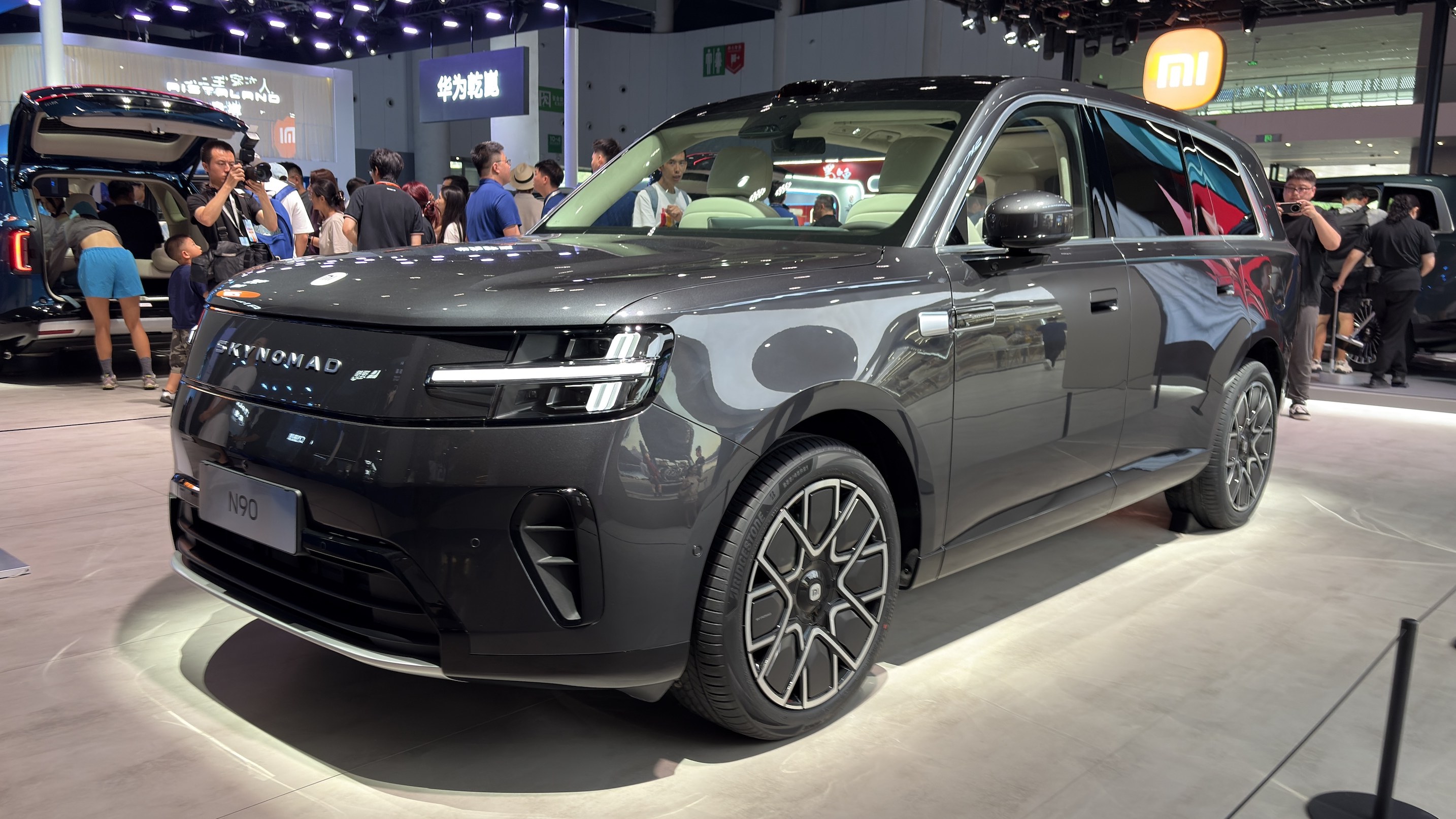
Xiaomi's second act in cars looks nothing like its first. After the low-slung SU7 sedan and YU7 crossover, the SkyNomad series is a pair of tall, boxy family SUVs that carry gasoline generators on board — Xiaomi's first extended-range EVs. They went on sale in China on September 7 as a four-version lineup starting at 209,900 yuan (about $31,300), and the seven-seat flagship claims up to 1,059 miles (1,705 km) of combined range on China's CLTC cycle. Launch prices landed below the July pre-sale figures.
The open questions have moved on: whether SkyNomad joins Xiaomi's European push, and when each version actually reaches customers. Our correspondents spent time with both SUVs on Xiaomi's stand at the Chengdu Motor Show in late August, so this guide draws on what we saw up close as well as the launch-day numbers.
What's actually in the SkyNomad lineup?
SkyNomad — Pengcheng in Chinese — is Xiaomi's second vehicle series, built on a new architecture called Kunlun and positioned by the company as an "intelligent, reconfigurable, large-space SUV." Where the SU7 and YU7 chase drivers, SkyNomad chases families.
Four versions are on sale: the five-seat N70 Pro and N70 Max, the three-row N90 Max, and the N90 Max Explorer Edition, a five-seat camper with a factory power pop-up roof. All are EREVs: a 1.5-liter turbocharged engine works purely as a generator and never drives the wheels. China's regulatory filings had also listed a base N70 and an "N90 Max Camping Edition." The base car didn't appear at launch, and Xiaomi hasn't said whether the Explorer Edition is that Camping Edition under its production name — the spec matches, so that's my working assumption, flagged as one.
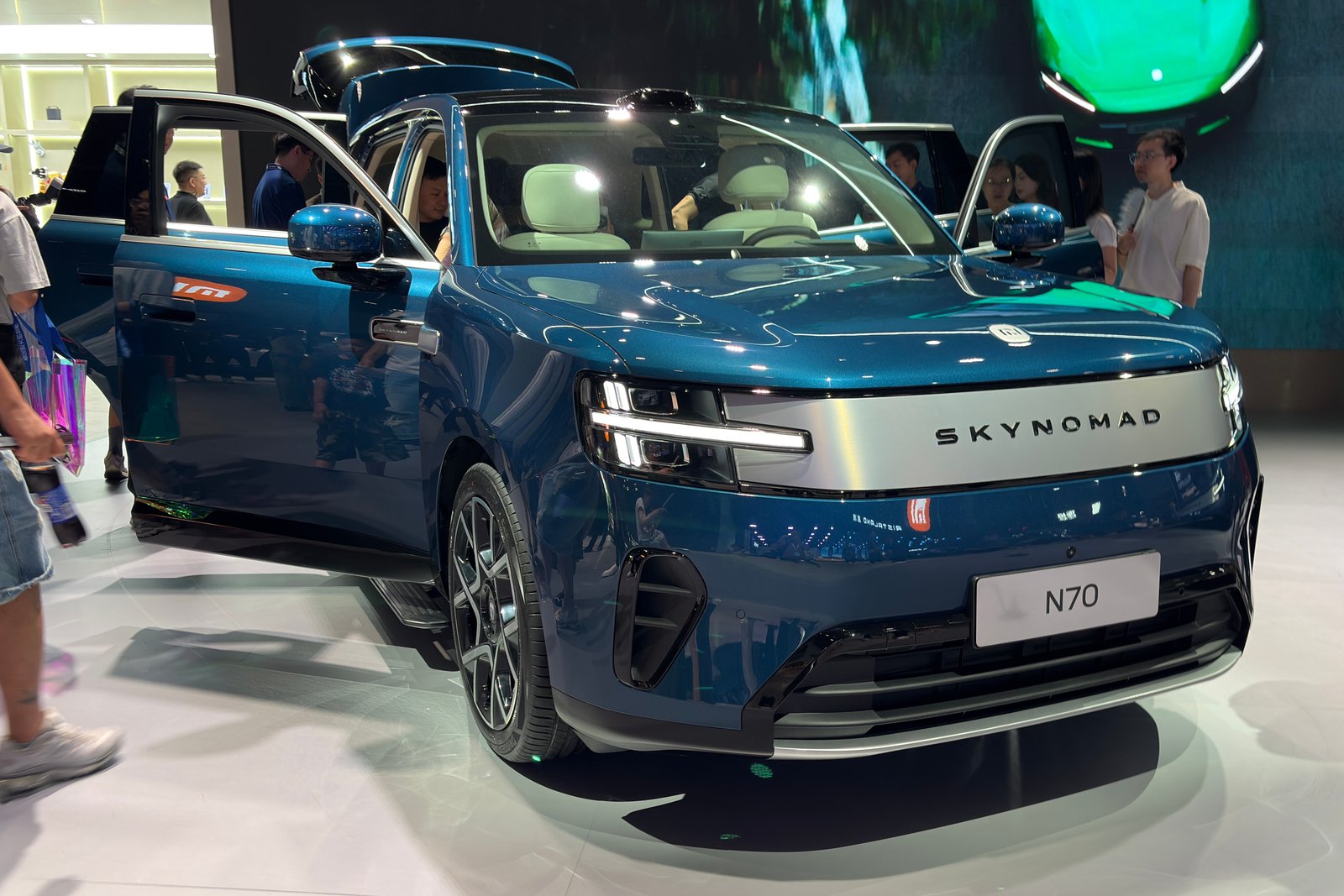
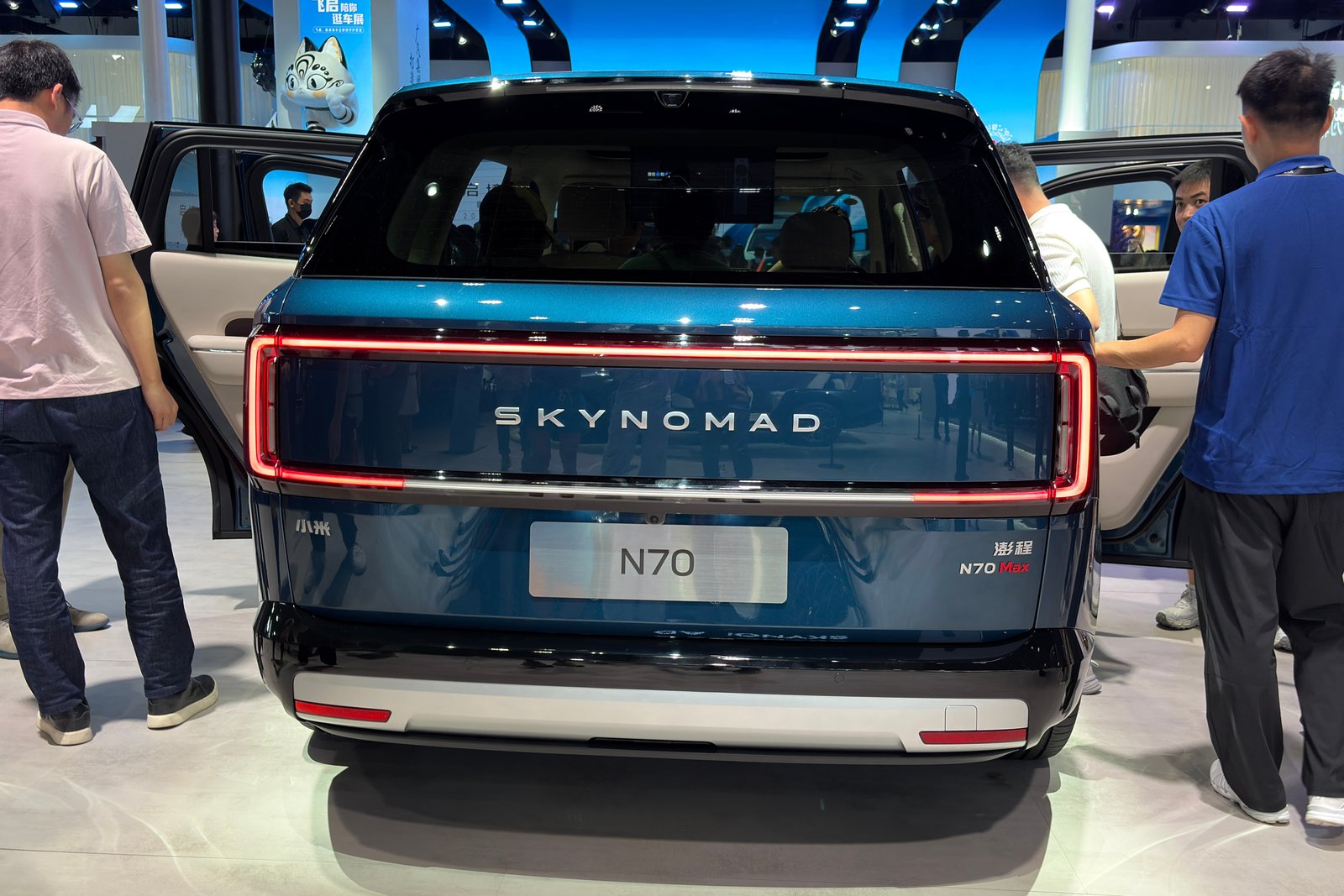
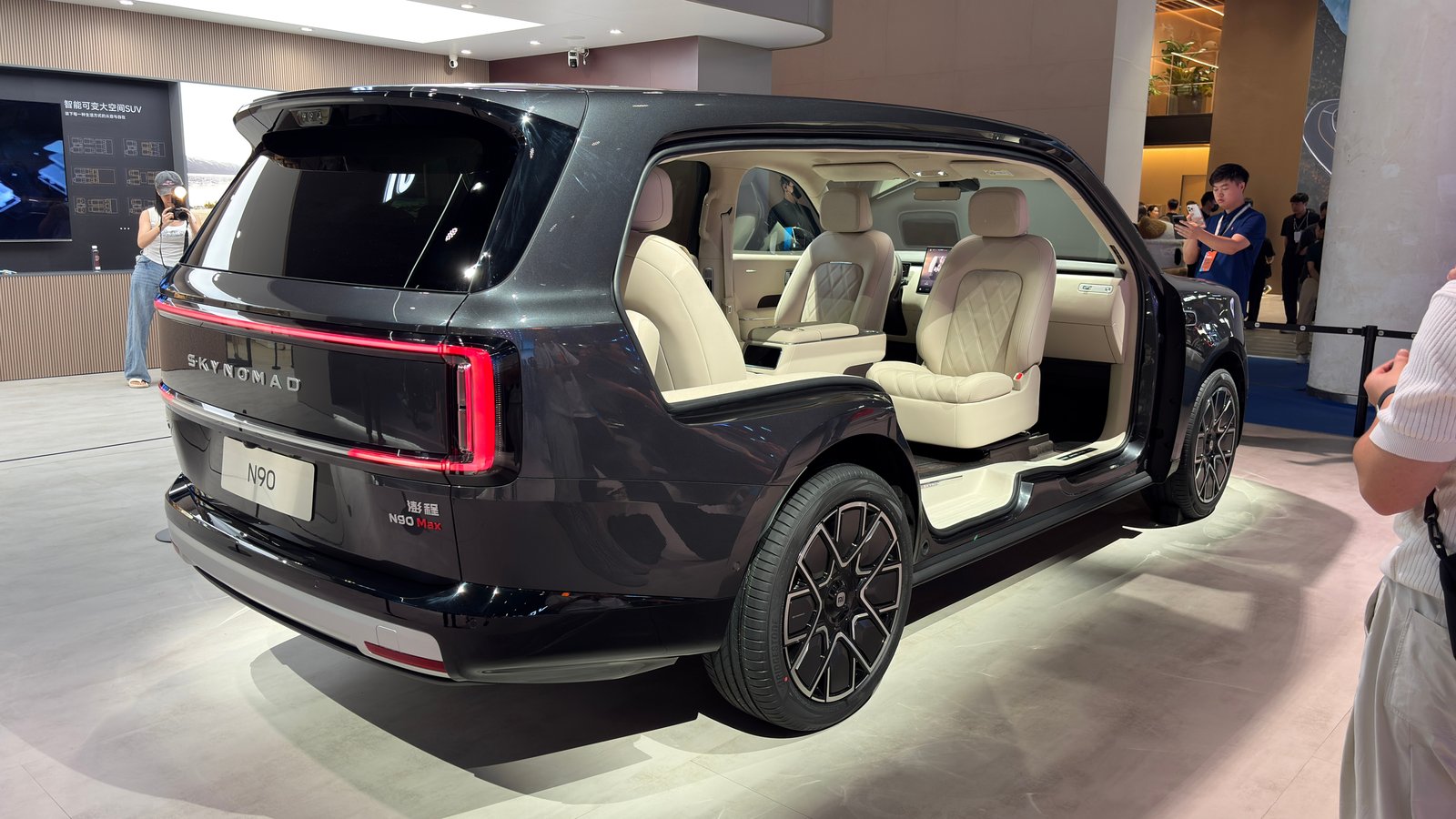
Early coverage sometimes blurred which badge belongs to which car, so we checked the metal. On the Chengdu stand there were two distinct models — the teal N70 Max and the dark-gray N90 Max, each wearing its own tailgate badge. That's not one SUV under two names; it's a smaller and a larger car sharing one family face.
Range and charging
Every figure below is CLTC, China's test cycle, and every one comes from Xiaomi:
- N70 Pro: 52-kWh lithium iron phosphate battery, single 282-hp (210 kW) motor, 218 miles (351 km) electric and 840 miles (1,351 km) combined.
- N70 Max: 76-kWh nickel-manganese-cobalt battery, dual-motor all-wheel drive with 416 hp (310 kW), 314 miles (505 km) electric and 908 miles (1,461 km) combined.
- N90 Max: same 76-kWh pack and 416-hp drivetrain, 288 miles (464 km) electric and 1,059 miles (1,705 km) combined.
- N90 Max Explorer Edition: 287 miles (462 km) electric and 1,049 miles (1,688 km) combined.
Xiaomi calls the N70 Max's 505 km the longest electric range of any production EREV. Xiaomi's spec page doesn't say which axle the N70 Pro's motor drives, and launch coverage splits between front and rear, so we're not calling it until Xiaomi does.
A caveat I'd underline: those are CLTC numbers. There are no EPA equivalents, because none of these SUVs is headed to the US, and CLTC is far more generous than EPA testing — knock off roughly a third for a realistic estimate. Our CLTC-versus-EPA explainer walks through why the gap is that large.
Xiaomi quotes 18 minutes from 20 to 80 percent for every version, and says a 15-minute stop adds up to 193 miles (310 km) of CLTC range on the 76-kWh cars or 137 miles (220 km) on the N70 Pro. And in a company-run test on August 31, a Xiaomi marketing executive drove an N90 Max 764 miles (1,230 km) from Shanghai to Beijing on one charge and one tank, with four adults aboard and range to spare. Xiaomi's own numbers, to be clear — but a data point worth logging.
How big are they?
The N90 Max measures 208 inches long on a 121-inch wheelbase (5,285 mm and 3,080 mm) — a couple of inches shorter than a Chevrolet Tahoe. The N70 is 195 inches (4,960 mm) with a 116-inch (2,950 mm) wheelbase, closer to a big two-row crossover.
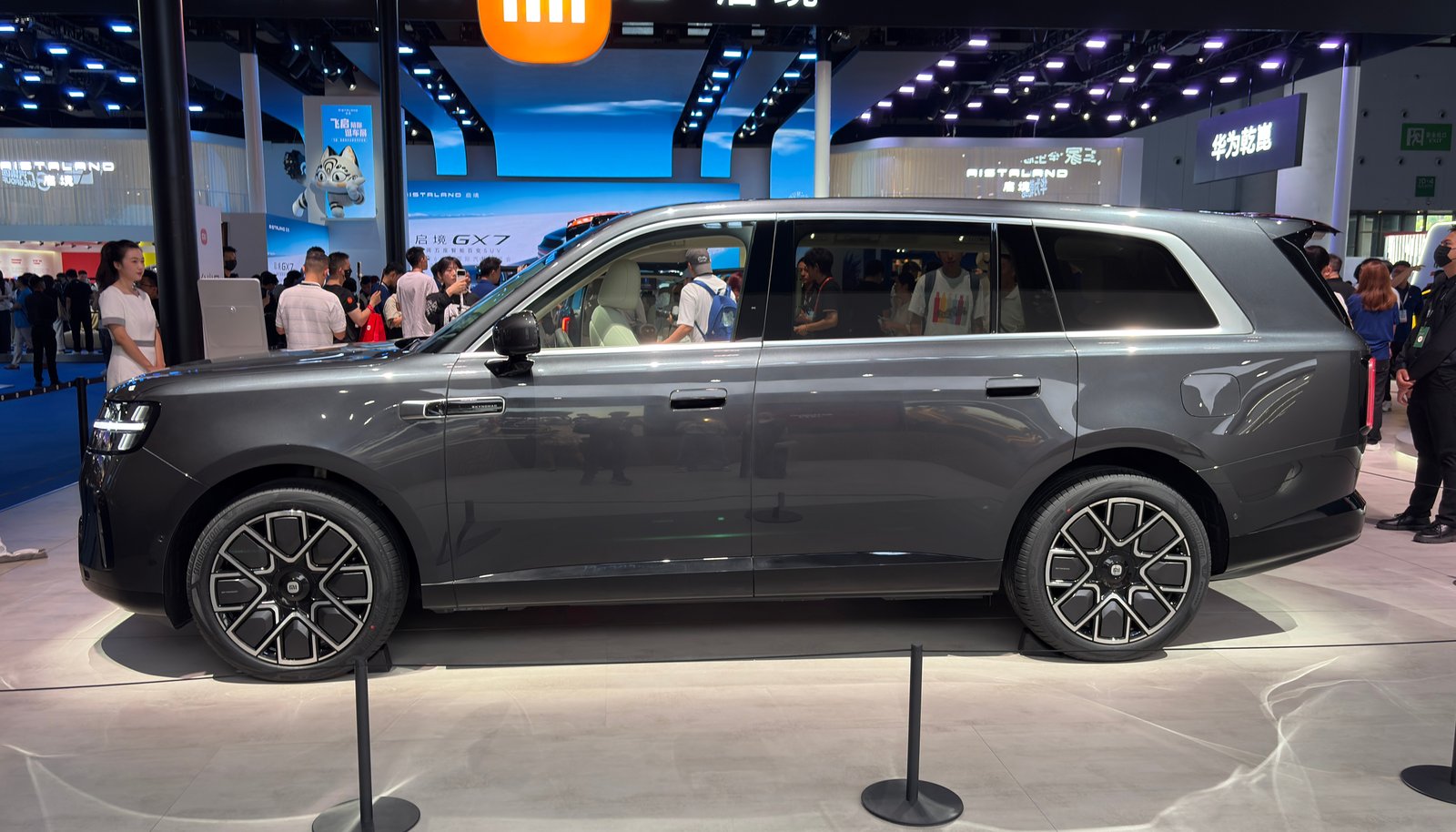
Standing next to the N90 in Chengdu, what strikes me is how honest the shape is: near-vertical glass, a flat roof, squared shoulders. Xiaomi says the Kunlun platform was packaged from the inside out, and the proportions read exactly that way.
Interior and tech
The N70 Pro's single motor gets it from 0–62 mph (0–100 km/h) in 7.9 seconds; the dual-motor N70 Max does it in 5.5 and the heavier N90 Max in 5.9. But the cabin is the actual pitch. The N90 Max seats seven in a 2+2+3 layout, its front seats rotate 180 degrees to face the second row, and voice commands switch the interior between preset layouts.
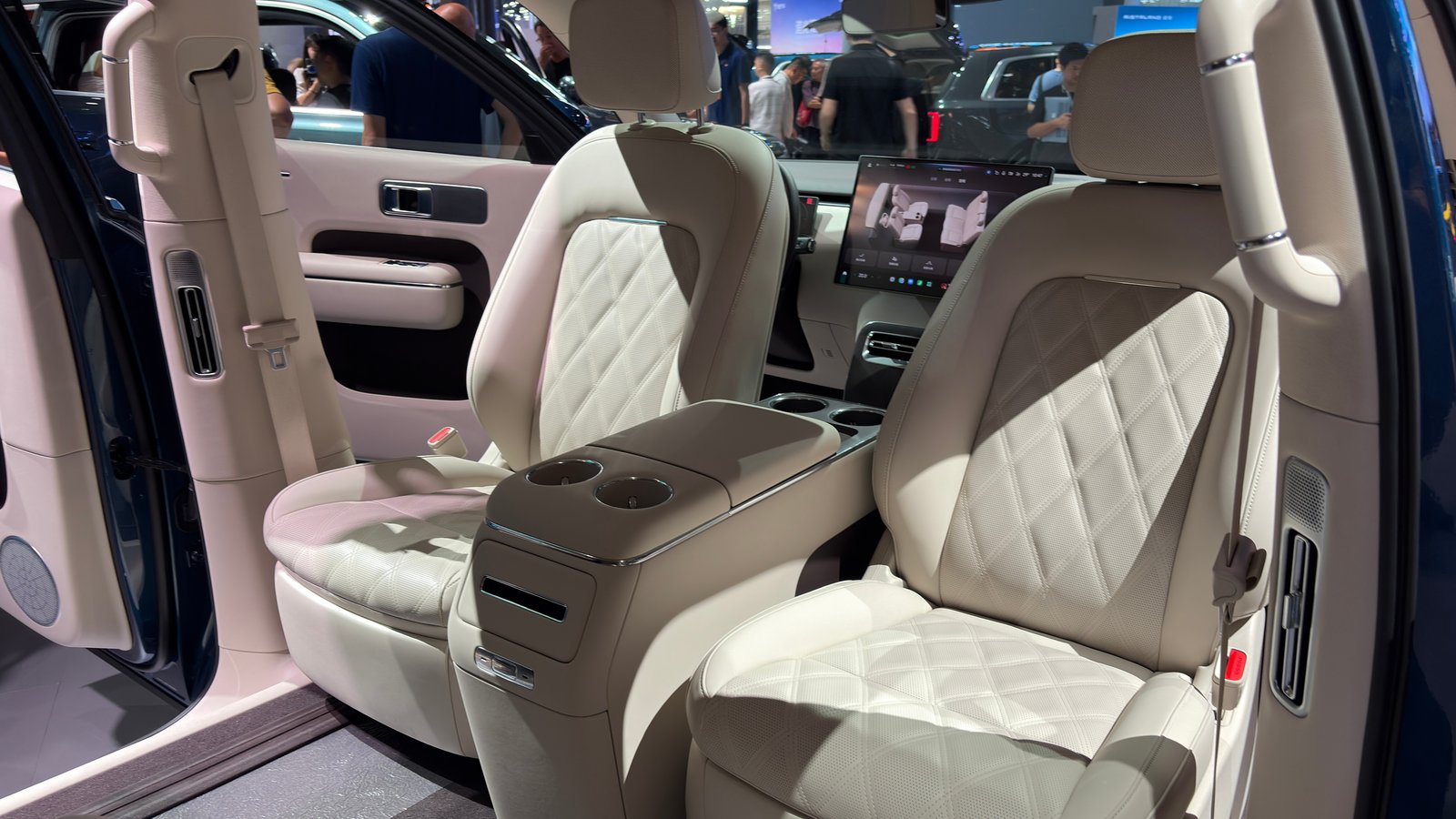
The second row we sat in at Chengdu had airline-style captain's chairs, a wide console, and a large entertainment screen serving the rear rows. Driver assistance runs on Nvidia's 700-TOPS Thor chip with lidar on every version, and both N90s add a rear-facing solid-state lidar.
The Explorer Edition turns the N90's flat floor into a camper. Its power pop-up roof lifts the interior height to 90 inches (2,294 mm), opening a second level a person can stand under; the rear seats fold flat into a bed, and the floor is heated. Xiaomi says the roof is only for use parked off public roads. We haven't seen this version in person yet — it wasn't on the Chengdu stand.
Prices and release date
Launch pricing, all in yuan and all for China:
- N70 Pro: 209,900 (about $31,300)
- N70 Max: 239,900 (about $35,800) — 20,000 yuan under its July pre-sale price
- N90 Max: 269,900 (about $40,200) — 30,000 yuan under pre-sale
- N90 Max Explorer Edition: 299,900 (about $44,700)
The dollar figures are for scale only. Even the Explorer Edition sits 40,000 yuan under Tesla's six-seat, China-market Model Y L at 339,900 yuan; the N90 Max undercuts it by 70,000, and the N70 Max lands just under Li Auto's L6. We broke down the cuts on launch day. In my view, the 30,000-yuan drop on the N90 Max is the tell: Xiaomi needs volume from this series, and it priced accordingly.
Deliveries began on September 13, six days after the launch event, with the first wave covering 75 cities, according to CarNewsChina; CEO Lei Jun handed over keys in person at events in Shanghai and Xuzhou. All four listed versions are shipping, which settles both Xiaomi's own one-to-five-week window and the October–November timing some Chinese outlets had given the N70. Xiaomi also claimed more than 10,000 locked-in orders within four minutes of the event ending, on Weibo and without a breakdown by version. None of these numbers is independent.
Why this matters if you live in the US
Xiaomi does not sell cars in the United States, and nothing suggests that will change soon: tariffs effectively price Chinese-built EVs out of the market. Europe is the export plan. On September 3, four days before the SkyNomad launch, Xiaomi Auto signed memoranda with eight German dealer groups ahead of a 2027 entry — an announcement that named no models.
So why cover it? Because Xiaomi is the company that made Detroit blink. Ford CEO Jim Farley had an SU7 shipped from Shanghai and told the Everything Electric Show he'd driven it for six months and didn't want to give it up. The SkyNomad is that same company deciding what an American-style family SUV should be — three rows, a huge battery, gas on board — for a fraction of US money. In my view, it's the clearest preview yet of the competition US automakers would face without a tariff wall.
What we don't know yet
- Export plans. Xiaomi's Europe-2027 commitment and the German dealer deals are company-wide; it has not said whether SkyNomad is part of them, and no US plans exist.
- EPA-comparable figures. Every range number here is CLTC; treat them as best-case.
- The base N70. China's filings list a cheaper N70 below the Pro. It wasn't at the launch, and Xiaomi hasn't said whether or when it arrives.
What's next
Customer deliveries started on September 13 across 75 cities, with the Explorer Edition in the first wave, so the next test is volume: China Passenger Car Association data in early October will show whether launch-night orders turn into registrations. After that, watch for any word on the base N70 from the regulatory filings — it was not part of the launch lineup — and whether SkyNomad is on the list when Xiaomi names its European models. We'll update this page as each of those lands.