2028 Genesis GV90: Price, Range, Release Date, and Everything We Know
Genesis revealed its first full-size flagship SUV with 657 hp, coach doors, and a 123.5-kWh battery. Price and EPA range are the questions it hasn't answered.
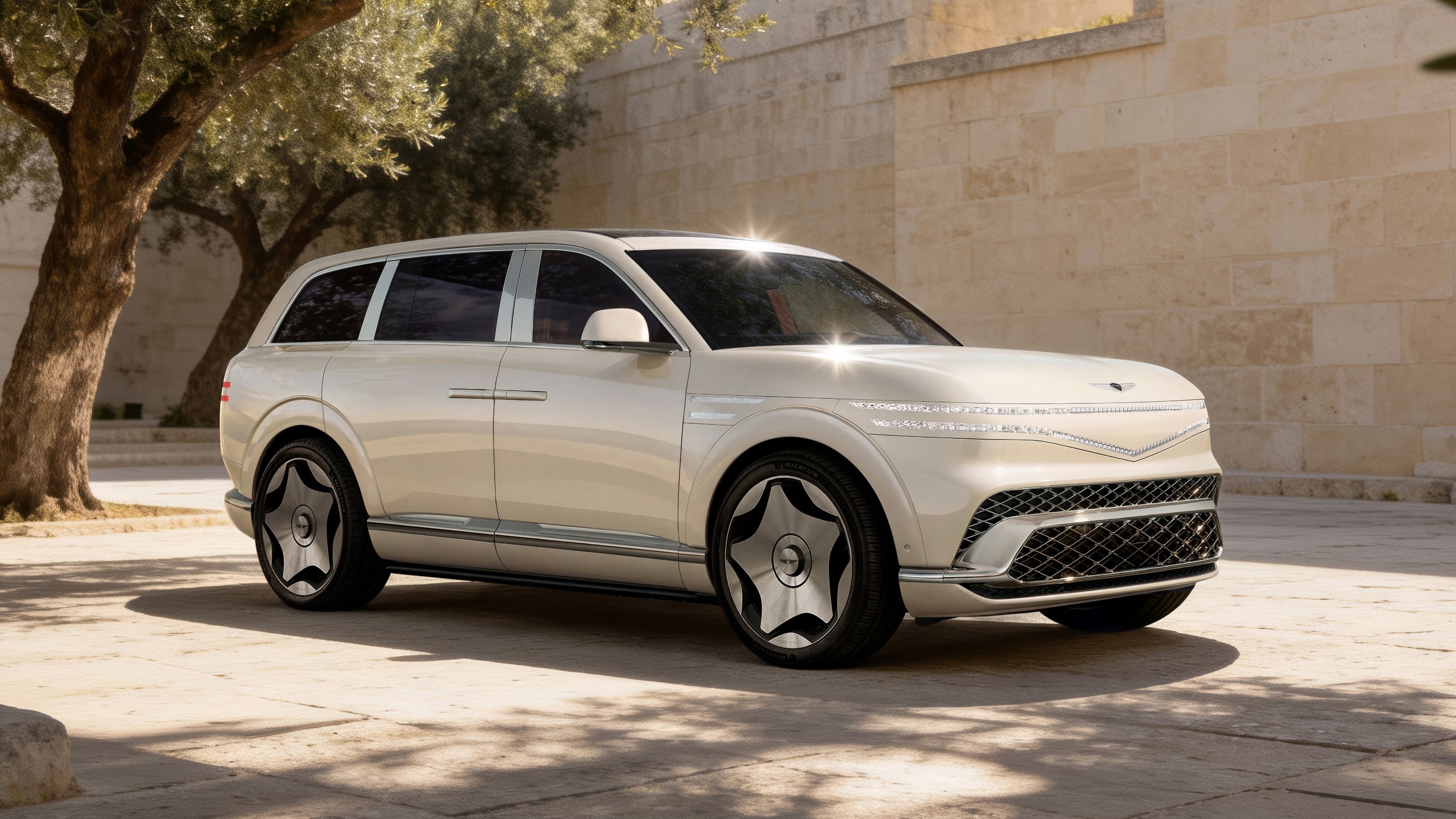
Genesis pulled the cover off its first full-size flagship SUV on August 19, 2026, at the Palace of Fine Arts in San Francisco. The GV90 arrives in two forms: the standard GV90 with conventional doors and the GV90 Neolun, which hides its B-pillar to make room for independently opening coach doors. A Neolun First Edition, built on the four-seat Executive Suite configuration, tops the range.
The headline numbers are already on the table: 657 hp, a 123.5-kWh battery, and a Genesis-estimated 310 miles of range. The headline answers are not. Genesis has not announced pricing, an EPA-certified range figure, or U.S. trim details, and the on-sale window is still a loose "early 2027." Here is everything we know so far, and everything we are still waiting for.
When Does the GV90 Go On Sale?
In the United States, the GV90 will be sold as a 2028 model. Genesis lists the SUV as arriving in early 2027 on its U.S. consumer site, and company representatives confirmed the 2028 model year designation at the debut. South Korea and other global markets get the SUV first, where it carries a 2027 model year. Genesis dated the Korean launch September 9, 2026, and that date has now passed without a price list: the brand's Korean site lists three versions — GV90, GV90 Neolun, and GV90 Neolun First Edition — and says the details follow once sales open.
Genesis has not opened U.S. order books, named a delivery month, or published a reservation process. For now, the closest you can get to one is Genesis House in New York, where the brand is displaying the SUV.
How Much Will the GV90 Cost?
Genesis has not said, and that is the biggest open question hanging over the launch. The GV90 takes over the flagship position from the G90 sedan, which starts at $92,700 before destination charges, so a starting price above that mark is a reasonable projection. Treat it as exactly that: our forecast, not a Genesis figure.
Positioning offers another clue. Genesis is aiming the GV90 at the Cadillac Escalade IQ and Mercedes-Benz EQS SUV, both of which live in six-figure territory once equipped. The Neolun's coach doors and the First Edition's exclusive touches should stretch the ladder well past the base price, whatever it turns out to be.
Range, Charging, and Performance
The GV90 rides on eMP, a dedicated platform Genesis developed for its flagship rather than the E-GMP architecture under the brand's current EVs. The battery is a 123.5-kWh pack, the largest in a Hyundai Motor Group EV to date.
Genesis estimates the seven-seat GV90 will cover approximately 310 miles (500 km) on a charge, based on internal testing. That is not an EPA rating, and the certified number will almost certainly differ once it lands. On a 350-kW DC fast charger, the pack goes from 10 to 80 percent in 22 minutes.
Two motors, 240 kW up front and 250 kW at the rear, combine for 657 hp (490 kW) and 590 lb-ft (800 Nm) of torque, the most powerful setup in a Hyundai Motor Group EV. Each motor gets its own electronic limited-slip differential, a group first that Genesis credits with sharper cornering and better traction on slick surfaces. Multi-chamber air suspension adjusts ride height and stiffness, and rear-wheel steering turns the back wheels up to five degrees, shrinking the turning circle to something closer to a midsize car's.
Design: A Moon Jar on 24-Inch Wheels
Genesis modeled the GV90's surfacing on the Korean moon jar, the white porcelain vessel prized for its restraint. In practice that means a clamshell hood, Wing Face Micro Lens Array headlamps laser-engraved into the bodywork, smooth flanks, and a tail with no spoiler and flush-mounted taillights. The SUV measures 208.1 inches (5,285 mm) long on a 127.8-inch (3,245-mm) wheelbase and rolls on 22- or 24-inch wheels, with the larger forged set standard on the Neolun.
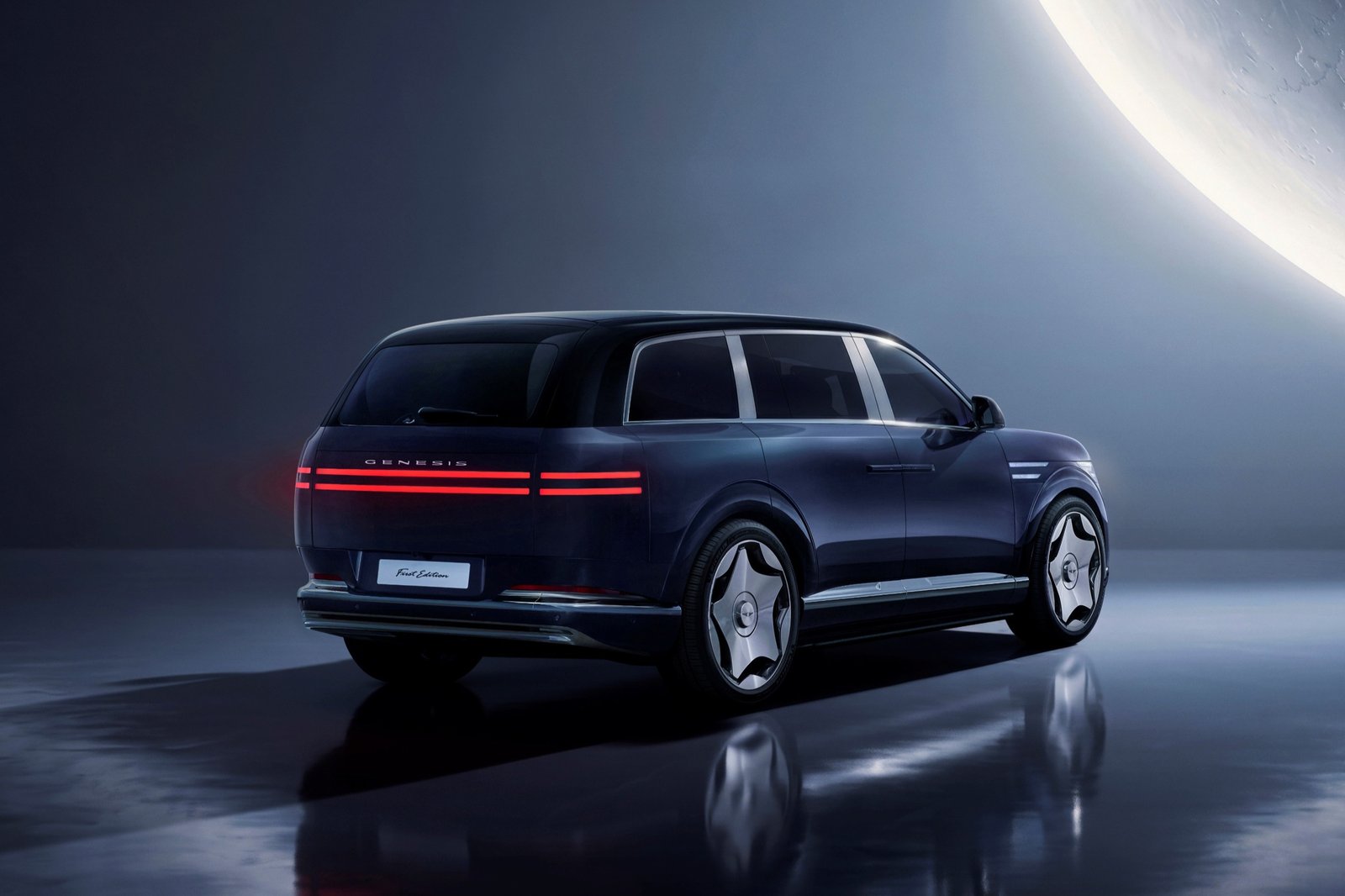
The two variants read differently at the side glass. The standard GV90 uses frame-flush windows for an unbroken surface, while the Neolun wears anodized aluminum accents between the first and second rows, a subtle tell for the party trick underneath.
That trick is the Neolun Arch Gate, which Genesis calls the world's first independently opening and closing hidden B-pillar coach doors. A dual-motion hinge slides each rear door slightly outward before rotating it open, so the rear doors operate without waiting on the fronts. With no visible B-pillar, high-strength dual steel beams and a concealed roll cage, built on a frame 1.5 times thicker than a conventional vehicle's, carry the structural load. Genesis says crash performance matches a car with conventional pillars, though independent crash testing will have to confirm that.
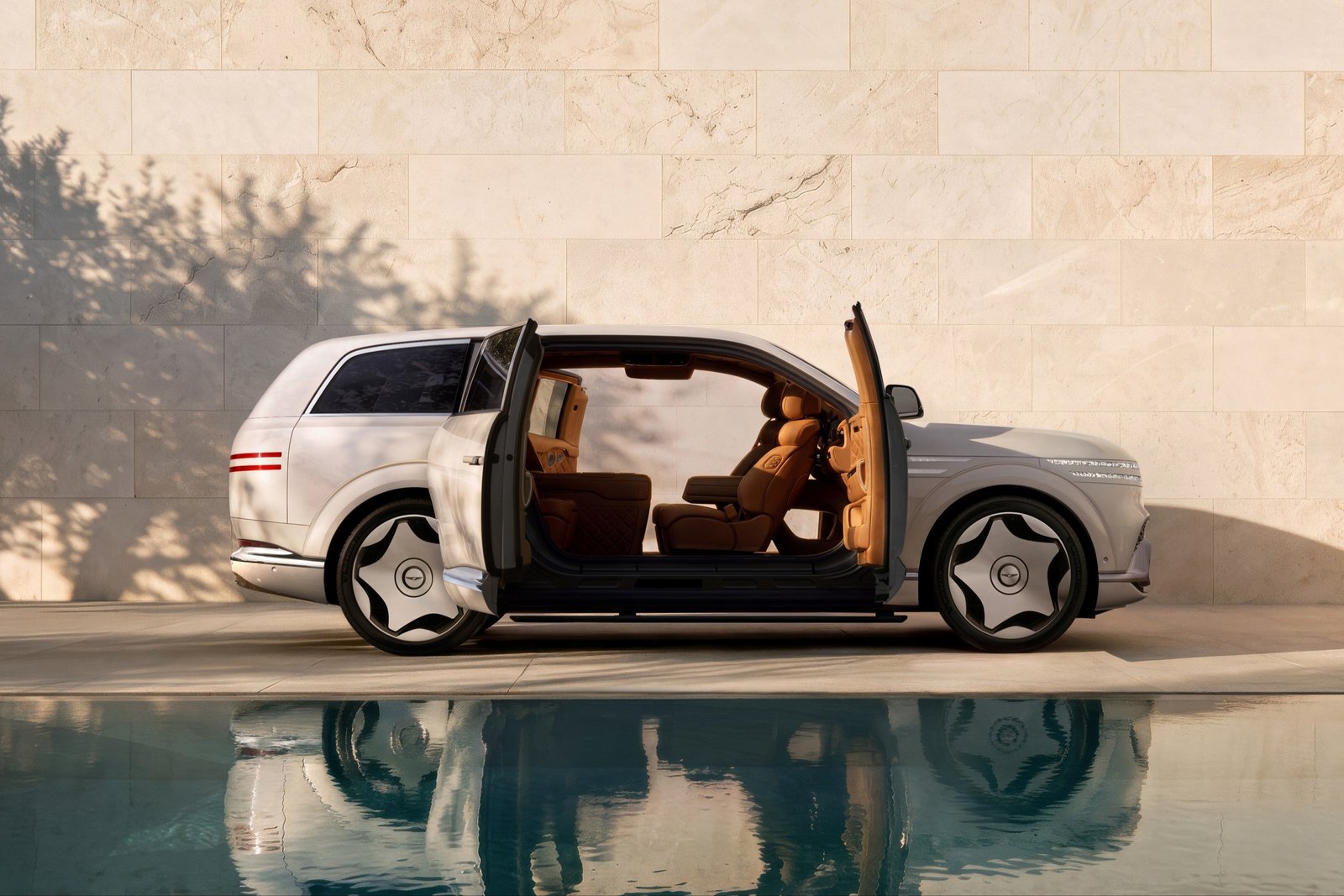
Buyers get 16 exterior colors, 13 gloss and three matte, along with five interior schemes for each variant.
Interior and Tech
The cabin is where Genesis spent its ambition. The Neolun's front seats swivel a full 180 degrees while parked, turning the first two rows into a facing lounge. A 23.6-inch OLED display handles cluster, navigation, and media duties, and when the vehicle is parked, a button raises it 90 mm into a 24.6-inch screen for movies. A 25-inch head-up display replaces a separate instrument cluster.
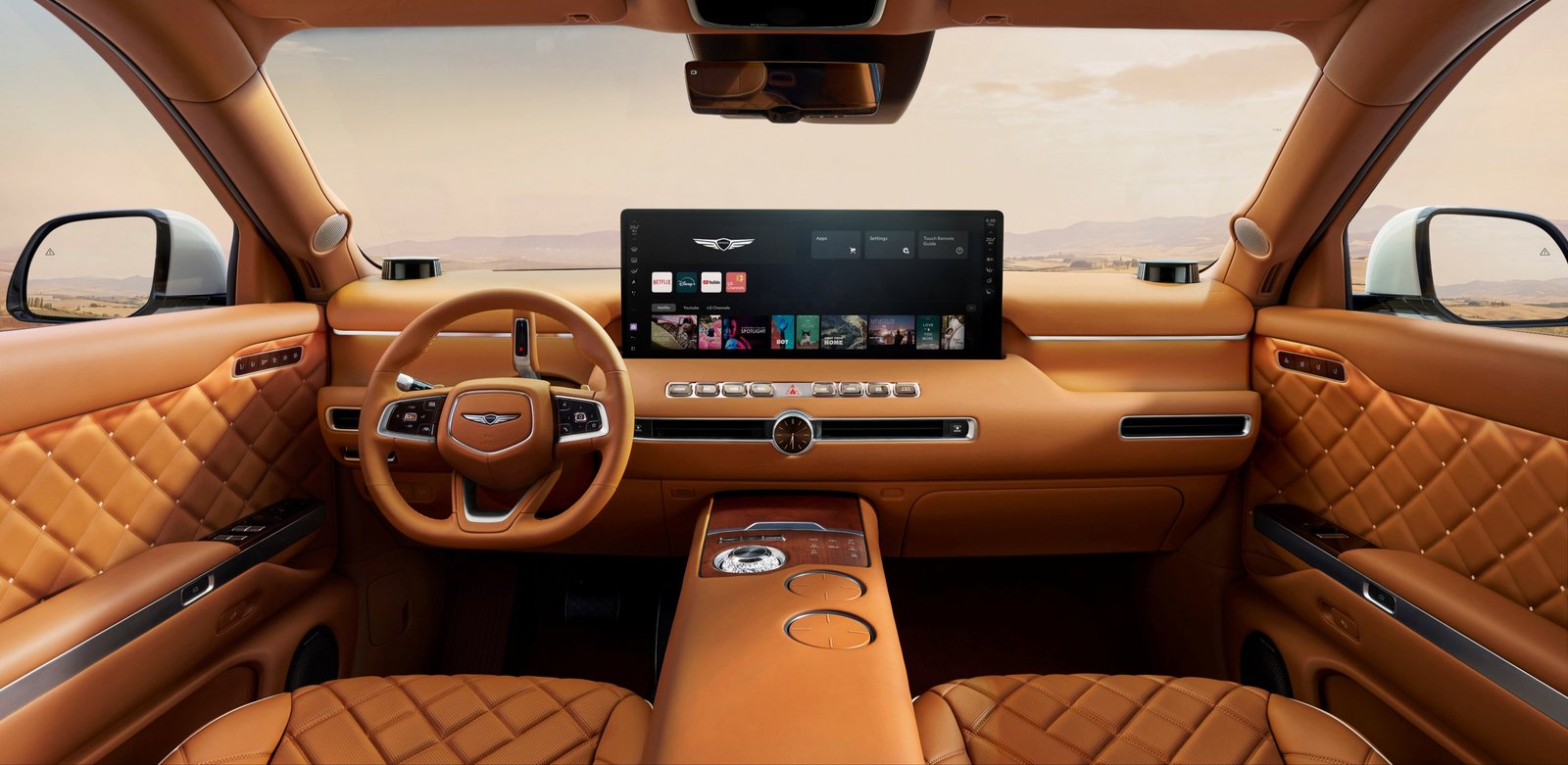
There is no start button. Pull the door handle and the GV90 powers up; press the brake and it is ready to drive, while the column shifter rotates into position and the Crystal Sphere Controller turns to reveal its controls. Infotainment runs on Pleos Connect, Hyundai Motor Group's Android Automotive-based platform with an app market and a generative AI assistant called Gleo. A 25-speaker Bang & Olufsen system delivers 7.1.4-channel Dolby Atmos.
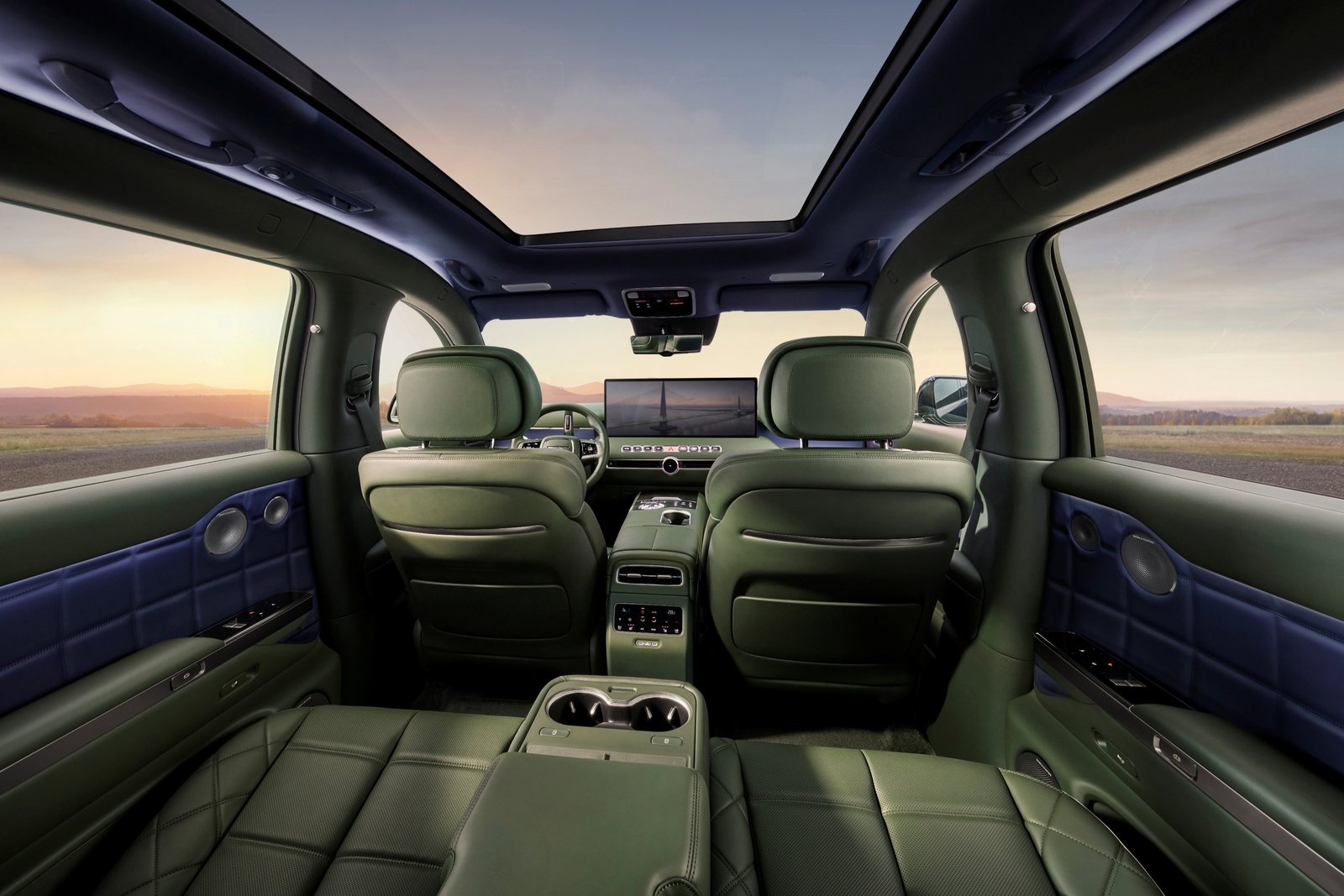
Materials run from natural wood to genuine stone and wool cashmere, and the Neolun Executive Suite adds a Smart Vision Roof whose liquid-crystal film adjusts transparency across six zones. The First Edition layers on a two-tone exterior, body-color 24-inch wheels, and exclusive logo engraving.
Safety: 12 Airbags and a World First
The GV90 carries 12 airbags, including what Genesis describes as the world's first roof airbag, designed to deploy across the roof glass in a rollover to keep occupants inside the vehicle. Passenger airbags deploy in two stages depending on posture, seat cushions hide anti-submarining airbags, and the curtain bags extend to the third row. An in-cabin monitoring system reads occupant position to tune airbag and seatbelt behavior.
The body structure leans on cast and extruded aluminum underneath with ultra-high-strength steel in the sides, and the battery gets thermal-runaway protection that isolates cells to keep heat from spreading.
What We Don't Know Yet
For a fully revealed production car, the GV90's spec sheet still has real gaps:
- Price. No MSRP for any version, in any market. Genesis said pricing would come closer to launch; the September 9 Korean launch date has come and gone without one.
- Exact on-sale date. "Early 2027" is the only guidance for the U.S.
- EPA range. The 310-mile figure is a Genesis internal estimate, not a certification.
- U.S. trims and equipment. How the GV90, Neolun, and First Edition translate into American trim levels and option packages is unannounced.
- Curb weight and towing. Genesis has not published either, and both matter for a three-row EV this size.
What's Next
Home-market deliveries come first — Genesis dated the Korean launch September 9, 2026 — followed by the U.S. launch in early 2027 as a 2028 model. Between now and then, expect the pricing announcement, EPA certification, and U.S. order books to open, in roughly that order. We will update this page as each of those lands.