Why Four Automakers Are Suing New Jersey Over What Dealers Get for Warranty Work
Ford, Honda, Volkswagen and Stellantis say a New Jersey law shifts $375 million a year to dealers. Here is what the statute requires and what both sides claim.
Four automakers have asked a federal court to block a New Jersey law that changes how much they pay dealers for warranty and recall repairs. Ford, Honda, Volkswagen and Stellantis' FCA unit filed the complaint on November 20 in U.S. District Court in Trenton, according to Reuters.
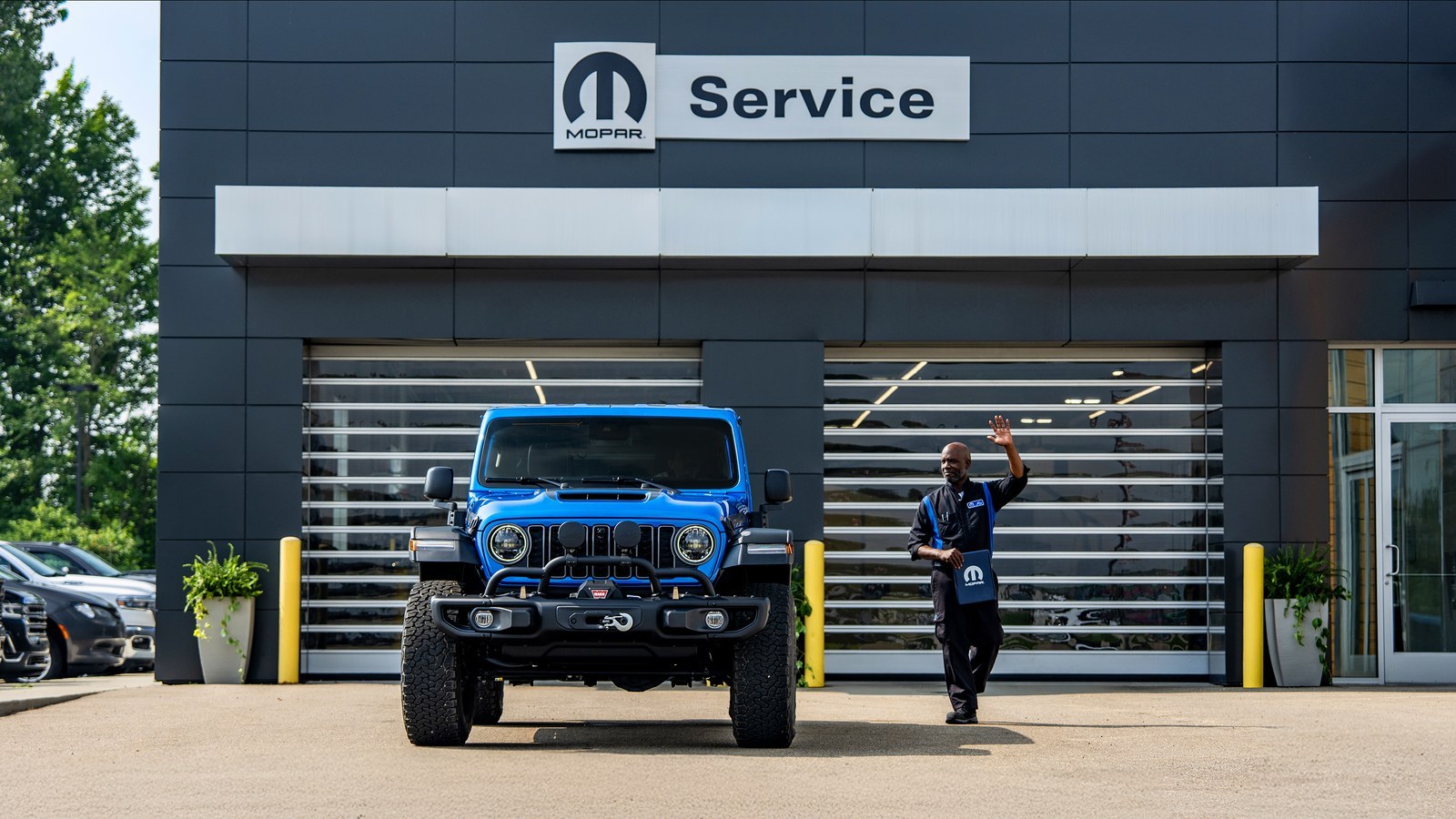
The money at stake is not a fine and is not billed to owners. It is the reimbursement a manufacturer sends a dealer after the dealer fixes a car for free under warranty or a recall, a cost line we covered in our breakdown of Ford's warranty costs. The automakers say the new rules move more than $375 million a year from them to New Jersey dealers. Here is what the statute says, what the lawsuit argues and where owners fit in.
What the law requires
The Motor Vehicle Open Recall Notice and Fair Compensation Act is P.L. 2025, c.140. Then-Gov. Phil Murphy signed it on September 11, 2025, and it took effect on April 1, 2026. It amends the state's Franchise Practices Act, and its reimbursement rules cover warranties, extended warranties, maintenance and service plans, and recalls.
The core provisions:
- Labor rate. The dealer's retail rate is total labor charges divided by total labor hours across a sample of customer-paid repair orders: 100 sequential orders or 90 days' worth, whichever is less.
- Labor time. A dealer may elect an "average retail labor time allowance," a multiplier applied to the manufacturer's own time guide. It compares the hours the dealer bills retail customers with the hours the factory guide allows for the same jobs.
- Parts. Reimbursement is the dealer's cost plus its average retail markup, taken from the same sample. If the manufacturer supplies a part free or at a reduced price, the markup still applies to the part's wholesale value. EV batteries and complete engine and transmission assemblies are handled separately, at 30 percent of the manufacturer's price.
- No recoupment. Manufacturers may not recover the cost from New Jersey dealers through targeted surcharges or vehicle price increases. Ordinary-course price changes remain allowed.
- Parts pricing. Manufacturers may not cut a part's price within 60 days before a recall announcement, after a recall, or after a warranty claim arises.
- Stop-sale pay. For a used car a dealer cannot sell because recall parts are unavailable, the manufacturer owes at least 1.5 percent of the car's value per month, capped at that value.
Dealers declare their rate, time allowance and markup; each takes effect 30 days later and can be changed twice a year. A manufacturer can audit only against the sample the dealer submitted.
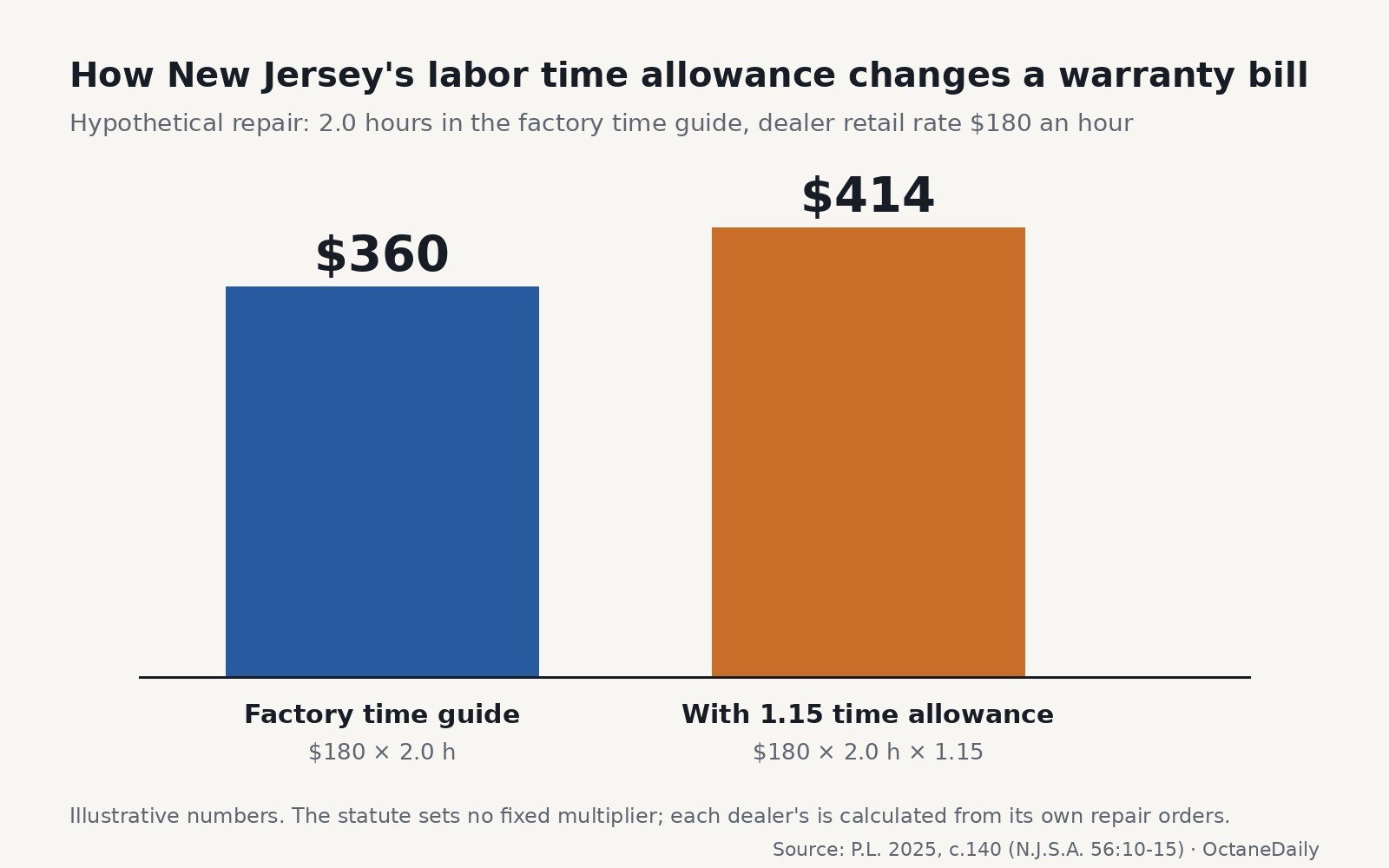
A hypothetical shows how the multiplier works. Take a retail rate of $180 an hour and a repair the factory guide lists at 2.0 hours: the labor payment is $360. If the dealer's sample produces a time allowance of 1.15, the payment becomes $414. The numbers are ours, for illustration; the statute sets no fixed multiplier.
The act also has a consumer side. The Motor Vehicle Commission must include an open-recall notice with registration and renewal mailings, pointing owners to the NHTSA database and to free repairs at franchised dealers. And it gives dealer associations standing to sue under the franchise law.
What the automakers argue
Reuters reports that the complaint calls the act a "blank check" for dealers. The automakers say dealers alone now set the prices manufacturers must pay, and that the law bars manufacturers from avoiding or recovering the cost.
Their specific objections, as reported: the labor multiplier lets dealers bill for more time than a technician works; manufacturers must pay marked-up prices on parts dealers received free or at a discount; and nothing obliges dealers to spend the added money on technicians or customers. Each company says it has received dozens of bills since April that exceed what comparable dealers charge and what retail customers pay.
The legal claims are four: the Commerce Clause and the Takings Clause of the U.S. Constitution, preemption by federal recall law, and the New Jersey Constitution. The suit targets the state, whose attorney general enforces the law, and the New Jersey Coalition of Automotive Retailers (NJ CAR), the dealer association.
On the larger figure in some headlines: Autoblog, citing Automotive News, puts the cost at as much as $2 billion over five years. Five years at $375 million is $1.875 billion. OctaneDaily has not reviewed the complaint itself, so the reimbursement provisions above come from the statute and the allegations from wire reporting.
What the dealers and the state say
NJ CAR President Laura Perrotta told Reuters the group expects to prevail. Her argument is that manufacturers have for decades taken deep discounts on parts and labor at dealers' expense, and that dealers competing for customers cannot pass warranty and recall costs on to them. When the bill was signed, NJ CAR said it would improve recall completion and bring the state in line with its neighbors. The attorney general's office declined to comment to Reuters.
How other states handle it
Retail-rate reimbursement itself is not new. Virtually every state, New Jersey included, already lets dealers claim warranty labor at their average retail rate, according to the law firm Nelson Mullins. The newer fight is over time: how many hours a manufacturer must pay for a given repair.
| State | Warranty labor time rule | Adopted |
|---|---|---|
| New Jersey | Dealer-specific multiplier on the factory guide, from a repair-order sample | 2025; in force April 2026 |
| Illinois | Agreed guide; otherwise factory guide times 1.5. Cost-recovery fees on dealers barred | 2021; in force 2022 |
| New York | Any retail time guide the dealer reasonably uses for customer-pay work | 2024 |
| California | Dealer may elect the time guide it uses for non-warranty work | 2023 |
| Minnesota | Time guide the dealer applies to customer-paid work | 2023 |
| Montana | Dealer chooses factory guide or its own retail guide | 2021 |
| Alaska | Allowances no lower than independent time guides | 2024 |
Sources: Nelson Mullins and Seyfarth Shaw state surveys; California AB 473.
Illinois is the closest precedent. Volkswagen sued in December 2022, saying the 1.5 multiplier cost it $10 million in its first year. A federal judge dismissed the case in May 2024, finding the law rationally related to fair pay for dealers and technicians, and reading its recoupment bar as leaving Volkswagen free to raise prices in Illinois. Volkswagen and Audi dealers there later protested a company surcharge before the state's review board.
That ruling does not bind a New Jersey court, and the claims differ: the New Jersey suit adds federal recall preemption, and New Jersey's multiplier is set dealer by dealer rather than by statute. Franchise law is state law, as our state-by-state guide to direct sales shows.
Where the owner fits in
Nothing in the act changes what an owner pays for a warranty or recall repair: it stays free. Programs such as the Dodge Durango taillight warranty extension work the same way for the customer; the law changes what the dealer is paid afterward.
The two sides make opposite claims about indirect effects, and neither is tested:
- Automakers: because reimbursement is built from what dealers charge paying customers, the act rewards dealers for raising those retail prices. Their trade group, the Alliance for Automotive Innovation, has told Rhode Island lawmakers weighing a similar bill that such costs end up with consumers.
- Dealers: competition keeps retail service prices in check, underpaid warranty work is a cost dealers have been absorbing, and fair pay gets recall repairs done faster.
The complaint, as reported, does not show that car or service prices have risen in New Jersey since April. For how sticker and transaction prices can diverge at the dealer level, see our explainer on dealer markups.
What we don't know yet
- Whether the automakers have asked for a preliminary injunction, and on what schedule. Coverage so far describes a suit to block the law without naming hearing dates.
- The method behind the $375 million estimate and how it splits among the four companies.
- Whether other manufacturers will join. General Motors, Toyota and Hyundai are not plaintiffs.
What happens next
The law stays in force while the case is pending unless the court orders otherwise. Under federal rules, defendants generally have 21 days after being served to answer or move to dismiss, or 60 days if they waive formal service. In Illinois, 17 months passed between Volkswagen's filing and the dismissal.