Ford Wants $1 Billion Back From Warranty and Parts. Here's What Quality Costs It
Ford holds $17.6 billion for future repairs and accrues about twice as much per car as Hyundai, while promising less coverage. Here's where the money goes.
Ford's third-quarter guidance assumes it will cut $1 billion of material and warranty costs this year, excluding tariffs and the Novelis aluminum fire. The same week, NHTSA opened a defect petition on Ford's 7.3-liter V8 and a recall query asking whether a 2024 Maverick camera fix actually worked, as we covered in our report on the two NHTSA probes into Ford trucks. And Toyota spent the week showing off medical-grade CT scanners on its U.S. plant floors.
Put those three things side by side and quality stops being a reputation question. It becomes a line in the income statement, and Ford's is the biggest in Detroit.
The reserve: $17.6 billion and still growing
Every automaker sets aside money for repairs it expects to make under warranty and recall. Ford's pile stood at $17.57 billion on June 30, according to its second-quarter 10-Q, up from $16.24 billion a year earlier. That is roughly $4,000 for every vehicle Ford wholesaled worldwide in 2025, by our math from its 4.395 million units. GM held $14.02 billion at the same date, per Warranty Week's compilation of the filings, as our Q3 earnings scorecard showed.
The same filing contains the first real evidence that Ford's quality push is working. In the first half of 2026, Ford added $475 million for changes to warranties it had already issued, down from $1.59 billion a year earlier. Total new charges fell 31 percent, to $3.41 billion. The reserve still grew because those charges exceeded the $3.03 billion Ford paid out in claims.
What one recall costs
The cleanest price tag Ford has published is for recall 25V467, which covered 694,271 Bronco Sport and Escape SUVs in the U.S. with fuel injectors that could crack and leak fuel near ignition sources. Ford booked a $571 million charge for that field service action in the second quarter of 2025, a figure that also covers Kuga crossovers sold in Europe.
Spread across the U.S. vehicles alone, that is about $822 per SUV, or $82 million per 100,000 vehicles. Because European Kugas share the bill, the true per-vehicle cost is lower, so treat $82 million as a ceiling rather than a rule. A software update usually costs less than a fix that needs new hardware and dealer labor.
That math is why the Maverick query matters more than its five owner complaints suggest. If NHTSA concludes the 2024 software update didn't fix the frozen camera, Ford pays twice for the same trucks. The recall-query process exists to catch exactly that: the agency checks whether a remedy filed under federal recall rules did its job, and a failed remedy typically means a second campaign.
Ford spends about twice as much per car
Warranty Week compiles how much each automaker accrues for new warranties per vehicle sold. In the 2024 reporting year, Toyota set aside $561 per vehicle, Hyundai $628, and GM $770. Using Warranty Week's $6.29 billion Ford accrual and Ford's 4.47 million wholesales, we get about $1,407. In 2025 that rose to roughly $1,527 by the same method.
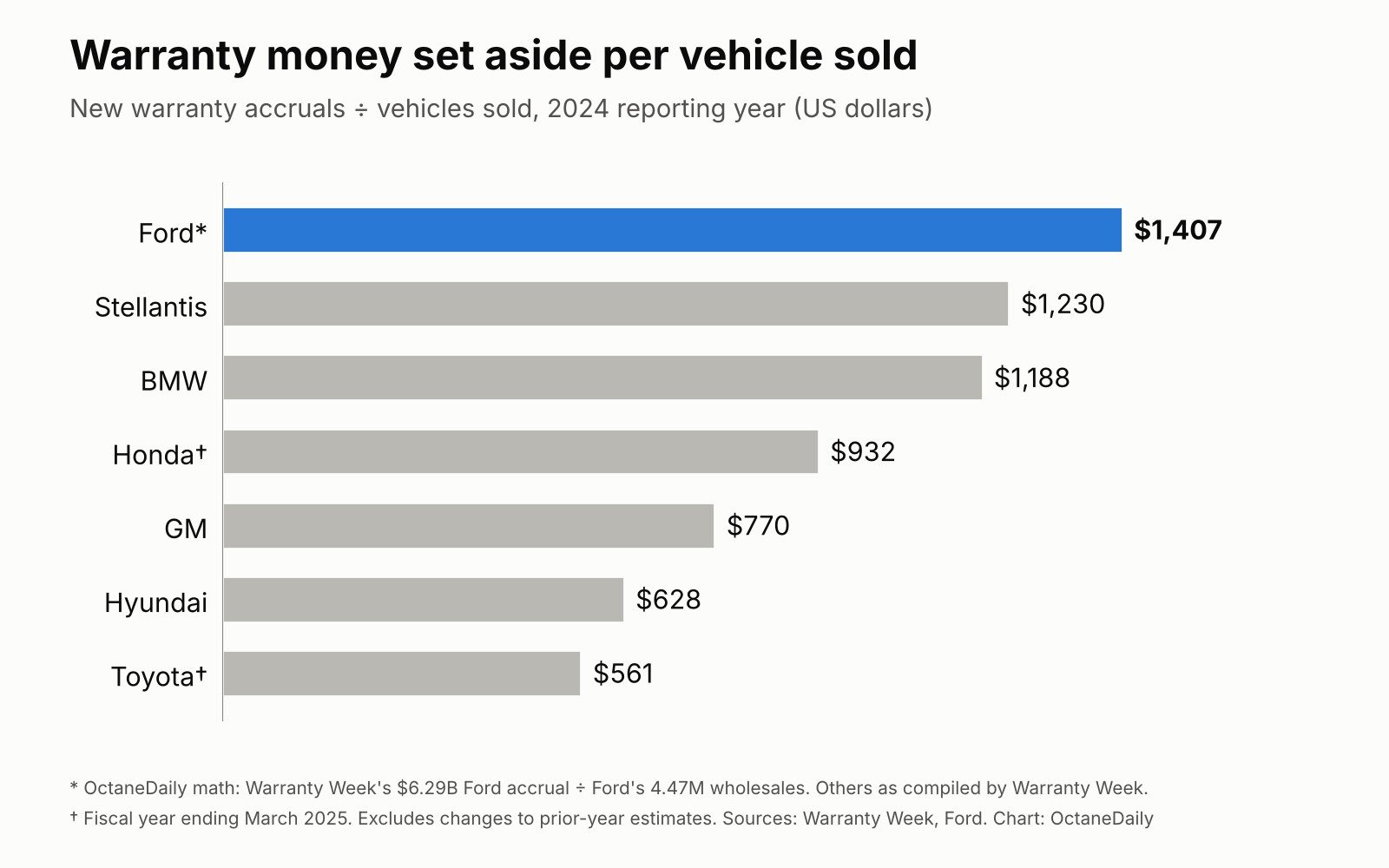
The comparison isn't perfect. Toyota and Honda report on a fiscal year ending in March, and Ford's mix leans heavily on heavy-duty trucks with expensive parts. But the gap is too large to be an accounting quirk. Among the mass-market automakers on the list, only Stellantis, at $1,230, comes close.
| Automaker | Warranty reserve (latest reported) | Accrued per vehicle sold (2024) | What it's changing at the plant |
|---|---|---|---|
| Ford | $17.57 billion (June 30, 2026) | ~$1,407 (our math) | $1 billion new paint shop at Kentucky Truck, groundbreaking promised by year-end |
| GM | $14.02 billion (June 30, 2026) | $770 | Central compute unit from 2028; GM claims 30% less wiring length and mass |
| Toyota | $14.95 billion (fiscal year to March 2025) | $561 | Medical-grade CT scans of aluminum castings in Missouri and Tennessee |
| Hyundai Motor Group | Not compiled | $628 (Hyundai brand) | In-house vision tunnel for plants abroad; 15-micron surface checks on every GV90 |
| Stellantis | Not compiled | $1,230 | Not disclosed |
Sources: Ford and GM 10-Q filings via Warranty Week; Warranty Week's worldwide warranty report; company plant announcements.
Why Ford Pro is the exposed flank
Ford Pro earned $1.67 billion in the third quarter on a 9.4 percent margin, according to Ford's earnings release. That is 63 percent of the company's $2.66 billion adjusted EBIT. Ford Blue made 5.1 percent, and Model e lost $1.06 billion.
The problem is that the trucks paying for everything are also where this month's quality headlines sit. Super Duty models make up 91,588 of the 102,159 trucks in the speedometer recall 26V653. The Godzilla petition names E-350 vans and F-59 and F-750 chassis, all commercial workhorses. In my view, that is the real risk in Ford's numbers: not the recall count, which I argued in our column on why recall counts mislead says little on its own, but the fact that warranty cost and profit are concentrated in the same vehicles.
What the competition is doing on the floor
Toyota's answer is inspection depth. Its plants in Missouri and Tennessee CT-scan cast aluminum parts for hidden voids, and its four U.S. assembly plants soak vehicles in a simulated downpour before a cabin leak check, as detailed in our look inside Toyota's U.S. plants. Genesis runs every GV90 through 15-micron camera checks and a wind-and-road rig before delivery, per our report from its Ulsan EV plant. GM is going after the parts count itself, with a central computer it says cuts wiring length and mass by 30 percent.
None of these is magic. CT scanners don't catch software faults, and plenty of recent recalls, Ford's Maverick camera among them, are software. But I'd argue each one attacks cost before the car leaves the plant, which is where the cheapest fix always is. Ford's $1 billion paint shop is a real investment; it is also a single site with no completion date.
Who actually pays for defects
Ford covers new vehicles for 3 years or 36,000 miles bumper to bumper and 5 years or 60,000 miles on the powertrain, with 5 years or 100,000 miles on Power Stroke diesels. Hyundai covers 5 years or 60,000 miles and 10 years or 100,000 miles on the powertrain for the original owner; a second owner drops to 5 years or 60,000 miles on both.
So Hyundai promises longer coverage and still accrues less than half as much per car. That tells you warranty cost is mostly a function of how often things break, not how generous the paperwork is. For a Ford buyer, the practical answer is that Ford pays during the warranty, and the owner pays after it. If you keep trucks past 60,000 miles, an extended service plan is worth pricing before you sign, not after.
Ford does have a counter-argument, and it's a fair one. J.D. Power's 2026 Initial Quality Study ranked Ford the top mass-market brand at 152 problems per 100 vehicles, against an industry average of 175. That measures the first 90 days. The warranty reserve measures the next five years, and it hasn't turned yet.
What we don't know yet
- How the $1 billion splits. Ford hasn't said how much comes from materials and how much from warranty.
- The third-quarter reserve. Ford's Q3 10-Q, expected around October 30, will show whether the reserve kept growing. GM's Q3 filing is out, but we're comparing June 30 balances like for like.
- The NHTSA outcomes. Neither DP26011 nor RQ26004 has a decision or a deadline.
We'll update this analysis when Ford's 10-Q lands, and owners of any Ford can check open campaigns by VIN at NHTSA's recall lookup.