Virginia Has Put 90 Speed Limiters in Reckless Drivers' Cars. Here's What the Box Does
Virginia installed 90 devices in three months; Washington, Illinois, Maryland, and Georgia follow by 2029. The box trims throttle, logs every override, and the offender pays.
Since July 1, a Virginia judge who convicts a driver of reckless driving can send them home with a GPS box wired into the throttle instead of taking their license. The state's monitoring agency told local television it had installed 90 of them in the program's first three months, against 145 court referrals. Four more states have signed similar laws, and Washington, D.C., has run its own program since October 2025. The question for drivers is what the box actually does.
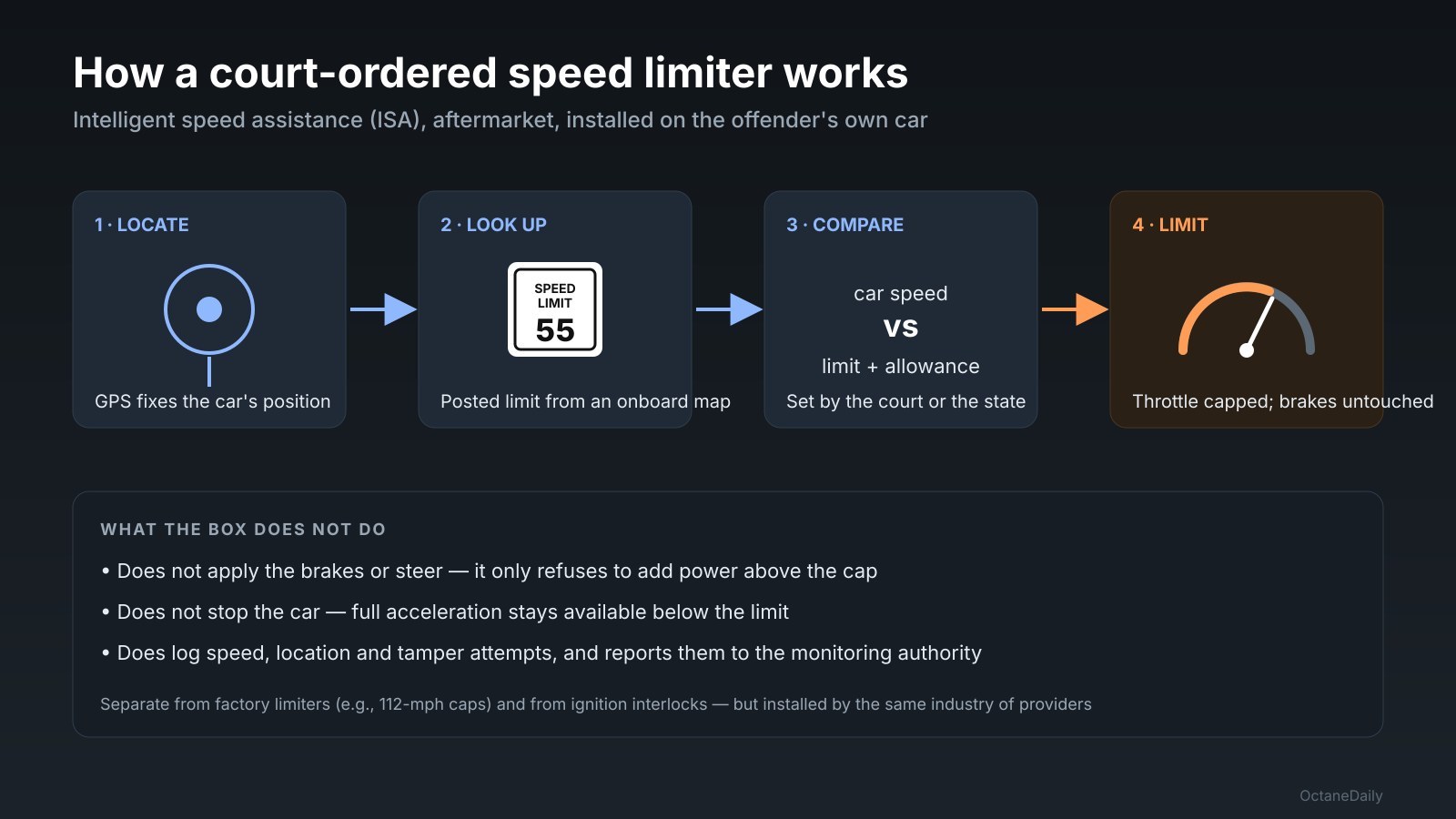
The short answer: it is an aftermarket intelligent speed assistance (ISA) device, built and sold by the same companies that make breathalyzer ignition interlocks. It does not brake, steer, or kill the engine. It compares your speed with the posted limit from a map and refuses to add throttle above that limit, plus a small allowance. Everything it sees goes into a log. That log is the part privacy advocates worry about, in the same way driver-data logs became the center of GM's $220 million OnStar settlement.
How the device limits speed
Court-ordered ISA units are wired into the car's electronic throttle control, the vendors say, and work on any vehicle with a drive-by-wire pedal. A GPS receiver tracks the vehicle's position; an onboard map, updated over the air, supplies the posted limit for that stretch of road. When the two disagree, the device trims the throttle signal going to the engine controller so the car cannot accelerate past the cap. Braking and steering are untouched, and full acceleration remains available below the limit. This is what the IIHS calls "active" ISA; the EU's mandatory version is the "passive" kind that only warns.

Every state program builds in an override for merging or emergencies, and the details vary. LifeSafer describes its override as configurable, with limits on how often and how long it can be used; D.C.'s program FAQ says the device allows a set amount over the limit and has no off switch. Washington's law caps overrides at three per month. Arizona's permits 10 mph over for 60 seconds, per the National Conference of State Legislatures' tracker. Every override is logged.
Two vendors are certified in Virginia: LifeSafer, which sells ISA both standalone and combined with an alcohol interlock, and Smart Start, whose Speed Aware unit is built with MAGTEC, the supplier behind New York City's fleet governors. D.C. has approved LifeSafer alone. None of them publishes a price list, and the statutes leave device pricing to the vendor. What the public documents do fix are the state's own charges: D.C. collects a $50 enrollment fee, $115 for reinstatement, and $20 for the restricted license; Washington adds a $21 monthly state fee; Illinois caps its permit fee at $30 a month.
Who it applies to, state by state
The trigger is narrower than "speeding." Every enacted law targets drivers already facing suspension for reckless driving, extreme speed, or a pattern of violations, and most offer the device as a way to keep driving legally rather than as an added punishment. The table reflects the legislatures' own texts.
| State | Law | Who gets the device | How long | Status |
|---|---|---|---|---|
| Virginia | HB 2096, Acts 2025 c. 652 (Va. Code §46.2-507) | Reckless driving conviction; mandatory if over 100 mph unless the court suspends instead; DMV may also offer it in lieu of a points suspension | 60 days–6 months (court); 9 months (DMV route) | In force since July 1, 2026 |
| Washington | ESHB 1596 "BEAM Act," c. 228 L 25 | "Excessive speeding" (20+ mph over above 40 mph; 10+ over at or below 40) as a probation condition; 3 moving violations in a year or 4 in two; reckless driving | At least 6 months (court); 120–150 days (administrative) | Signed; effective Jan. 1, 2029 |
| Illinois | HB 4948, Public Act 104-0507 | Two convictions for 26+ mph over within 12 months; ISA permit in place of full suspension | 12 months first time, longer on repeat; install within 14 days | Signed; effective Jan. 1, 2028 |
| Maryland | HB 107 / SB 366, Chs. 869–870 of 2026 | Point-based suspension built from speeding, reckless driving, or racing; participation is voluntary; no mph threshold | 90 days, 180 days, or 1 year depending on history | Enacted without governor's signature; effective Oct. 1, 2026; MVA pilot due by Oct. 1, 2027; sunsets 2031 |
| Georgia | SB 160, Act 418 | Limited driving permit for licenses suspended after a reckless stunt driving conviction | Permit term set by statute (TBA pending enrolled text) | Signed May 6, 2026; effective July 1, 2028 |
| New Mexico | No ISA bill located in 2025–26 session records | — | — | Not verified |
Outside that list: D.C.'s STEER Act program, live since October 1, 2025, ties the device to license reinstatement after an offense at 20 mph or more over the limit, for one to three years. New York's 2026 budget created an NYC pilot triggered by 16 school-zone camera tickets in a year. Arizona has a 2027 law on the NCSL list that we have not yet read in the statute itself.
Who pays, and what happens if you tamper
The offender pays in every state. Virginia and Illinois shift the cost for drivers a court finds indigent to a fund fed by a slice of vendor fees; Washington waives its state fee for low-income drivers but not the lease; Maryland waives its MVA fee. Tampering is a crime in most texts: a Class 1 misdemeanor in Virginia, a gross misdemeanor in Washington, a Class A misdemeanor in Illinois plus another 90 days of enrollment. Maryland names no tampering offense; it removes the driver from the program and lets the suspension resume.
What the box records, and who sees it
Virginia's statute requires the device to record speed and bypass attempts and to deliver electronic logs to the state's VASAP commission within 24 hours. Illinois lists what the provider keeps, including identity, speeds, overrides, tampering, and location, and orders most of it deleted after 30 days with no disclosure outside the program. Maryland requires destruction within 30 days, bans sale, and allows sharing only by court order, state law, or in anonymized form. Washington exempts the data from its Public Records Act and bars third-party sharing without a court order. LifeSafer told NBC Washington it forwards violations only when a court asks and does not transmit GPS coordinates. For the factory side of the same question, see our brand-by-brand guide to opting out of car data sharing.
Why now
NHTSA's latest speeding fact sheet counts 11,288 speeding-related deaths in 2024, down 5 percent from 11,913 in 2023 but still 29 percent of all traffic fatalities and 16 percent higher than a decade earlier. The policy push traces to the NTSB's November 2023 report on a 103-mph crash in North Las Vegas that killed nine: the board asked NHTSA to require warning-type ISA on all new vehicles and to develop guidelines for ISA interlock pilots aimed at repeat offenders. NHTSA calls the first recommendation open with an acceptable response and has proposed no rule; the same agency is weighing a school-zone speeding petition against Tesla's robotaxi.
The contrast with Europe is sharp. Under the EU's General Safety Regulation, every new car registered since July 7, 2024, must carry ISA, but the regulation requires only that the driver be warned, through the pedal or a signal, and that the system can be switched off and overridden. In the U.S., no federal rule exists; IIHS has said its Top Safety Pick+ award will require ISA beginning in 2027. Factory top-speed caps, such as Volvo's 112-mph limit, are a separate matter: they are set by the manufacturer, not by location, and they are not what these laws install.
The case for and against
Supporters frame the device as a targeted alternative to suspension. The Governors Highway Safety Association's August 2025 policy backs ISA and urges states to mandate it for speeding offenders instead of pulling licenses; IIHS, in a July case study on Washington's law, argued it avoids piling fines onto low-income drivers. AAA Mid-Atlantic testified for Maryland's bill.
Critics raise cost and data. The ACLU of Rhode Island opposed that state's 2026 bill over the burden on lower-income drivers, the lack of an emergency override in the draft, and questions about the data the system generates. The Owner-Operator Independent Drivers Association has said another dashboard device is not the answer. Maryland's Senate sponsor acknowledged in an NBC Washington interview that the privacy concern is real.
What we don't know
- Beyond Virginia's 90 installations as of mid-October (and the WSJ's "about 100" in early November), no state or D.C. has published enrollment counts. D.C. DMV lists its fees and its single vendor but no numbers.
- No federal requirement is pending. NHTSA's two ISA research projects have no rulemaking date attached.
- Georgia's operative terms (permit length, fee, indigency rule) come from the enacted-statutes summary; we will fill them in from the enrolled text.
- The WSJ reported a GPS-drift problem in Virginia, where a 65-mph highway was read as a 35-mph frontage road. Neither VASAP nor the vendors has published how often it happens or how it is being fixed.