Mercedes Crashed Two CLAs Into Each Other at 35 mph. Here's What Survived
A hybrid CLA hit an electric CLA's driver door at 35 mph with no braking. All eight dummies stayed under injury limits, and the battery pack was untouched.
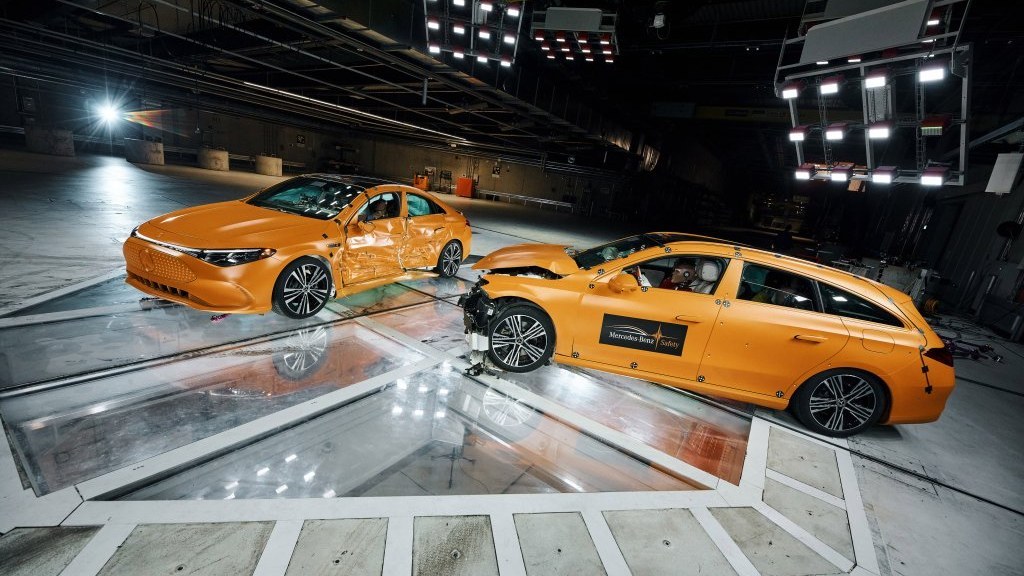
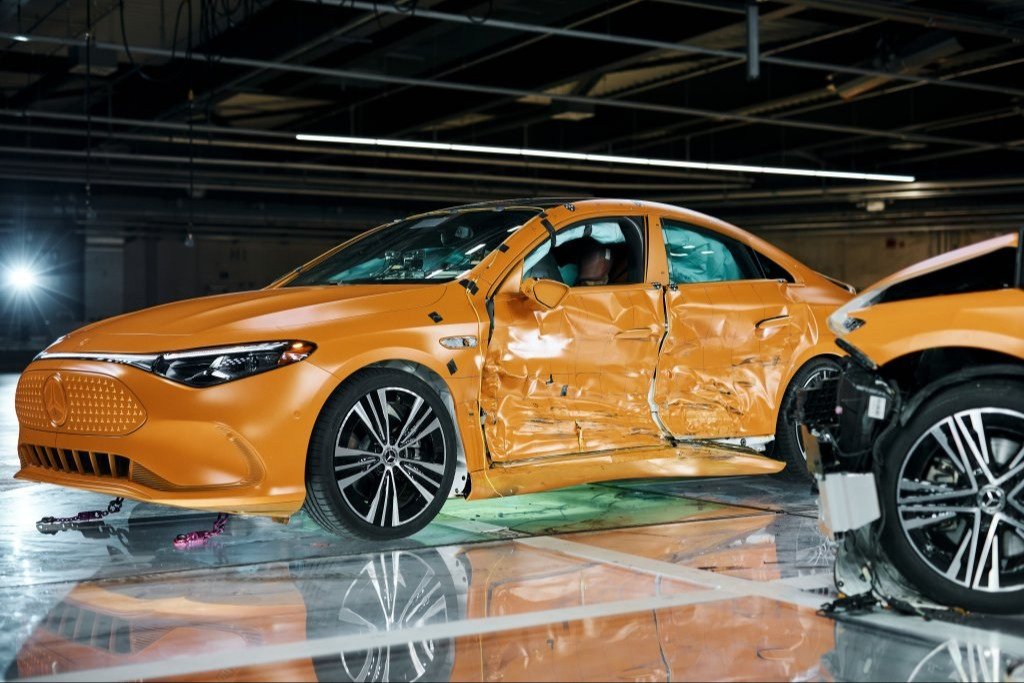
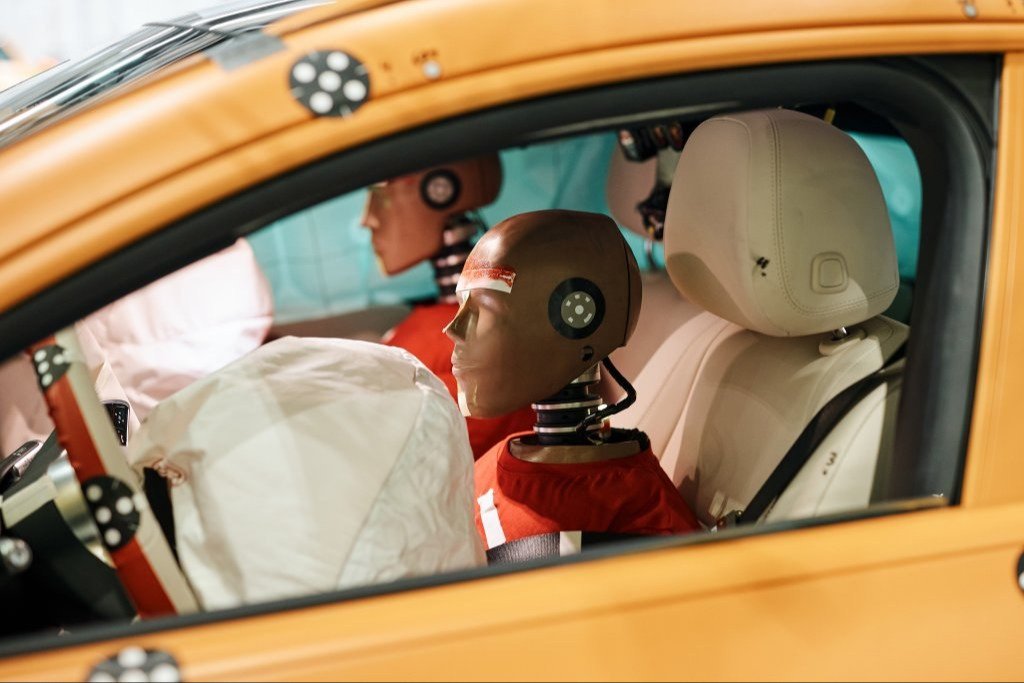
Mercedes-Benz drove a hybrid CLA into the driver's door of an electric CLA at 35 mph, with no braking, and says the people inside would have walked away. All eight crash-test dummies on board, four adult-sized and four child-sized, stayed below the injury thresholds the industry uses, and the electric car's underfloor battery came through undamaged.
The company bills it as the world's first public high-speed side crash between two production cars. No regulation or rating program asks for anything like it: official side tests hit a stationary car with a barrier or a dedicated impact cart. Mercedes instead staged a junction collision built from its own accident files, the same real-world approach Volvo took in its recent crash-protection study.
Why the side is the hard part
A side impact leaves very little room to absorb energy. Up front there's a crumple zone; on the side there's a door and a sill between the striking car's nose and the occupant. In an EV, that same zone also guards the high-voltage pack under the floor.
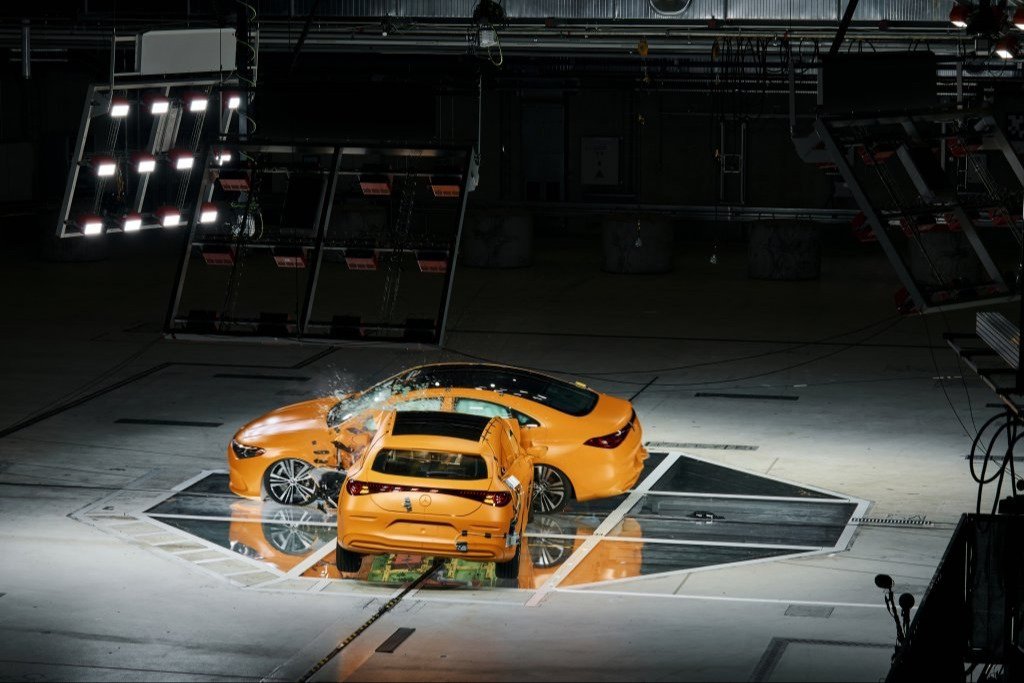
Mercedes says roughly a quarter of crashes that injure someone are side impacts, and that 35 mph sits at the top of the speed range its researchers see in serious junction crashes. Both cars weighed more than 4,000 pounds.
According to the automaker, both cabins kept their shape, and data from up to 150 sensor points per dummy confirmed that the airbags and other restraints worked as designed. It hasn't published the actual readings, only that they fell below the limits.
How it compares with the official tests
The toughest US benchmark is the updated IIHS side test, introduced in 2021, which hits a stationary vehicle with a 4,200-pound barrier at 37 mph, up from 3,300 pounds and 31 mph in the original version. It's the test behind ratings such as the Kia Telluride's IIHS Top Safety Pick+. Mercedes' scenario sits in similar weight and speed territory, but replaces the barrier with a real car's front end and has the struck car moving, too.
The CLA already has strong paper credentials. Euro NCAP gave the electric CLA five stars in 2025 with a 94% adult occupant score, and named it the best-performing car it tested that year. In the US, the electric CLA 250+ starts at $47,250 and the all-wheel-drive CLA 350 4MATIC at $49,800.
Mercedes says it has reconstructed real crashes since 1969, with about 6,000 analyzed by teams in Germany, China, and India, and that each new model goes through roughly 15,000 simulated crashes and about 150 physical ones. Vehicle safety director Paul Dick calls the approach "Real-Life Safety."
What the stunt doesn't tell buyers is how the CLA will score in US programs. Mercedes didn't mention IIHS or NHTSA results, and it didn't say when the hybrid CLA used as the striking car will be offered here. The CLA is part of what Mercedes calls the biggest product rollout in its history, alongside models like the electric GLC.