Jeep Has 159 Days of Stock, Toyota Has 39. That Gap Decides December Deals
Cox counts 2.92 million new cars on lots. Stellantis is drawing down, Ford and Buick are building up, and the cheapest band loosened fastest.
America's new-car dealers ended October with 2.92 million vehicles in stock, or 87 days of supply, according to Cox Automotive's October inventory report. That national figure hides two very different markets. A Jeep store holds 159 days of cars. A Toyota store holds 39.
That gap is the best guide to where December discounts are likely to show up. Our guide to the best time to buy a car covers the year-end calendar. This piece is about the stock behind it: which brands, models, and price bands have cars to move, and which have almost nothing to bargain with.
More cars, not fewer buyers
Inventory rose 4.2% from September, the second straight monthly gain, but it is still 2.9% below October 2025. Days of supply climbed from 83 to 87, against about 90 a year ago.
The detail that matters is the sales pace. Cox says it was little changed from September and from a year earlier, so the extra days came from extra cars, not from shoppers walking away. Dealers are not panicking. They are simply carrying more.
Prices on those cars are still climbing. The average listing price reached $50,498, up 1.7% in a month and 2.7% in a year, the highest monthly average in Cox's dataset.
Where the stock sits, brand by brand
Stellantis brands still carry the deepest piles: Jeep at 159 days, Ram at 148, and Dodge at 147. Buick follows at 136, Ford at 112, and GMC at 110. Chevrolet, at 94, is close to the national average. At the other end, Toyota has 39 days, Lexus 45, Honda 57, and Subaru 62.
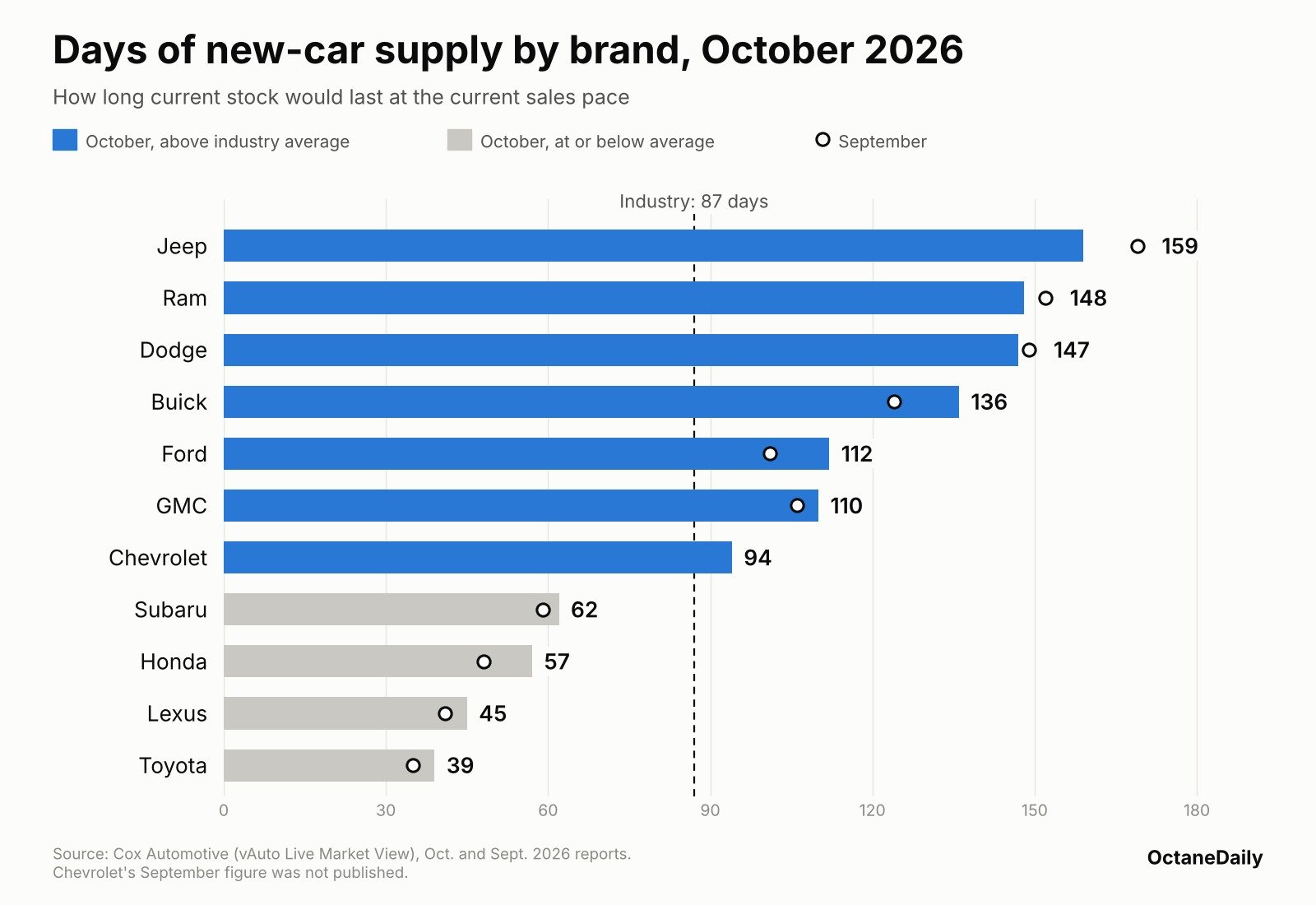
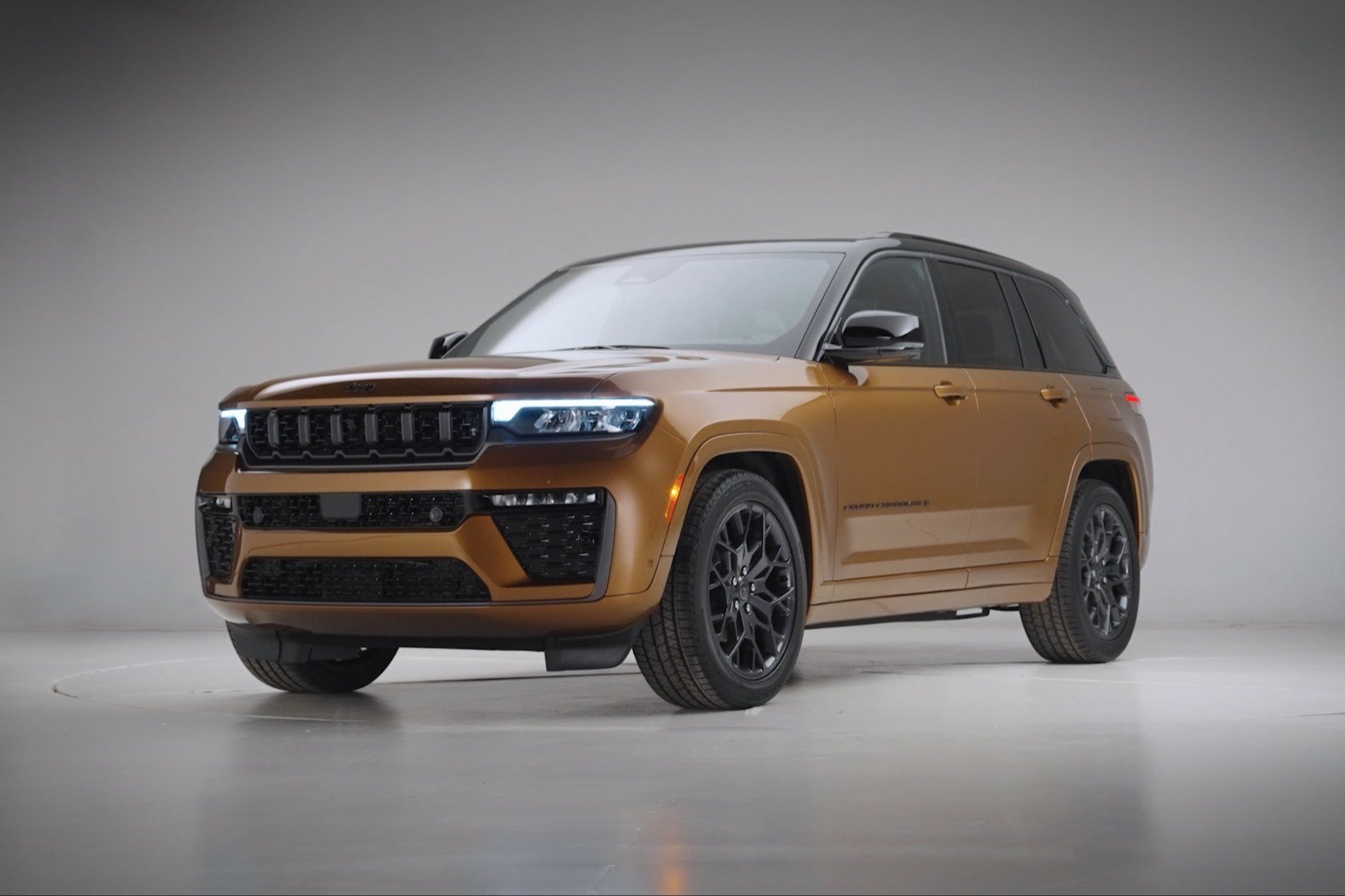
The direction matters as much as the level. Compared with Cox's September report, every Stellantis brand drew down: Jeep from 169 days, Ram from 152, Dodge from 149. The Grand Cherokee dropped from 179 days to 149, and the Wrangler from 162 to 155. That fits Stellantis' stated goal of ending December with about as much stock as it had in December 2025, which we unpacked in our look at Stellantis' third quarter and its Jeep and Ram inventory. In my view, two months is not much time to close what is left, and the Wrangler and Grand Cherokee remain the obvious targets.
Ford and Buick moved the other way. Ford rose from 101 days to 112 and Buick from 124 to 136, the two biggest monthly increases among the brands Cox named. GMC edged up from 106 to 110. If you want a sign of where pressure is building rather than easing, this is it.
Pickups need a caveat. The F-150 sat at 93 days and the Silverado 1500 at 99, but Cox notes that full-size trucks routinely carry more stock than the market. For them, 90-plus days is normal, not distress.
The lean brands got a little less lean, but not by enough to matter at the counter. Toyota went from 35 days to 39. The Grand Highlander had 22 days, the RAV4 24, and the Camry 28. Honda's CR-V had 43 and the Toyota Corolla 36.
The cheap end loosened fastest
Price bands tell a story the brand chart misses. Vehicles listed at $30,000 or less went from 63 days of supply in September to 80 in October, the biggest move of any band. The $30,000-to-$40,000 band rose from 68 to 74, and $40,000 to $50,000 sat at 78. Mid-priced cars, not the cheapest ones, are now the tightest.
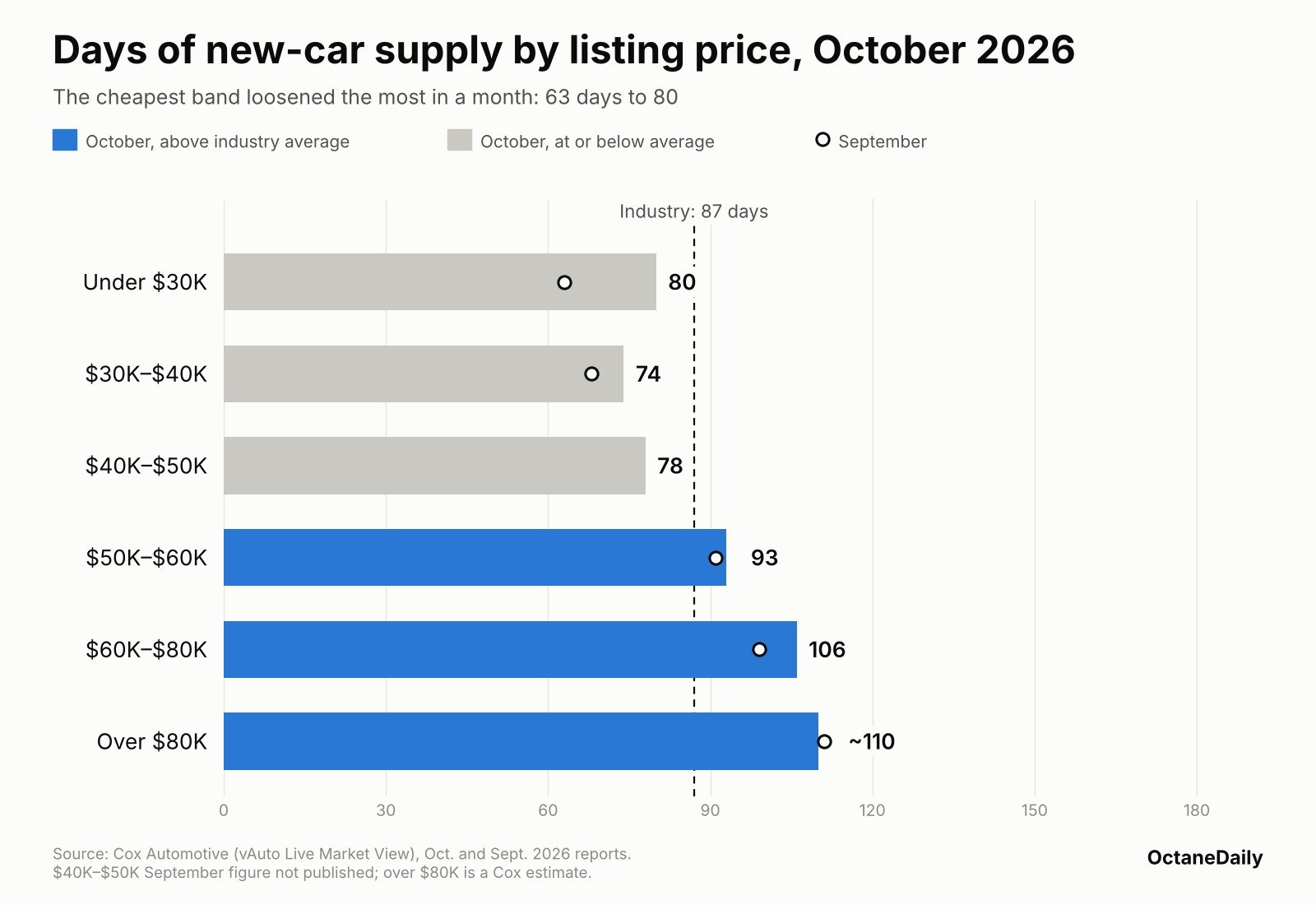
Supply still rises with price: 93 days for $50,000 to $60,000, 106 for $60,000 to $80,000, and about 110 above $80,000. Roughly 27% of new retail inventory lists above $60,000, while about half lists at $50,000 or less.
Cheap does not mean scarce across the board. Cox singles out the Ford Bronco Sport, Jeep Compass, and Volkswagen Taos as affordable models with more than twice the industry's days of supply. That is a useful shortlist for anyone who assumed deals only exist on $70,000 trucks.
Leftover 2026 models are the other lever
The 2027 changeover is running late. Next-year models made up 32% of inventory in October, up from 22.4% in September but well short of the 49% recorded a year earlier. About two-thirds of what sits on lots is not yet a 2027.
The split by brand is wide. The 2027 share was 58.1% at Kia and 43.6% at Honda, against 25.7% at Ford and 17% at Toyota. For some models, the changeover is effectively done: 2027s account for 99.9% of Kia Telluride stock, 98.7% of Honda HR-V stock, and 93.5% of Chevrolet Equinox stock. If you were hoping for a leftover 2026 Telluride, that window has mostly closed.
Ford is the combination worth watching: a high share of 2026 models and a growing pile overall. Toyota's low 2027 share means little by contrast, because it has so few cars of either year. Automakers usually aim programs at the outgoing year, and our guide to when the 2026 is the better buy lists the models where the leftover wins on paper.
What is already on offer
We are not predicting December discounts, but November's programs show where automakers are already spending. As covered in our Black Friday car deals breakdown, the 2026 Chevrolet Silverado 1500 and GMC Sierra 1500 carry 0% financing for 60 months through November 30.
A CarEdge tally of automaker offers dated November 8 adds 0% for 60 months on the 2026 Ram 1500 and 0% for 36 months on the 2026 Wrangler and Gladiator, all through November 30. Ford's 0% for 60 months on most 2026 F-150 trims runs only through November 16. CarEdge found no national 0% offer from Honda or Volkswagen, and Toyota's only one was on the electric bZ Woodland.
One detail stands out to me. The Wrangler, with 155 days of supply, gets a shorter interest-free term than the Ram 1500, from a brand sitting at 148. A 36-month 0% loan saves less interest and pushes the monthly payment up, so the term matters as much as the headline rate.
The listing price is not a haggling gauge
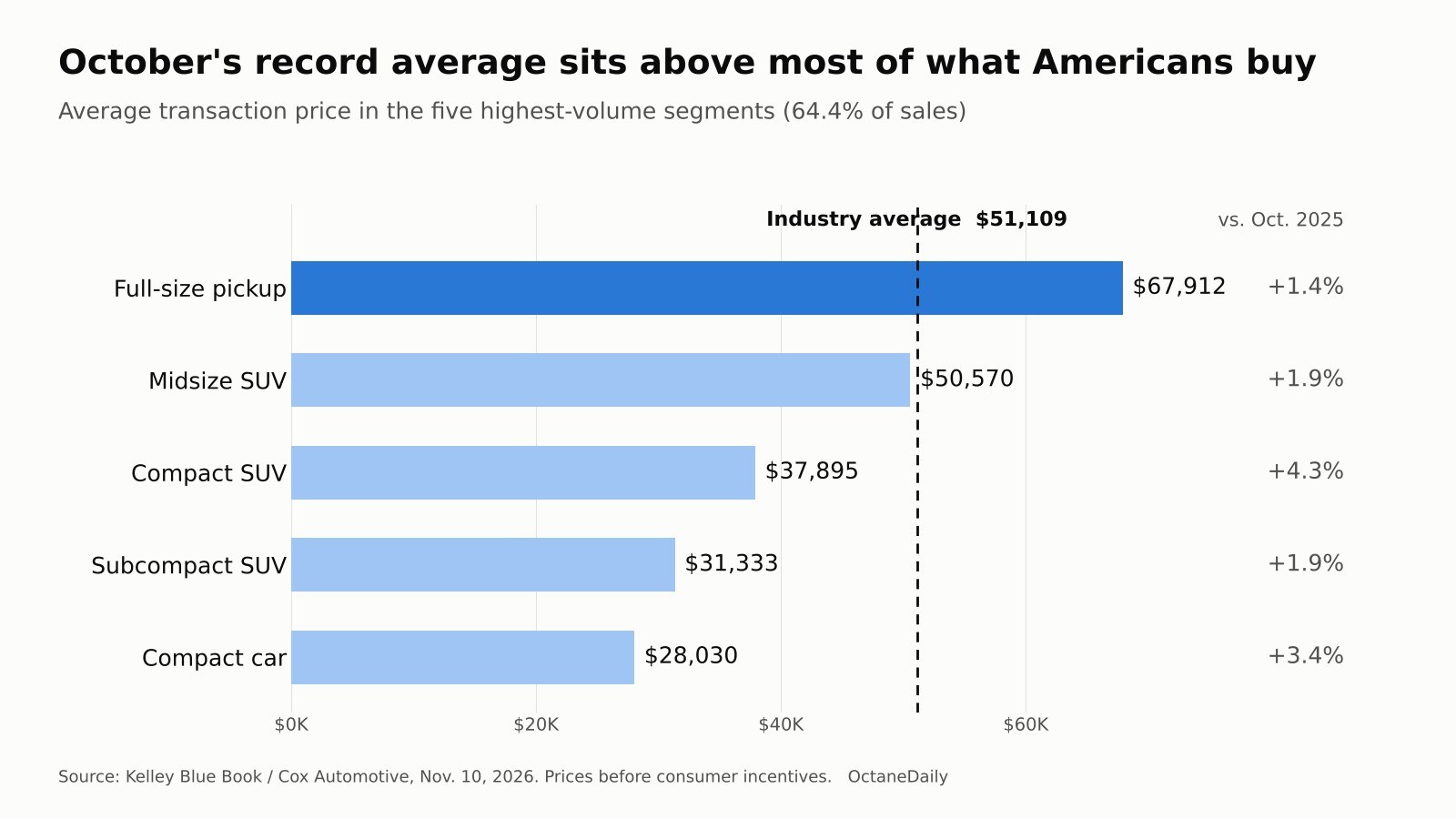
It is tempting to compare Cox's $50,498 average listing price with Kelley Blue Book's record $51,109 average transaction price for October and treat the difference as negotiating room. It is not. The transaction price is actually higher, because the two numbers measure different things: listings average every car on the lot at its advertised price, while the transaction price averages the cars that sold, before consumer incentives.
A cleaner measure is sticker versus sale. Buyers paid an average of $1,824 below MSRP in October, about 3.4%, and incentives averaged $3,490, or 6.8% of the transaction price, as our breakdown of the $51,109 average explains. Last December, incentives reached 7.5%.
There is one signal in the listing data. Advertised prices rose 2.7% year over year, faster than the 2.1% rise in transaction prices. My read is that asking prices are running ahead of what buyers end up paying, which is room a shopper can test. It is not a promised discount.
How to use this in December
- If your shortlist includes Jeep, Ram, Dodge, Buick, Ford, or GMC, the supply data favors waiting for December programs and comparing 2026 and 2027 stock on the same lot.
- If it is a Toyota, Lexus, Honda, or Subaru, the data gives little reason to expect a better price in December than now, and some reason to expect fewer cars.
- Read the term on any 0% offer. Thirty-six months at 0% is worth less than 60.
- Get the out-the-door price in writing before talking about payments.
What we don't know yet
December incentive programs have not been announced, and most November offers end on November 30. Cox's November inventory report, due in mid-December, will show whether Stellantis kept drawing down and whether Ford and Buick kept building. Stellantis has not said how much inventory it held in December 2025, so its target cannot be measured precisely. Days of supply also depend on the sales pace: a strong Black Friday weekend would shrink every figure in this story.