Auto Loans in 2026: $1,000 Payments, 84-Month Terms, and Falling Trust in Lenders
Edmunds, J.D. Power, and the New York Fed show where the average car loan got more expensive, and why lenders are losing their most reliable borrowers.
Black Friday lands on November 27, and the dealer ads will talk about prices. The loan behind the price is the bigger story this year. New-car buyers financed a record $44,664 on average in the third quarter, one in four signed up for seven years or longer, and more than one in five committed to $1,000 or more a month, according to Edmunds.
The same buyers are souring on the companies that hold their loans. J.D. Power's 2026 U.S. Automotive Financing Satisfaction Study, released November 12, found that satisfaction and trust both slipped among the borrowers lenders should find easiest to keep: the financially healthy ones. Our guide to what's real in Black Friday car deals covers the offers on the lot. This piece takes the loan apart: what made it more expensive, how long it now runs, and where the relationship with the lender is breaking.
Price, rate, term: the three levers
A monthly payment is set by three numbers: how much you borrow, the interest rate, and how many months you take to pay. Edmunds has published the average of each for the third quarter of every year, which lets us line up a pre-pandemic loan, the high-rate loan of 2023, and today's.
| Average new-car loan (Edmunds) | Q3 2019 | Q3 2023 | Q3 2026 |
|---|---|---|---|
| Amount financed | $32,674 | $40,149 | $44,664 |
| APR | 5.7% | 7.4% | 7.0% |
| Term | 69.6 months | 68.4 months | 70.5 months |
| Monthly payment | $556 | $736 | $787 |
| Down payment | $4,045 | $6,907 | $5,554 |
| Share paying $1,000+ a month | Not published in that quarter's release | 17.5% | 21.2% |
| Share of loans 84 months or longer | Not published in that quarter's release | Not published in that quarter's release | 25.5% |
The table says something the headlines do not. The rate is not the main problem. Edmunds put the average APR at 7.0% both a year ago and now, below its 2023 level. What changed is the amount borrowed, which is up about $12,000 since 2019.
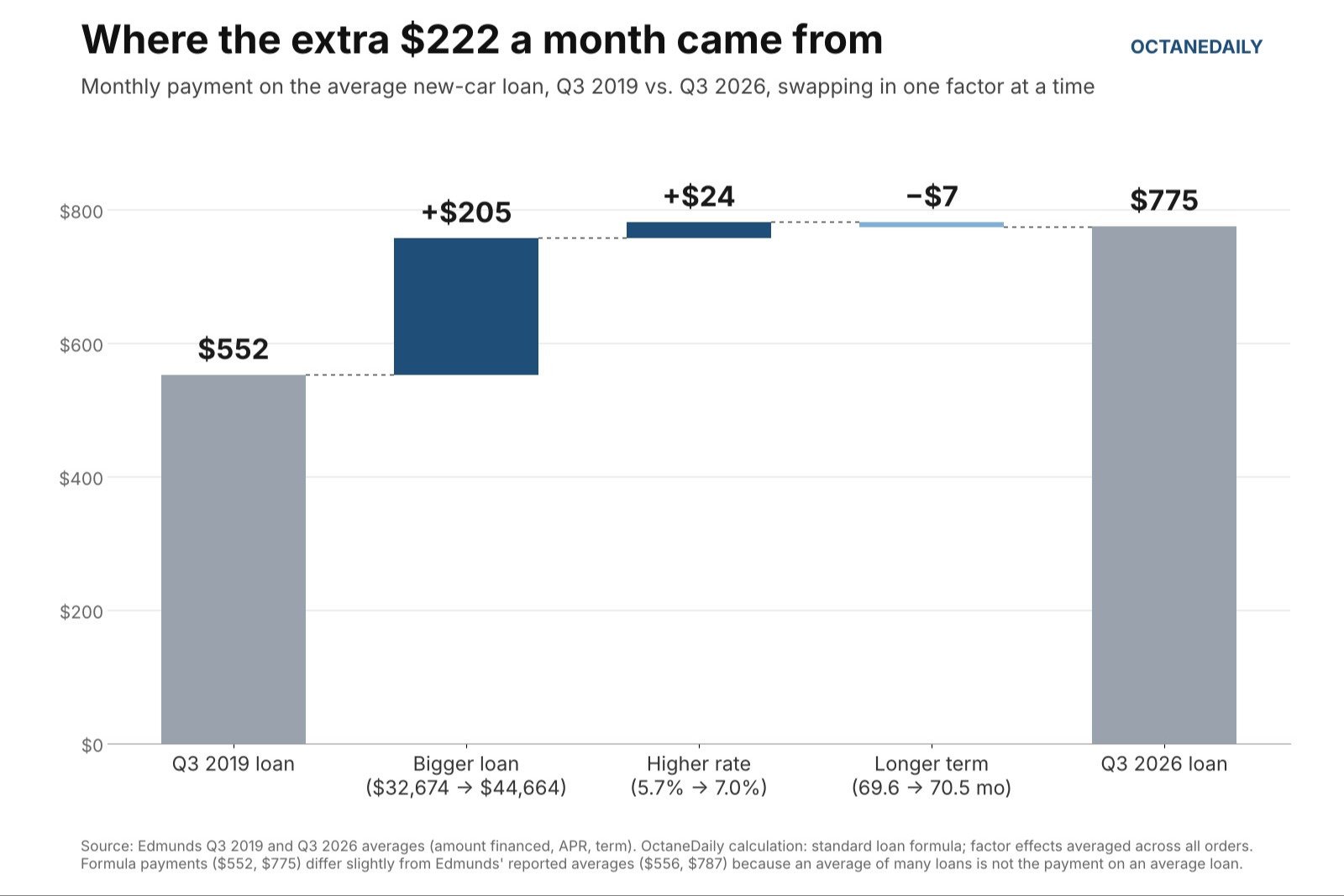
To put numbers on that, we ran the averages through a standard loan formula and swapped in one 2026 value at a time, averaging the effect across every order of swaps. On that basis, the formula payment rises by $222 a month between 2019 and 2026. About $205 of it comes from the bigger loan, about $24 from the higher rate, and the slightly longer average term takes about $7 back off. Those are our calculations on averages, not Edmunds figures, and the formula lands a little under Edmunds' reported payments ($552 vs. $556 in 2019, $775 vs. $787 now) because an average of many loans is not the payment on an average loan.
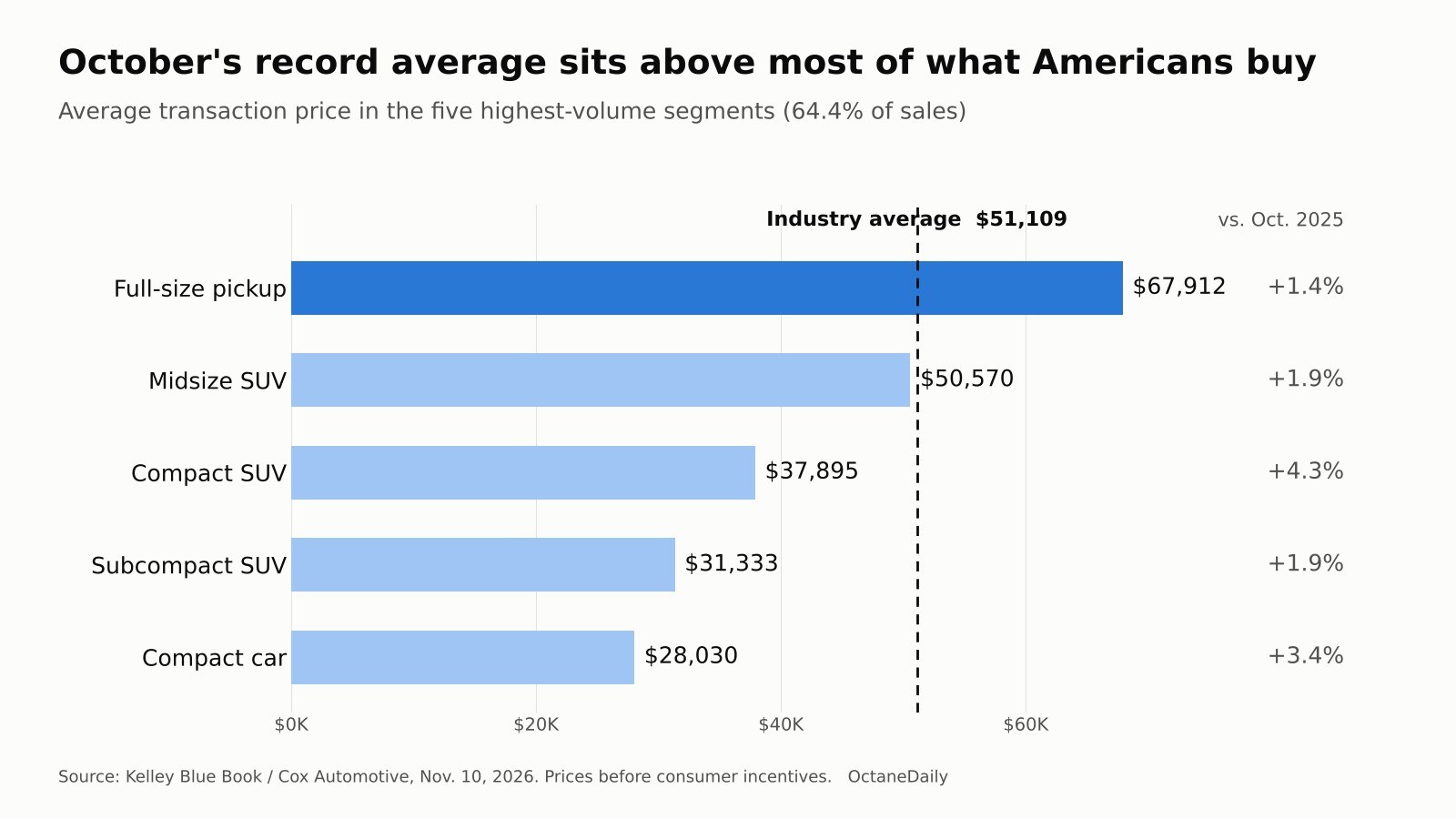
The loan size tracks the sticker. Kelley Blue Book put the average transaction price at a record $51,109 in October, with incentives at 6.8% of it, which we unpacked in what is driving the $51,109 average. Down payments are also doing less work than in 2023: the average fell to $5,554 in the third quarter from $6,021 a year earlier.
The average term barely moved. The tail did.
If the average loan runs 70.5 months, how can a quarter of buyers be on seven-year terms? Because an average hides the spread: shorter loans pull it down while a growing group stretches to 84 months and beyond. Edmunds counts that group at a record 25.5% of financed new-car purchases, up from 21.8% a year ago, and says the stretching is most visible among buyers with the highest payments. Edmunds' head of insights, Jessica Caldwell, called the quarter "a remarkable display of consumer resilience against a very stretched financing landscape."
A longer term lowers the payment and raises the total interest, and Edmunds' average lifetime interest bill reached $9,938 per loan. By our formula, the 2019 average loan carried roughly $5,800. We ran the same loan at 60, 72, and 84 months in what an 84-month loan really costs.
Where trust is breaking, according to J.D. Power
J.D. Power scores lenders on eight dimensions, and the study ranks trust in the provider as the most important of them. Among financially healthy customers, overall satisfaction fell 8 points to 735 on a 1,000-point scale, and trust fell 8 points to 737. Those customers now make up 47% of auto loan borrowers, according to the study, which surveyed 12,801 people who financed a new or used vehicle in the past three years.
The decline starts at the beginning of the loan. Satisfaction with the new-customer experience fell 14 points to 736 in that group. The share who said they got guidance on setting up automatic payments dropped 5 percentage points from a year earlier, and so did the share who were told how to reach their lender with a question or a problem.
What these borrowers say they want is specific: recognition for loyalty and a heads-up when refinancing or paying off early would make sense. Borrowers under financial pressure ask for different things, including flexible payment schedules, a clear explanation of payment relief, and a person who can help. Patrick Roosenberg, J.D. Power's senior director of automotive finance intelligence, said that while lenders watch credit and portfolio risk, "relationship risk is emerging as a challenge."
Last year's study framed the gap from the other side. In 2025, J.D. Power classed 29% of auto finance customers as financially vulnerable and found their satisfaction 150 points below that of healthy borrowers, 593 vs. 743. The 2026 release does not update the vulnerable share or give an industry-wide score, so a full year-over-year comparison is not possible from what has been published.
For the record, the rankings: Ford Credit ranks highest among mass-market lenders for a third straight year with 722, followed by Chase Auto (701) and Bank of America (699). Among premium lenders, Audi Financial Services leads with 737, ahead of Chase Auto (734) and Bank of America (720).
The trade-in carries the old loan into the new one
Long terms matter most when the buyer trades early. Edmunds' third-quarter analysis found 29.1% of financed trade-ins toward new cars were underwater, up from 28.1% a year earlier, with an average shortfall of $7,107. Buyers who rolled that debt into the next loan financed an average of $57,235 at 8.1% APR and paid $952 a month. Edmunds estimates their lifetime interest at $16,610, and 91.2% of them took terms of 72 months or longer. Our look at used-car prices and trade-in values explains why the auction market sets the trade-in figure.
What the New York Fed sees
The New York Fed's third-quarter household debt report shows the same strain at national scale, but no collapse. Auto loan balances rose $21 billion to $1.734 trillion, and $208 billion in new auto loans appeared on credit reports. The flow of auto balances into serious delinquency, 90 days or more, was 3.02%, essentially flat from 2.99% a year earlier, while the move into early delinquency kept ticking up. The share of all auto balances 90 or more days late reached 5.66%, up from 5.02%.
By age, borrowers aged 18 to 29 still have the highest rate of new serious delinquencies, at 4.79%, a little below a year ago. The bigger change is at the other end: among borrowers 70 and older, the rate rose to 2.56% from 1.95%. Lending to the weakest credit tier also grew. Loans to borrowers with scores below 620 made up about 17% of third-quarter originations by dollar volume, up from about 15% a year earlier, by our calculation from the Fed's data.
The market going into Black Friday
Inventory gives buyers a little more room. Cox Automotive counted 87 days of supply at the end of October, and our brand-by-brand inventory breakdown shows where the surplus sits. Most of the strongest national offers this month are subsidized financing on outgoing 2026 models, which lowers the rate lever only. It does not change the amount borrowed or the term.
What we don't know yet
- Whether the share of financially healthy borrowers, now 47%, rose or fell from 2025. The 2026 J.D. Power release does not give a prior-year figure.
- The 2026 share of financially vulnerable borrowers and an industry-wide satisfaction score. Neither is in the public release.
- How fourth-quarter loans look. Edmunds' Q4 financing data is due in early January, and the New York Fed's Q4 report in February.
- Whether Black Friday and year-end subsidized financing moves the average APR. In Edmunds' data, it was 7.0% in the third quarter of 2025 and in the second and third quarters of 2026.