What Is an EREV? How Scout's Harvester Works and Who Sells One Next
Most of Scout's 212,000 reservations are for the gas-generator Harvester. Here's how an EREV works, how it differs from a plug-in hybrid, and what's coming.
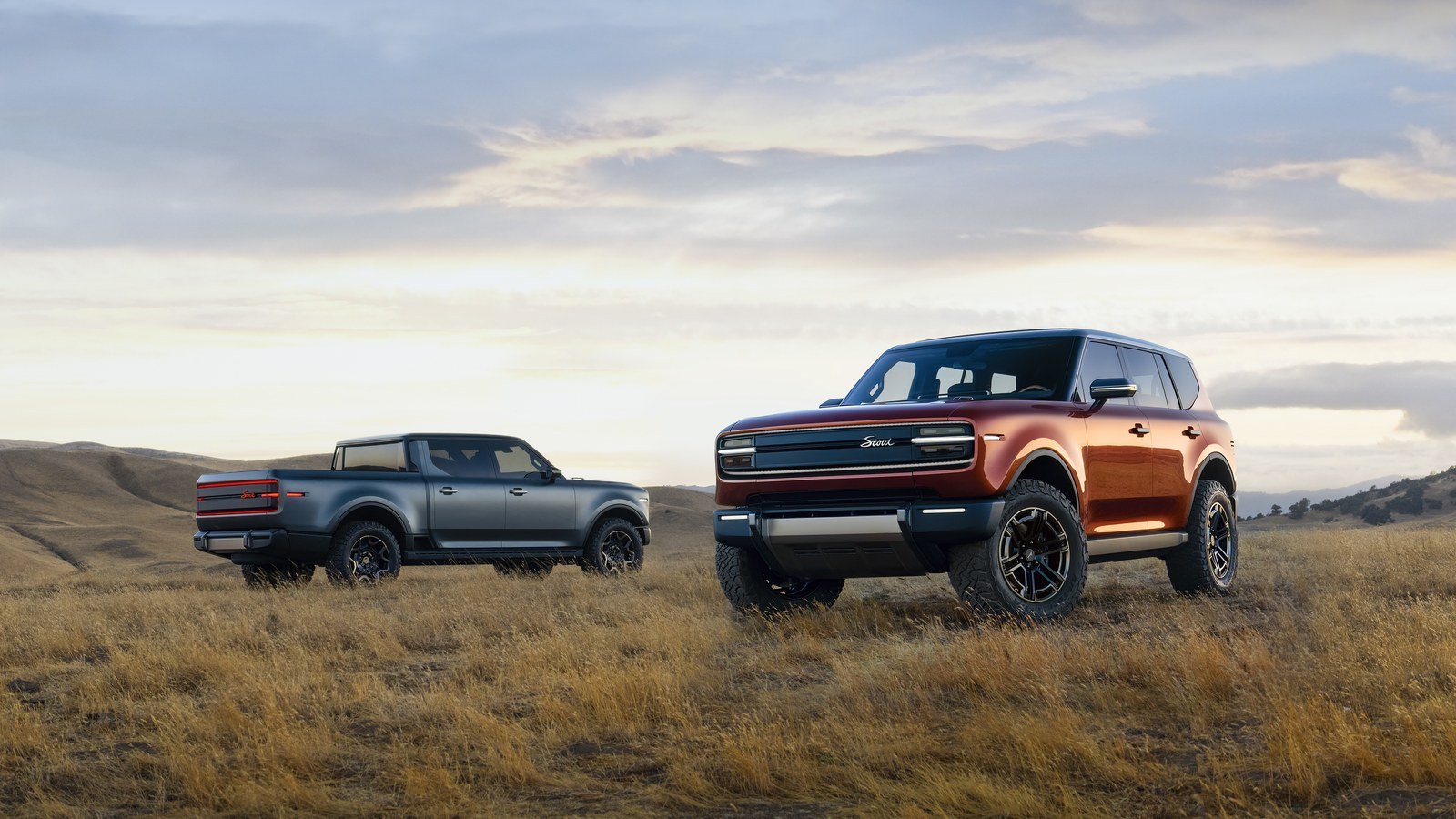
Scout Motors says roughly 212,000 people have put down refundable reservations for its Traveler SUV and Terra pickup, and CEO Scott Keogh told CNBC on Nov. 12 that about 87% of them chose the Harvester version. Harvester is Scout's name for an extended-range electric vehicle, or EREV: an EV that carries its own gasoline generator.
That share is the clearest sign yet that American buyers want electric drive without depending on chargers. It also explains why Scout, which showed two new Traveler concepts in September, says the Harvester models will reach customers before the battery-only ones. Here is how the setup works, how it differs from the plug-in hybrids and hybrids already on sale, and which EREVs are actually coming to the U.S.
How an EREV works
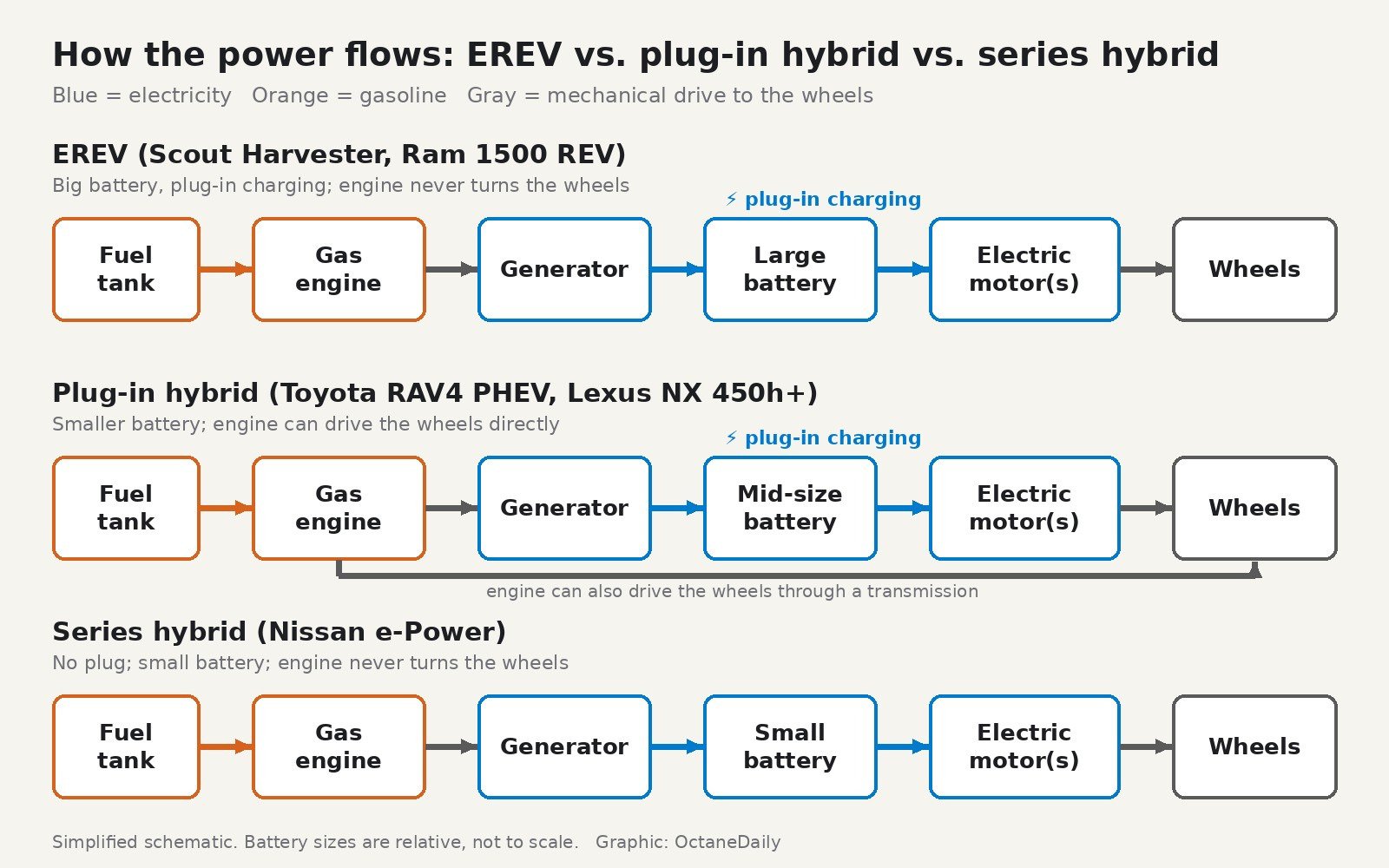
An EREV is built like a battery-electric vehicle. A large battery feeds one or more electric motors, and only the motors turn the wheels. You charge it from a plug like any EV, and on short trips it can run on electricity alone.
The difference is a small gasoline engine whose only job is to spin a generator. When the battery runs low, the engine starts and makes electricity to keep the motors going. It is never connected to the wheels, so the truck drives like an EV whether the engine is running or not. Refueling takes minutes at any gas station, which is the whole point.
EREV vs. plug-in hybrid vs. series hybrid
The three layouts share parts but split the work differently.
- Plug-in hybrid (PHEV). A Toyota RAV4 plug-in hybrid has a smaller battery and a gas engine that can drive the wheels through a transmission. The engine is a primary power source, not a backup.
- Series hybrid. Nissan's e-Power, used in the 2027 Rogue Hybrid, also keeps the engine away from the wheels. But it has no plug and only a small battery, so the engine runs regularly. We cover it in our e-Power explainer.
- EREV. Take the series hybrid, add a battery big enough for real daily electric driving, and add a charging port. That is an EREV.
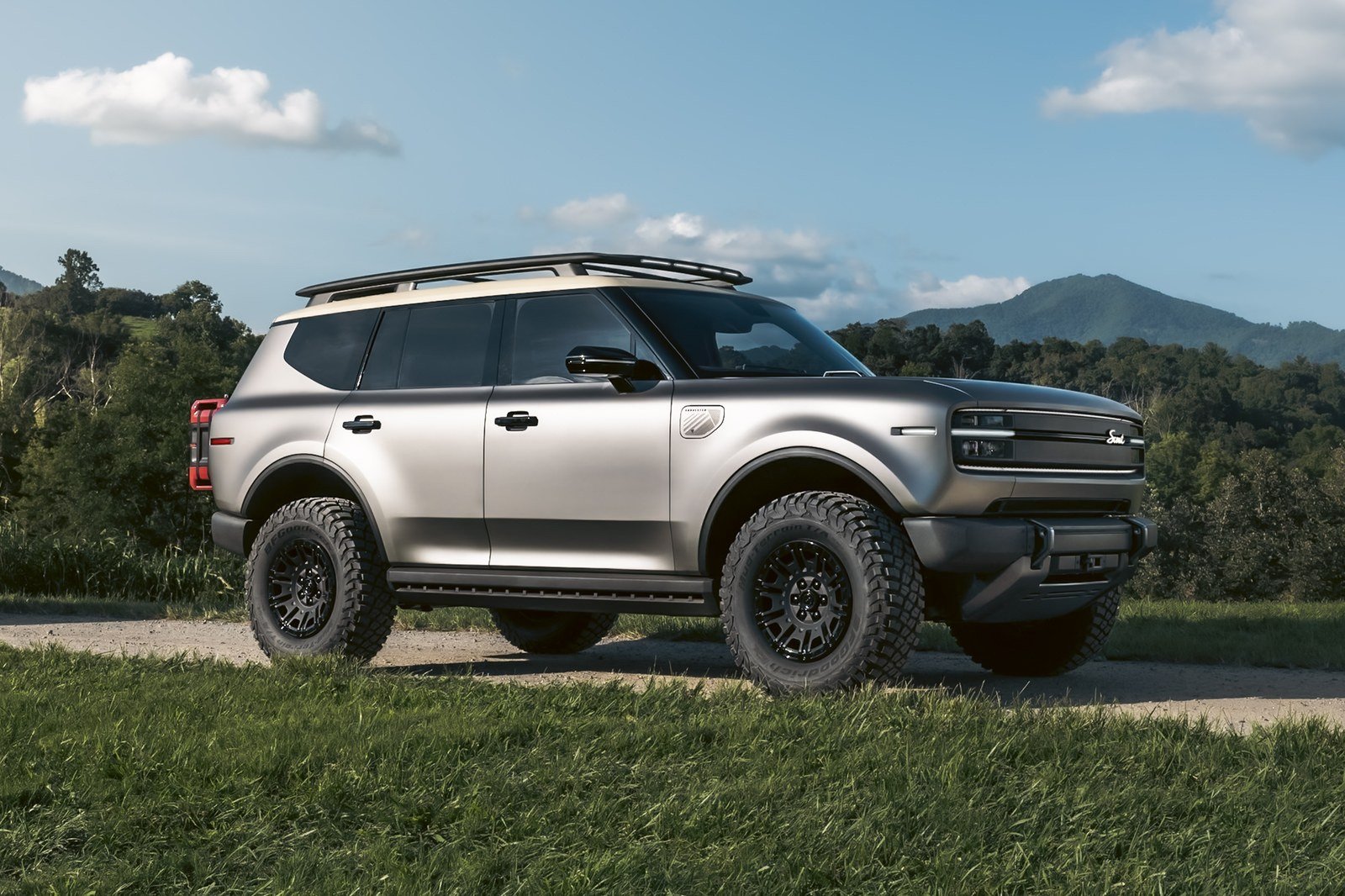
Scout Traveler and Terra Harvester
Scout's own figures are still projections from the 2024 reveal. In its launch release, Scout estimated more than 500 miles of total range for Harvester models, up to 350 miles for the battery-only versions, and towing of more than 7,000 pounds for the Traveler and more than 10,000 pounds for the Terra. Keogh told InsideEVs in January that Harvester models would get about 150 miles of electric range from a roughly 63-kWh lithium-iron-phosphate battery. The generator is a naturally aspirated four-cylinder that Scout will source from Volkswagen Group Mexico.
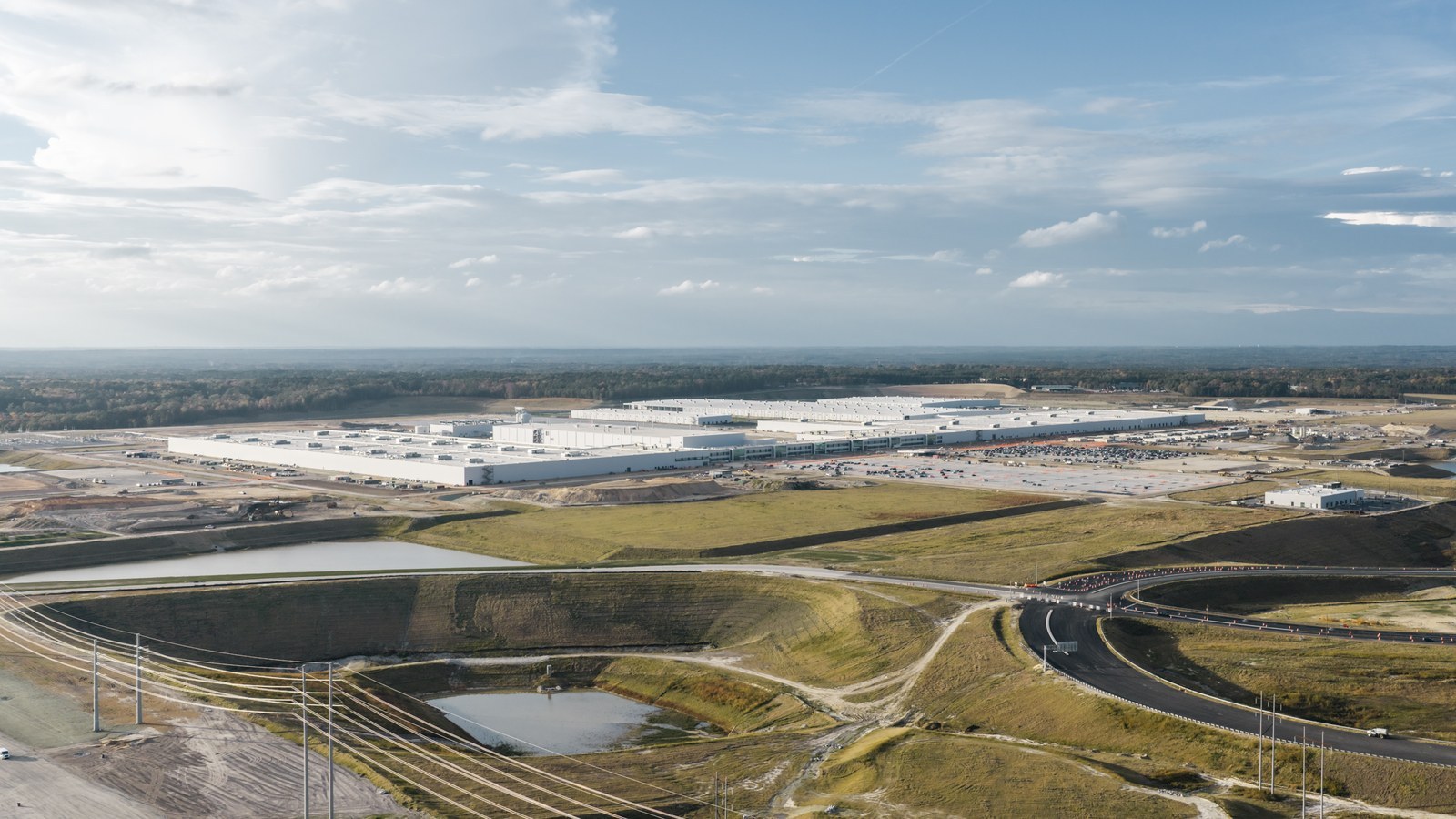
On Nov. 12, Scout said it had started welding, painting, and assembling validation vehicles at its Blythewood, South Carolina, plant, with those builds continuing into 2027. Keogh told CNBC that customer deliveries are targeted for 2028. Scout's 2024 price target was under $60,000 at retail; it has not published final pricing. The Traveler and Terra are part of the wider retro EV push we saw at the Paris show.
Who else is bringing an EREV to the U.S.
Jeep Grand Wagoneer EREV. Stellantis says it pairs a 92-kWh battery with a 3.6-liter V6 driving a 130-kW generator and quotes about 500 miles of total range, according to Electrek. Automotive News, citing a supplier memo, reported in September that production was moving to November 2026 at Warren Truck. A Stellantis spokesperson said Jeep remained on track "for this year."
Ram 1500 REV. This is the pickup Ram first showed as the Ramcharger. After Stellantis canceled the battery-only Ram 1500 REV, the REV name moved to the range-extended truck. It shares the Jeep's 92-kWh battery and V6 generator, and Ram quotes 647 hp, 14,000 pounds of towing, about 145 miles of electric range, and up to 690 miles in total. Ram says it arrives in 2027; the Automotive News memo puts production in mid-April. The Ramcharger name now belongs to a coming Ram SUV, which CEO Antonio Filosa said will be offered with gas and range-extended power. Here's what is confirmed about the Ramcharger SUV.
Hyundai Santa Fe EREV. At its August 2026 investor day, Hyundai said its first EREV, the Santa Fe EREV, will arrive in the first half of 2027 with more than 600 miles of total range and will be built at its Alabama plant. Hyundai has not given battery size, electric range, or price.
Ford F-150 Lightning EREV. Ford ended production of the battery-electric Lightning and said in December 2025 that the next generation will be an EREV with an estimated range of more than 700 miles, built at the Rouge Electric Vehicle Center. Ford has not announced timing. Shoppers who want an electric pickup today can start with our electric pickup buying guide.
Kia. Kia said at its April 2026 investor day that a Telluride EREV will launch in 2029 and an EREV pickup by 2030. Nissan and Mazda have not announced EREVs for the U.S.; Nissan's American electrified bet for now is e-Power.
U.S. EREVs at a glance
| Model | Battery / electric range | Generator | Total range | Timing | Price |
|---|---|---|---|---|---|
| Jeep Grand Wagoneer EREV | 92 kWh / TBA | 3.6L V6, 130-kW generator | About 500 miles (Stellantis) | Production November 2026 (reported); Jeep says 2026 | TBA |
| Ram 1500 REV | 92 kWh / about 145 miles | 3.6L V6 | Up to 690 miles (Ram) | 2027; mid-April production (reported) | TBA |
| Scout Traveler / Terra Harvester | About 63 kWh LFP / about 150 miles (Keogh) | Naturally aspirated four-cylinder | 500+ miles (Scout estimate) | Deliveries targeted for 2028 | Under $60,000 target (2024) |
| Hyundai Santa Fe EREV | TBA | TBA | 600+ miles (Hyundai) | First half of 2027 | TBA |
| Ford F-150 Lightning EREV | TBA | TBA | 700+ miles (Ford estimate) | TBA | TBA |
| Kia Telluride EREV | TBA | TBA | TBA | 2029 | TBA |
How the EPA rates an EREV
There is no separate EREV category on the window sticker. An EREV is certified and labeled as a plug-in hybrid, so its label lists electric efficiency in MPGe and kilowatt-hours per 100 miles, gasoline-only fuel economy, electric range, and total range. When the engine starts only after the battery is depleted, as in an EREV, EPA rules have the label show that figure as "All electric range" rather than a blended number.
For regulatory compliance, EPA blends a plug-in's electric and gasoline results using a utility factor, an estimate of how much driving happens on battery power. A bigger battery earns a heavier electric weighting. None of the EREVs above has an EPA rating yet, so every range number here comes from the automakers.
The federal tax credit is no longer part of the math. The IRS says the new clean vehicle credit is not available for vehicles acquired after Sept. 30, 2025, so none of these models will qualify. Scout's 2024 promise of prices "as low as $50,000 with available incentives" assumed that credit.
The trade-offs
An EREV carries two power sources, and the buyer pays for both. The battery is smaller than a long-range EV's, but the engine, generator, fuel tank, exhaust, and cooling hardware add cost, weight, and packaging. The engine still needs oil changes and emissions equipment, so maintenance looks more like a hybrid's than an EV's.
Efficiency on gas is the big open question. Once the battery is empty, energy goes from fuel to generator to battery to motor, with losses at each step. No EREV coming to the U.S. has an official gasoline-only rating yet, and none has been independently tested towing a heavy trailer on a depleted battery.
The upside is the reason Scout's reservation mix looks the way it does. An EREV can tow or head off-road far from a fast charger, then refill at a gas pump, while covering a typical commute on electricity. For truck and SUV buyers who never bought into charging stops, that is the pitch.
What we don't know yet
- Prices. No automaker has announced a final MSRP for a U.S. EREV.
- EPA numbers. Electric range, MPGe, and gasoline-only mpg are all unrated.
- Towing on generator power. How much capability remains once the battery is depleted under load.
- Final timing. Stellantis has not confirmed the reported Jeep and Ram production dates, and Ford has given no date for the Lightning EREV.