Ford's Mach-E Battery Report: 92% After 5 Years. So Why Are Used Ones So Cheap?
Ford says 36,000 first-year Mach-Es average 92% battery health after 2 billion miles. The data is strong, and it points the depreciation problem away from the pack.
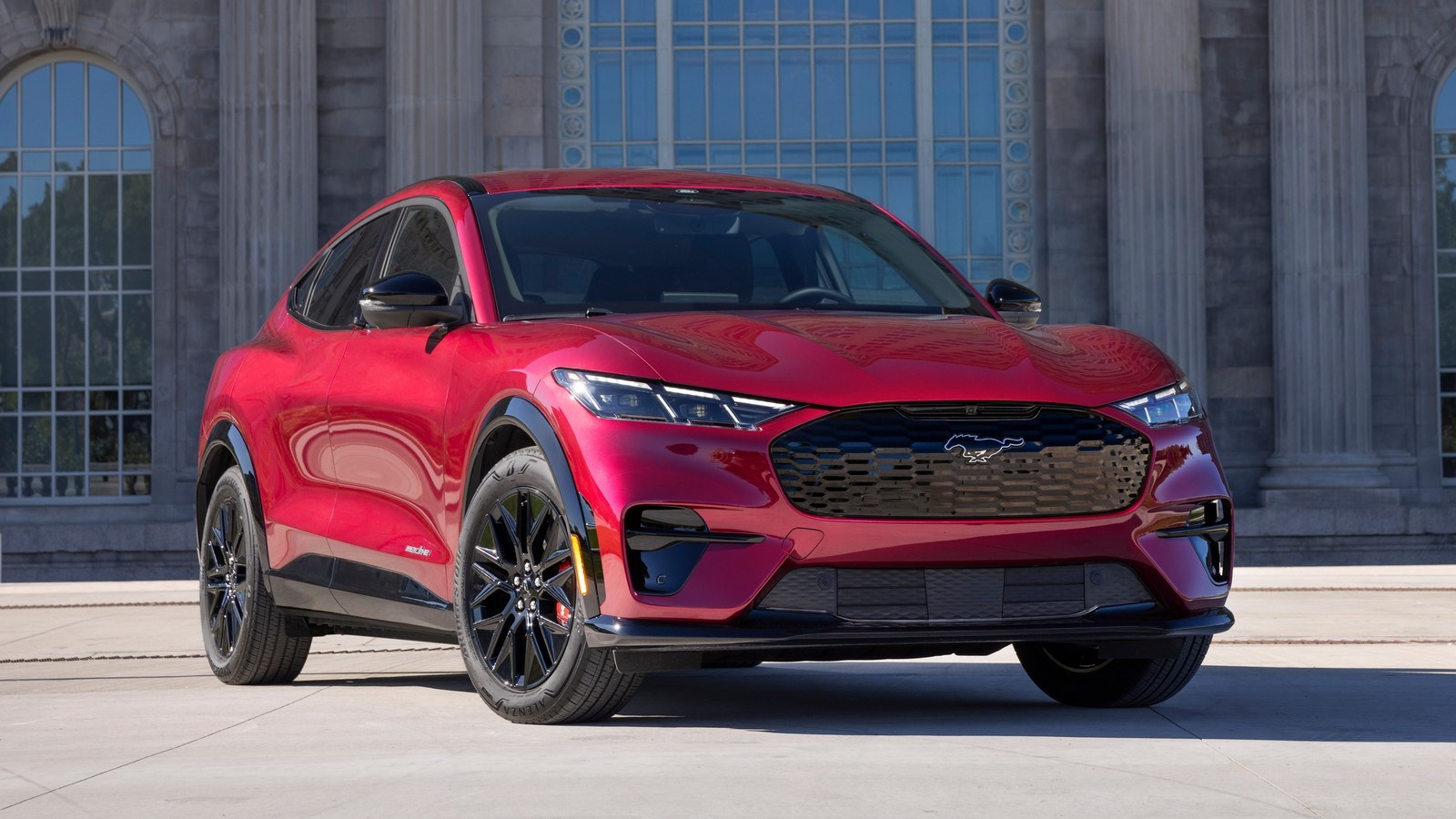
Ford has opened the books on the first-year Mustang Mach-E. After five years and more than 2 billion miles, the roughly 36,000 2021 models in its connected fleet hold an average of 92% of their usable battery capacity, the company said on Nov. 9. Cars that have passed 100,000 miles average about 91%.
That is a strong result, and it arrives at an awkward moment for Mach-E owners. A five-year-old example now sells for little more than half of what it cost new. If the batteries are fine, something else is doing the damage. Here is what Ford's data shows, what it leaves out, and what it means if you are shopping for a used Mach-E rather than the new one we put up against the Tesla in our Mach-E vs. Model Y comparison.
What Ford's numbers say
The figures come from Ford's own connected-vehicle data as of August 2026. They cover 2021 Mach-Es in the U.S. and Canada whose owners have had them for 5.2 years on average, and Ford says the percentages reflect usable capacity.
| Group of 2021 Mach-Es | Vehicles | Average battery health |
|---|---|---|
| Entire 2021 fleet | 36,000+ | 92% |
| Middle 95% of the fleet | About 34,000 | Between 87% and 97% |
| Past 100,000 miles | 2,000+ | About 91% |
| Past 200,000 miles | 30+ | 88% |
Source: Ford, data as of August 2026. The 34,000 figure is our arithmetic from Ford's 95% share.
Ford's own battery lead points readers past the average. "The number I look at closely is the spread," said Kevin Vander Laan, Ford's technical leader for high-voltage battery cells and systems. A band of 87% to 97% for nearly every car is tight for a fleet spread across all 50 states and Canada.
Read plainly, the table also says mileage is not the main driver. Going from the fleet average to the 100,000-mile group costs about one point of health. Going past 200,000 miles costs four. Ford hasn't published an age-versus-mileage breakdown, so that is a reading of the table, not a finding.
The most famous high-mileage Mach-E is not in this group. David Blenke's car, which Ford says has passed 400,000 miles on its original battery, is a 2022 model. When he told Forbes in February that his pack was at about 92% at 316,000 miles, that reading was his own.
What the report doesn't tell you
- How health is measured. Ford doesn't publish its method, so it isn't clear whether 100% means the capacity at delivery or the rated figure, or how the car's software estimates it. A battery-management estimate is not the same as a lab capacity test.
- The effect of fast charging and heat. Ford advises Level 2 charging at home, DC fast charging when you need it, and preconditioning while plugged in. It hasn't shown how heavy fast-charge users or cars in hot climates compare with the average.
- The weakest 5%. Roughly 1,800 cars sit outside the 87%–97% band, and Ford doesn't say how far below it the low end goes.
- Replaced packs. Ford doesn't explain how cars that received new batteries were counted.
- Independent checking. This is one automaker, one model year, and its own data. No outside auditor has reviewed it.
How it compares with independent data
The broadest outside benchmark comes from fleet-telematics firm Geotab. Its 2024 analysis of nearly 5,000 EVs found average degradation of 1.8% a year, with the best models at 1.0%. If Ford's packs started at 100%, losing eight points in 5.2 years works out to roughly 1.5 points a year: better than Geotab's average, short of the best performers.
Recurrent, which tracks more than 30,000 connected EVs, reported last November that battery replacements outside the big Chevrolet Bolt and Hyundai Kona recalls remain under 4% across all model years, and 0.3% for 2022 and newer cars. Forbes, reporting on Ford's release, cited Recurrent data showing tracked Teslas averaging 86% at 100,000 to 150,000 miles. The methods differ, so treat that as context rather than a head-to-head.
The line that actually matters to an owner is the warranty floor. Ford's 2021 Mach-E warranty guide covers the pack for eight years (160,000 km in the Canadian edition, about 100,000 miles) and pays for repair only if a Ford EV-certified dealer finds capacity below 70% of its starting level. The 200,000-mile group averages 18 points above that line. At 1.5 points a year, an average pack would need more than a decade more to reach 70%. That is an extrapolation, since batteries rarely age in a straight line.
If you're shopping for a used 2021–2022 Mach-E
- Run the VIN for recalls. Campaign 22V-412 covered 48,924 Mach-Es whose main high-voltage contactors could overheat with DC fast charging and repeated full-throttle runs, risking a loss of drive power. Campaign 23V-687 followed for 34,762 2021–2022 cars with the extended-range battery and replaced the high-voltage junction box, including on cars already fixed once. Check any car in the NHTSA recall lookup.
- Get a battery number in writing. Ford's report doesn't tell owners how to read their own pack's health, and under its warranty a certified dealer is the one who measures capacity. Ask the seller or a Ford EV dealer for a high-voltage battery report before you pay, or buy a third-party report.
- Know which pack you're buying. The 2021 car came with 68 kWh or 88 kWh of usable capacity. At 92%, a standard-range pack holds about 63 kWh, well short of the 88 kWh that is now standard on a new Mach-E.
- Check the warranty clock and the software. Eight years runs from the original in-service date, so most 2021s lose battery coverage in 2028 or 2029. Ford's guide also requires battery software updates within 30 days of release, so ask whether automatic updates were left on.
Our used EV buying guide covers battery checks across brands. Separately, Ford's BECM software recall applies only to 86 2023–2025 cars with LFP packs and replacement control modules, not to 2021s.
So why is a used Mach-E so cheap?
Start with what isn't happening. Across the market, the used EV discount has disappeared: one- to five-year-old EVs listed for $579 more than comparable gas cars in September, as we covered in our report on iSeeCars' price data. The Mach-E's problem is depreciation from its own sticker.
In iSeeCars' latest five-year study, covering cars sold from March 2025 to February 2026, the Mach-E lost 60.8% of its inflation-adjusted MSRP, the eighth-steepest drop of any vehicle. The average for all vehicles was 41.8%, and for EVs 57.2%. The site's model page puts the average 2021 Mach-E at about $23,600. Three forces explain most of that, and none of them lives inside the battery.
The sticker overstated the price. The 2021 Mach-E Select was announced at $43,995 including destination, and it was marketed alongside the $7,500 federal tax credit then available. Depreciation measured from MSRP counts that credit as value lost, even though many first owners never paid it.
The new car got cheaper and better. Ford cut Mach-E prices by up to $5,900 in January 2023 to answer Tesla. The 2027 Select starts at $39,995 before destination, with the 88 kWh battery standard. A used 2021 standard-range car is priced against that, not against its own launch price.
The incentives went away. Federal credits for new and used EVs ended on Sept. 30, 2025, which removed a subsidy that had propped up demand at both ends of the market.
Battery doubt still plays a part, mostly as risk pricing. Buyers who can't verify a pack discount it. That calculus is shifting, as BMW and Volkswagen hinted in their latest earnings calls; we broke down what that means in our look at the residual-value flip.
The bottom line
Ford's numbers are self-reported, cover one model year, and come without a published method. Even so, they line up with independent fleet data, and they put the average 2021 Mach-E far from its warranty floor. If they hold up, the strongest case for buying a five-year-old Mach-E cheaply is not a worn battery. It is the price of the new one.