GM vs. Ford vs. Stellantis in Q3: Who Has Money for Truck Deals This Winter
GM banked the biggest truck profits, Ford kept prices firm, and Stellantis set an inventory target that points to Jeep and Ram deals before year-end.
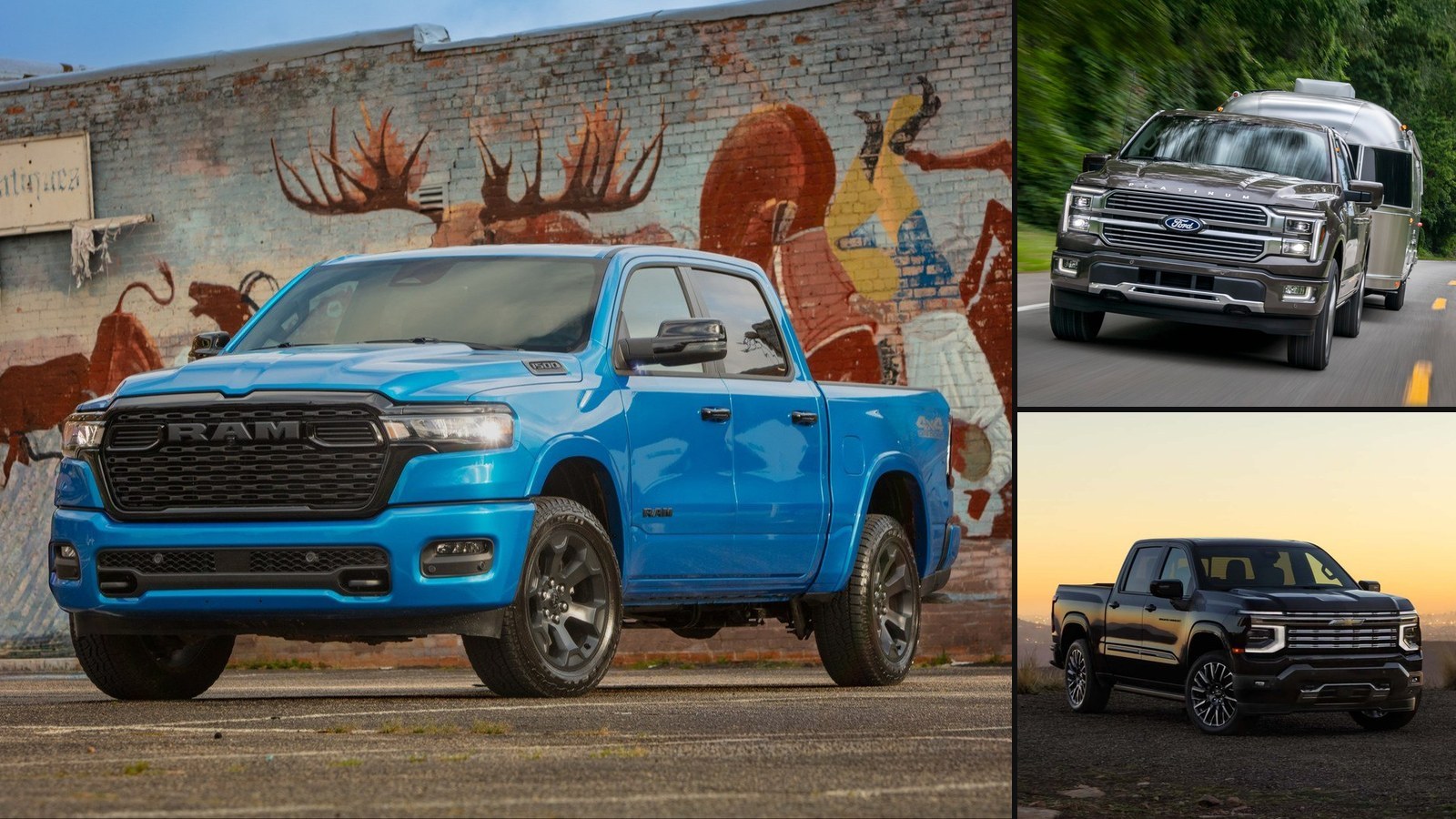
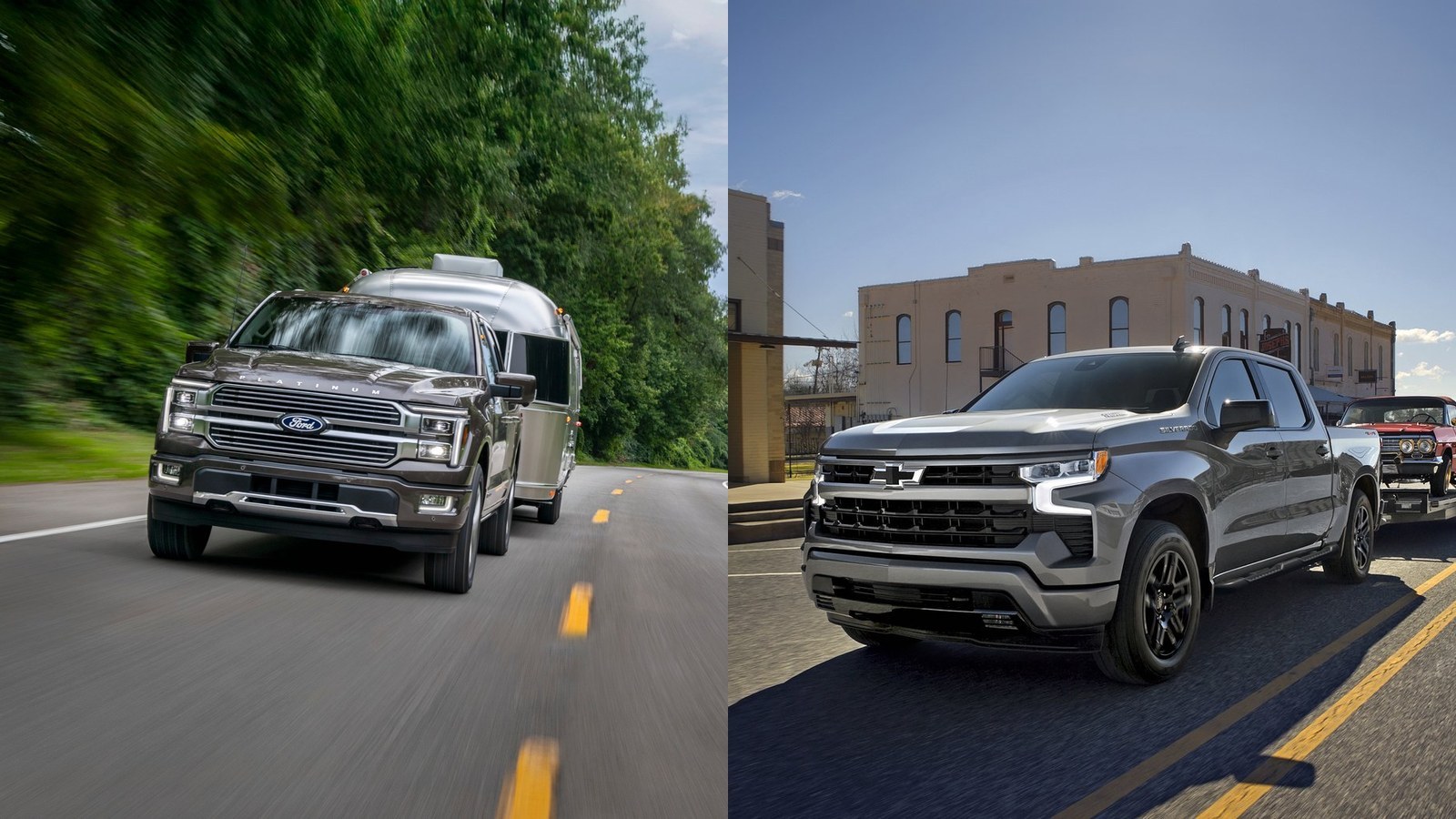
All three Detroit-rooted automakers have now opened their books for the third quarter, and they sell the same thing to the same people: full-size pickups. Yet they reported three different businesses. GM earned the most and sold fewer vehicles. Ford held its truck profits steady and raised its forecast. Stellantis barely broke even in North America while its Ram 1500 had a blowout quarter.
This is the follow-up to our Q3 earnings scorecard of GM, Tesla, Volvo, and Ford, which went out before Ford and Stellantis reported. That piece asked who can afford to cut prices. This one narrows it to trucks and asks who will actually have to.
Three companies, three strategies
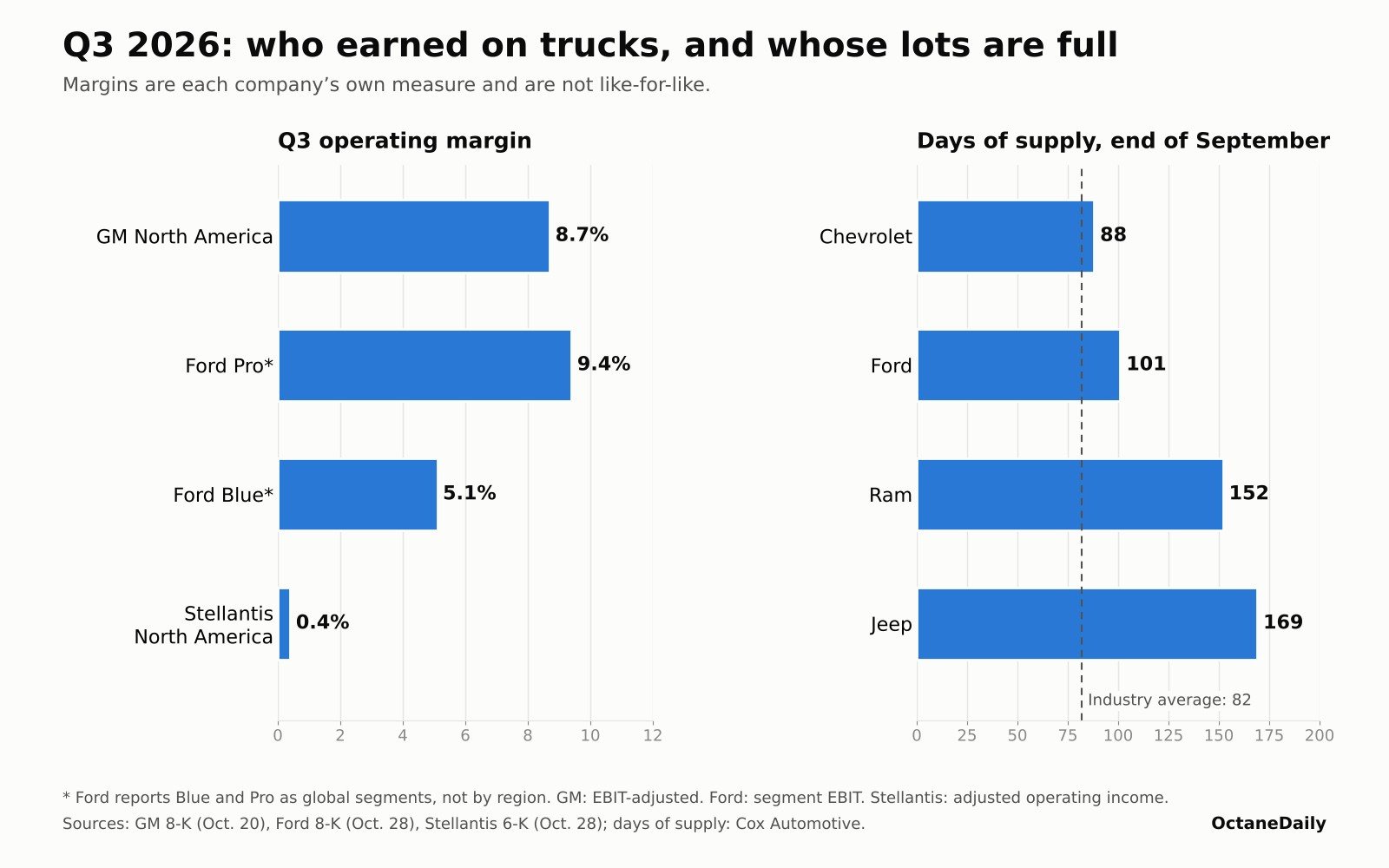
GM is protecting margin and accepting lower volume. Its North American business earned $3.59 billion on an EBIT-adjusted basis at an 8.7% margin, up from 6.2% a year ago, according to GM's third-quarter release. Over the same three months, its U.S. sales fell 5.5% to 671,000 and its share slipped to 16.1%. GM's share of the U.S. "trucks" category, which also counts full-size SUVs, fell to 31.0% from 32.3%. Our breakdown of GM's quarter covers where the volume went.
Ford is holding the line. Ford Blue, the gas and hybrid business behind retail F-150 sales, earned $1.4 billion at a 5.1% margin, and Ford Pro, the commercial arm, earned $1.7 billion at 9.4%, according to Ford's earnings release. Pro's revenue actually rose 2%, to $17.8 billion; its profit fell 16% on commodity costs and launch costs for Super Duty production at Oakville, Ontario. Ford raised the low end of its full-year adjusted EBIT forecast to $10.5 billion, as we detailed in what Ford's quarter means for truck shoppers.
Stellantis is rebuilding from a loss. Its North American shipments fell 12% to 357,000 as it idled plants building the Jeep Grand Cherokee and Compass, but the region swung to €64 million of adjusted operating income, a 0.4% margin, from a €475 million loss a year earlier, according to Stellantis' third-quarter filing. U.S. sales of the Ram 1500 rose 73% with the 5.7-liter HEMI V-8 back in the lineup, and Ram's North American sales rose 30%.
The North American scorecard
The figures below come from each company's own filing. They are not measured the same way: GM reports North America as a region, Ford reports Blue and Pro as global segments, and Stellantis reports in euros. Read across the rows for direction, not for a precise ranking.
| GM North America | Ford Blue + Ford Pro | Stellantis North America | |
|---|---|---|---|
| Q3 revenue | $41.4 billion, +2% | $27.1 billion (Blue), −3%; $17.8 billion (Pro), +2% | €15.6 billion, −3% |
| Margin | 8.7% EBIT-adjusted, up from 6.2% | 5.1% (Blue), down from 5.5%; 9.4% (Pro), down from 11.4% | 0.4% adjusted operating income, up from −3.0% |
| Volume | 870,000 wholesales, +4%; U.S. sales 671,000, −5.5% | 657,000 (Blue), −10%; 358,000 (Pro), −4% (global wholesales) | 357,000 shipments, −12%; Ram 1500 U.S. sales +73% |
| Profit per vehicle shipped, by our math | About $4,100 | About $3,000 (Blue and Pro combined) | About €180 |
| Days of supply, end of September (Cox) | Chevrolet 88; GMC 106 | Ford 101 | Ram 152; Jeep 169 |
| What it said about prices | No Q4 pricing guidance in the release; 2027 Silverado 1500 trims up $1,200 to $8,800 | Assumes U.S. industry pricing about 1% higher for 2026 | Expects Q4 pricing broadly stable versus Q3 |
| What it means for a pickup buyer | Little pressure to discount the Silverado | Firm prices overall, with room for targeted deals on stock | Most pressure to move metal, mainly through incentives |
The industry average was 82 days of supply at the end of September, according to Cox Automotive. GM's "trucks" share and the per-vehicle figures are our calculations from the filings.
GM: the cushion it isn't spending
About $4,100 of North American profit per vehicle shipped is a big cushion. GM is sending it elsewhere: it finished a $6 billion buyback and approved a new $20 billion authorization in the same release. The next-generation Silverado also arrives with higher stickers on every trim but one, as our 2027 Silverado 1500 price breakdown shows.
In my view, that is a company with no reason to buy truck volume back this winter. Chevrolet's 88 days of supply is close to the industry average. If you want GM leverage, it sits on the outgoing 2026 trucks still on lots and on GMC, not on a 2027 Silverado order.
Ford: firm prices, a commercial cushion
Ford's guidance is the clearest pricing statement of the three. It now assumes U.S. industry prices finish 2026 about 1% higher than last year, and it expects commodity costs close to $2.5 billion above last year. Those two assumptions don't describe a company planning a price war.
Ford Pro is the reason Ford can sit still. Even after a 16% drop, it remains the highest-margin truck business of the three, and its revenue grew. Ford Blue is thinner, at 5.1%, and Blue wholesales fell 10%; Ford blamed lower volume from discontinued models, among other things. Ford's release mentions an all-new F-150 but gives no timing or price.
The open question is inventory. Ford-brand stock sat at 101 days at the end of September, above Chevrolet's 88. My bet is that Ford spends on targeted F-150 finance and lease offers rather than cutting sticker prices, because its own guidance assumes industry prices go up.
Stellantis: a target that implies deals
Stellantis gave the most useful line for shoppers. It said it is managing North American inventory so that December 2026 lands at a similar level to December 2025, while shipping more vehicles in the fourth quarter than in the third. If more vehicles go to dealers and the year-end stock still has to come down, more have to leave the lot.
With "broadly stable" pricing as its stated plan, I'd argue the tools are incentives rather than lower MSRPs: cash, cheap financing, and lease support. Our look at Stellantis inventory points to the Grand Cherokee and Wrangler as the deepest piles. The Ram 1500 is a different case. Its sales are growing faster than any other Stellantis model named in the filing, so I'd expect smaller help on it than on a Jeep, even with Ram at 152 days of supply.
Stellantis also has less money to spend than GM or Ford. Its North American margin is 0.4%, and it expects €1.0 billion of net tariff costs this year, €0.6 billion of it already booked through September.
Who will have money for deals this winter
Here is my read. GM has the money but no motive. Ford has a motive in its inventory, but its guidance assumes rising prices, so its deals should be selective. Stellantis has the strongest motive and the least room, which is why its help will most likely show up as incentives tied to specific Jeeps and older Rams, not as cheaper window stickers.
That fits what we have seen across the market, where the few price cuts so far land where sales are slipping. If you are trading in a truck, the used side still matters as much as the new one: trade-in values are holding, as our Q4 used-car price report shows.
What we don't know
- October U.S. sales. Ford reports on November 3; GM and Stellantis publish U.S. sales quarterly, so their next official figures come in January. Until then, monthly industry estimates are the best read on whether lots are shrinking.
- November incentive programs. Brand programs typically land around the start of the month, and none of the three filings discloses incentive spending.
- Pickup-only profit. None of the three breaks out earnings for the Silverado, F-150, or Ram 1500.
- Stellantis' December 2025 inventory level, which its target is measured against. It hasn't published the number.