Rivian's R2 Outsells Every Other Rivian, but the Car Business Still Loses Money
Revenue rose 38% and software kept Rivian in gross profit, but its vehicle business lost $80 million as R2 launch costs piled up.
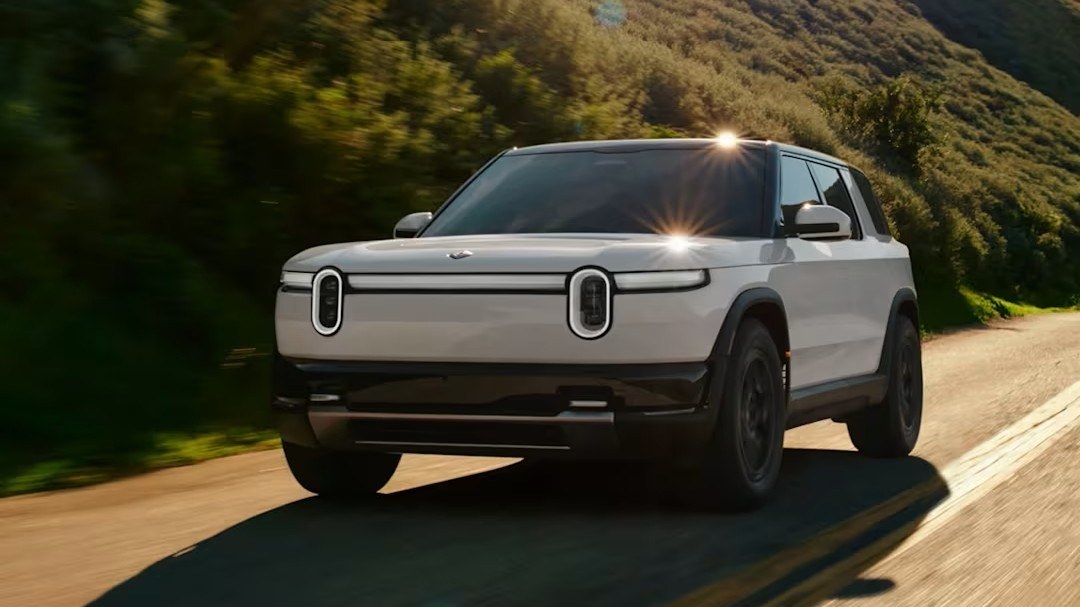
The R2 is now Rivian's best-selling vehicle. In its third-quarter results, Rivian says the midsize SUV outsold both the R1 lineup and the electric delivery van between July and September, helping push revenue up 38% to $2.155 billion. The catch: the business of building and selling vehicles still lost money.
The result follows the record 19,248 deliveries Rivian reported earlier this month, 46% more than a year ago. Production rose 84% to 19,751 units at the Normal, Illinois, plant, where Rivian added a second R2 shift during the quarter.
Where the money came from
Rivian booked $176 million in gross profit, an 8% margin, compared with $24 million a year earlier. Most of it came from software and services, which earned $256 million in gross profit on $605 million in revenue. That segment includes engineering work for Rivian's joint venture with Volkswagen Group and the Autonomy+ driver-assistance subscription that launched in April.
The automotive segment posted an $80 million gross loss. That's better than the $130 million loss a year ago but worse than the $36 million loss in the second quarter. Rivian says launching R2 production added about $120 million in costs that it wouldn't carry at normal output. Average selling prices also fell as the cheaper R2 and commercial vans made up more of the mix.
Two items outside day-to-day car sales helped the quarter: $81 million in regulatory credit revenue and a receivable for a refund of IEEPA tariffs. On the other side of the ledger, Rivian says its automotive cost per vehicle dropped by more than $12,000 from the second quarter as volume spread fixed costs.
The losses haven't gone away
The net loss attributable to shareholders was $913 million, down from $1.173 billion a year ago but up from $833 million in the second quarter. Adjusted EBITDA was negative $435 million. Free cash flow came in at negative $1.124 billion, roughly $275 million worse than in the second quarter, and Rivian ended September with $5.502 billion in cash and short-term investments.
The contrast with the other American EV startup is stark. Lucid delivered 3,806 vehicles in the same quarter and, according to its own production report, dropped a second shift at its Arizona plant in June to bring output in line with demand. Rivian is moving the other way.
What Rivian still hasn't disclosed is how many of the 19,248 vehicles were R2s, what the average R2 sold for, or how large the order backlog is. For now, only the $57,990 Performance with Launch Package is available to order, as covered in our R2 vs. Tesla Model Y comparison.
A slightly higher forecast
Rivian narrowed its 2026 delivery outlook to 67,000 to 70,000 vehicles, raising the bottom end from 65,000. Having delivered 41,807 vehicles through September, it now needs roughly 25,200 to 28,200 in the fourth quarter. It also improved its adjusted EBITDA forecast to a loss of $1.75 billion to $1.85 billion, and cut planned capital spending to $1.40 billion to $1.50 billion, which it attributes to timing.
The next dates are about autonomy. Rivian plans an Autonomy and AI Day on December 9, and expects to start a limited, invitation-only rollout of its Point to Point hands-free driving feature later this year. It also expects to hit a milestone with Uber by year-end that would unlock another $250 million equity investment. Detailed segment figures will follow in Rivian's quarterly 10-Q filing; for how the rest of the industry fared, see our Q3 earnings scorecard.