Snow Hit the Cascades and Rockies This Week. Winter-Proof Your Car Before Sunday
Seven checks to do before the clocks change, who should do each one, and why AWD is no substitute for the right tires.
Winter showed up early this week. On Oct. 28, National Weather Service offices in Portland, Pendleton, and Great Falls posted winter weather advisories for the Oregon and Washington Cascades and Montana's Rocky Mountain Front, warning that bridges and overpasses would turn slick. Most of the country is still dry, but the calendar is not on your side: daylight saving time ends at 2 a.m. this Sunday, Nov. 1, and the evening commute moves into the dark the next day.
That makes this weekend the cheapest moment to get a car ready. Nothing below requires a new car or a big bill, and most of it you can check in a driveway in under an hour. Where the job belongs at a shop, we say so. If you are still deciding between all-wheel drive and a set of winter tires, start with our AWD vs. 4WD vs. winter tires breakdown; the short version is further down.
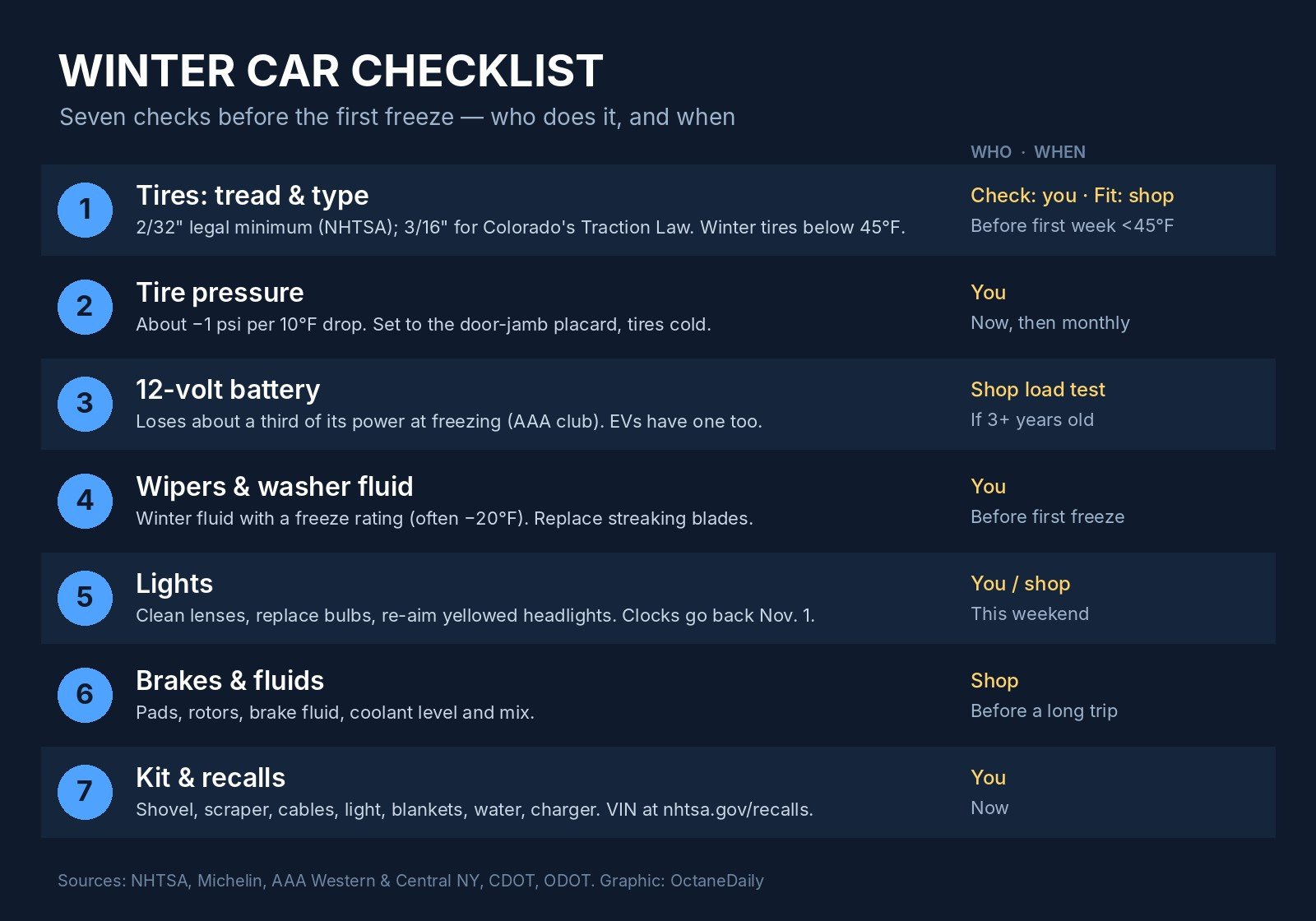
The 7-point winter checklist
Each item lists who should do it, what it costs in general terms, and when. We are not printing tire or battery prices: they swing too much by size, region, and shop for a national number to mean anything.
1. Tires: tread depth and type
NHTSA's floor is 2/32 of an inch of tread on every tire. The penny test still works: put Lincoln in the groove head-down, and if you can see the top of his head, the tire is done. For winter, treat that as the absolute minimum, not a target. Colorado's Traction Law asks for at least 3/16 of an inch, three times as much.
Then check what kind of tire you have. Plain all-seasons carry an M+S (mud and snow) marking. All-weather tires add the three-peak mountain snowflake symbol, which means they passed a standardized snow-traction test. Dedicated winter tires carry that symbol too and use softer rubber built for cold pavement, dry or not. Michelin recommends fitting winter tires once daily temperatures consistently fall below 45°F.
- Who: Tread check yourself; mounting and balancing at a shop.
- Cost: Free to check. A tire set is a shop quote; ask whether it includes mounting, balancing, valve stems, and TPMS service.
- When: Before the first week below 45°F. In Oregon, studded tires are legal only from Nov. 1 through March 31.
2. Tire pressure
Cold air shrinks. Both Michelin and Tesla's owner's manual put the loss at about 1 psi for every 10°F drop, so a car set up on a warm September afternoon can be several psi low on the first frosty morning, which is often when the TPMS light comes on. Inflate to the number on the driver's door-jamb placard, not the maximum molded into the sidewall, and check when the tires have sat for at least three hours, as NHTSA advises.
- Who: You.
- Cost: A gauge, and air if your station still charges for it.
- When: Now, then monthly, and after any big temperature swing.
3. The 12-volt battery
Cold slows battery chemistry just as a gas engine needs more current to crank. AAA's Western and Central New York club says batteries lose about a third of their power at freezing temperatures, typically last three to five years in that region, and that jump-starts made up 40% of its calls during a January 2025 cold snap. Electric cars have a 12-volt battery too, and when it dies, the car will not wake up.
- Who: A shop or parts store with a load tester; clean corroded terminals yourself.
- Cost: A test is usually quick. Replacement is a quote; price depends on size and whether your car needs an AGM battery.
- When: This month if the battery is three or more years old, or if the engine has been cranking slowly.
4. Wipers and washer fluid
Summer fluid can freeze in the lines on the first cold night. Run the reservoir down and refill with a winter blend that carries a freeze rating, commonly -20°F on the jug; colder climates sell lower-rated mixes. NHTSA also suggests testing the defrosters and replacing streaking blades, and winter blades in snow country.
- Who: You.
- Cost: Low; fluid and blades are commodity parts.
- When: Before the first freeze. If ice is forecast while you're parked, lift the blades off the glass.
5. Lights, before the clocks change
From Monday, many commutes home happen in the dark. Wipe road film off the lenses, replace burned-out bulbs, and if your headlights look yellow or aim at the treetops, have them restored or re-aimed. Headlight quality varies a lot by model and trim, as our rundown of IIHS headlight ratings for popular SUVs and trucks shows. November is also peak season for deer strikes; here's what your insurance covers if you hit one.
- Who: Cleaning and bulbs yourself on most cars; aiming and lens restoration at a shop.
- Cost: From nothing to a shop quote.
- When: This weekend.
6. Brakes and fluids
Snow does not wear brakes faster, but it punishes weak ones. Have pads, rotors, and brake fluid checked if they have not been looked at in a year, and confirm that the coolant is at the right level and mixed for your climate. NHTSA recommends a mechanic look over the battery, charging system, and belts at the same visit.
- Who: A shop, or your next scheduled service.
- Cost: An inspection is often bundled with an oil change; repairs are a quote.
- When: Before the first long winter trip.
7. Emergency kit and open recalls
NHTSA's list is a sensible baseline: a snow shovel, broom, and ice scraper; sand or cat litter for traction; jumper cables, a flashlight, and flares or reflective markers; a first-aid kit and any medicines you need; blankets, water, and non-perishable food; and a phone charger. If you are stuck, clear snow from the tailpipe before running the engine for heat, and run it only in short bursts.
Then put your VIN into NHTSA's recall lookup. Repairs for safety recalls are free, and a handful of open recalls this year come with a park-outside warning; here's what that means and which models are affected.
- Who: You.
- Cost: Mostly things you already own; recall repairs are free.
- When: Now, and before any trip over a mountain pass.
AWD is not a winter tire
All-wheel drive helps a car pull away on snow. It does nothing for stopping, because every car already brakes with all four wheels, and Consumer Reports says neither AWD nor 4WD improves braking. In the independent snow test we broke down in September, winter tires stopped a sedan from 25 mph in 56 to 63 feet on snow, while two ordinary all-season tires needed 81 and 85 feet. That is roughly two car lengths, at parking-lot speed.
The practical rule: an AWD car on worn all-seasons is the vehicle most likely to arrive at a stop sign too fast, because it got up to speed so easily. A front-drive car on good winter tires will out-stop it. If your budget covers only one, the tires do more of the work.
If you drive an EV
Expect less range, not a broken car. In battery analytics firm Recurrent's 2025/26 winter study, EVs kept 78% of their best warm-weather range on average at 32°F and 70% at 20°F. The gap between models is wide; our model-by-model table runs from 88% down to 69% at freezing. Most of the loss is heating the cabin, and Recurrent says the range comes back when temperatures rise.
The fixes are habits, not hardware. Tesla's owner's manual recommends turning on climate control 30 to 45 minutes before you leave, setting a scheduled departure so the battery warms while the car is still plugged in, and navigating to a charger 30 to 45 minutes ahead so the pack arrives warm enough to fast-charge at full speed. A blue snowflake on the display means some stored energy is temporarily unavailable, and regenerative braking will be weaker until the pack warms up. Other automakers, Ford among them, publish their own instructions for preconditioning before DC fast charging; check your owner's manual for whether your car does it automatically when you route to a charger.
NHTSA's advice is the same for every EV: keep the battery charged, plug in overnight in freezing weather, and keep the car as warm as you can to limit the drain from heating.
Chain and traction laws: Oregon and Colorado
Oregon enforces chain requirements year-round on posted roads. Signs may tell drivers to carry chains or traction tires, or to put them on. Passenger vehicles up to 10,000 pounds that are not towing can usually use traction tires (studded, or marked with the mountain-snowflake symbol) where signs allow, and some 4WD and AWD vehicles that carry chains are exempt in typical conditions. Ignoring the signs is a Class C traffic infraction for drivers of cars; the $880 fine you may have seen applies to commercial vehicles. Check TripCheck or call 511 before a pass.
Colorado's Traction Law covers the I-70 mountain corridor between Dotsero and Morrison every year from Sept. 1 through May 31, and can be activated on other state highways. According to the Colorado Department of Transportation, tires must have at least 3/16 of an inch of tread and be winter, all-weather, or M+S rated, or the vehicle must use chains or an approved traction device on two or more drive tires. CDOT lists the noncompliance fine at $50 plus a $17 surcharge.
Washington, California, Utah, and other mountain states run their own rules; the state DOT website or 511 line is the place to check before you leave.
What we don't know
- Prices by region. We have no reliable national figure for a set of winter tires or a replacement battery; both depend on size, brand, and local labor rates. Get two quotes.
- Your EV's real winter range. Fleet averages describe groups of cars, not yours. Battery age, trim, wheels, and how warm you keep the cabin all move the number.
- This winter. One early-season advisory says little about how hard the season will be. Prepare for the roads you actually drive.