AWD, 4WD or Winter Tires? What Actually Keeps You on the Road This Winter
All-wheel drive wins the hill start. Winter tires win the stop sign at the bottom — by two car lengths in Tire Rack's latest snow test.
Every fall the same argument resurfaces in showrooms and family group chats: pay for the all-wheel-drive version, or spend the money on winter tires? The two solve different problems. All-wheel drive and four-wheel drive help a car get moving on a slippery surface. Neither helps it stop, and neither does much to help it turn. Stopping and turning are the tire's job, and the numbers from independent testing make that gap hard to ignore.
What AWD and 4WD actually do
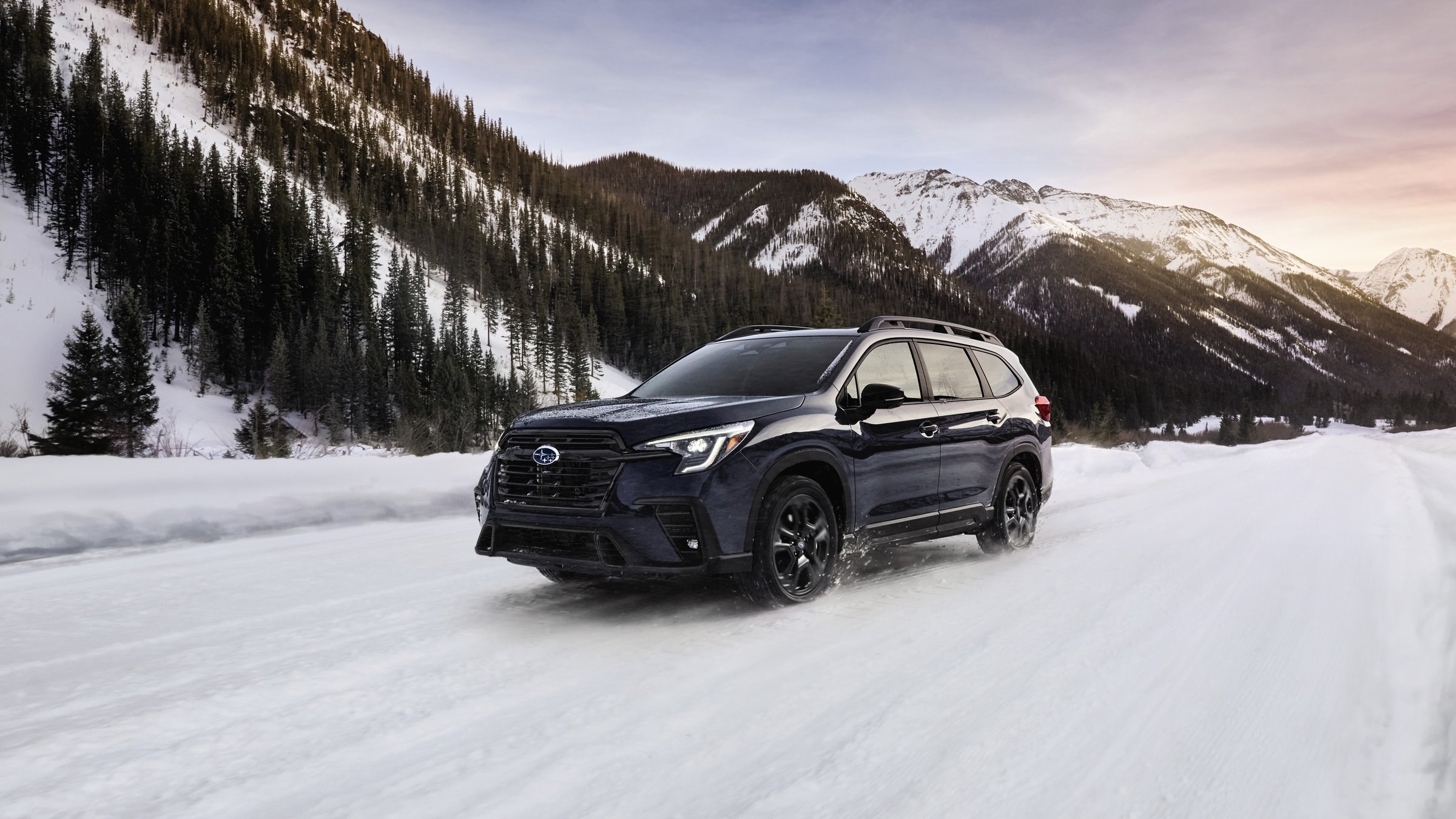
All-wheel drive on most crossovers works on demand: power goes mainly to one axle until the system detects slip, then some is shifted to the other. Subaru's mechanical setup always sends some torque to every wheel, while many front-drive-based systems run in pure front-wheel drive until the front tires spin. EVs do the same job with a motor on each axle and no driveshaft between them.
Four-wheel drive is the heavier-duty relative found on body-on-frame trucks and SUVs, usually with a two-speed transfer case. Consumer Reports splits modern 4WD into full-time, automatic, and part-time systems, and the part-time kind still common on pickups comes with a rule: CR warns that running it in 4WD mode on dry pavement can damage the drivetrain. If your truck has a 2H/4H/4L selector, that is the version you have. Our guide to which Chevrolet models use AWD and which use true 4WD shows how blurred the marketing has become.
What the drivetrain cannot do
Power to all four wheels only matters while you are on the throttle. Under braking, every car is already a four-wheel-brake car, and a driveshaft to the rear axle adds nothing to the grip available to slow it down. Consumer Reports puts it plainly: neither AWD nor 4WD improves braking, and most systems have little or no effect on cornering.
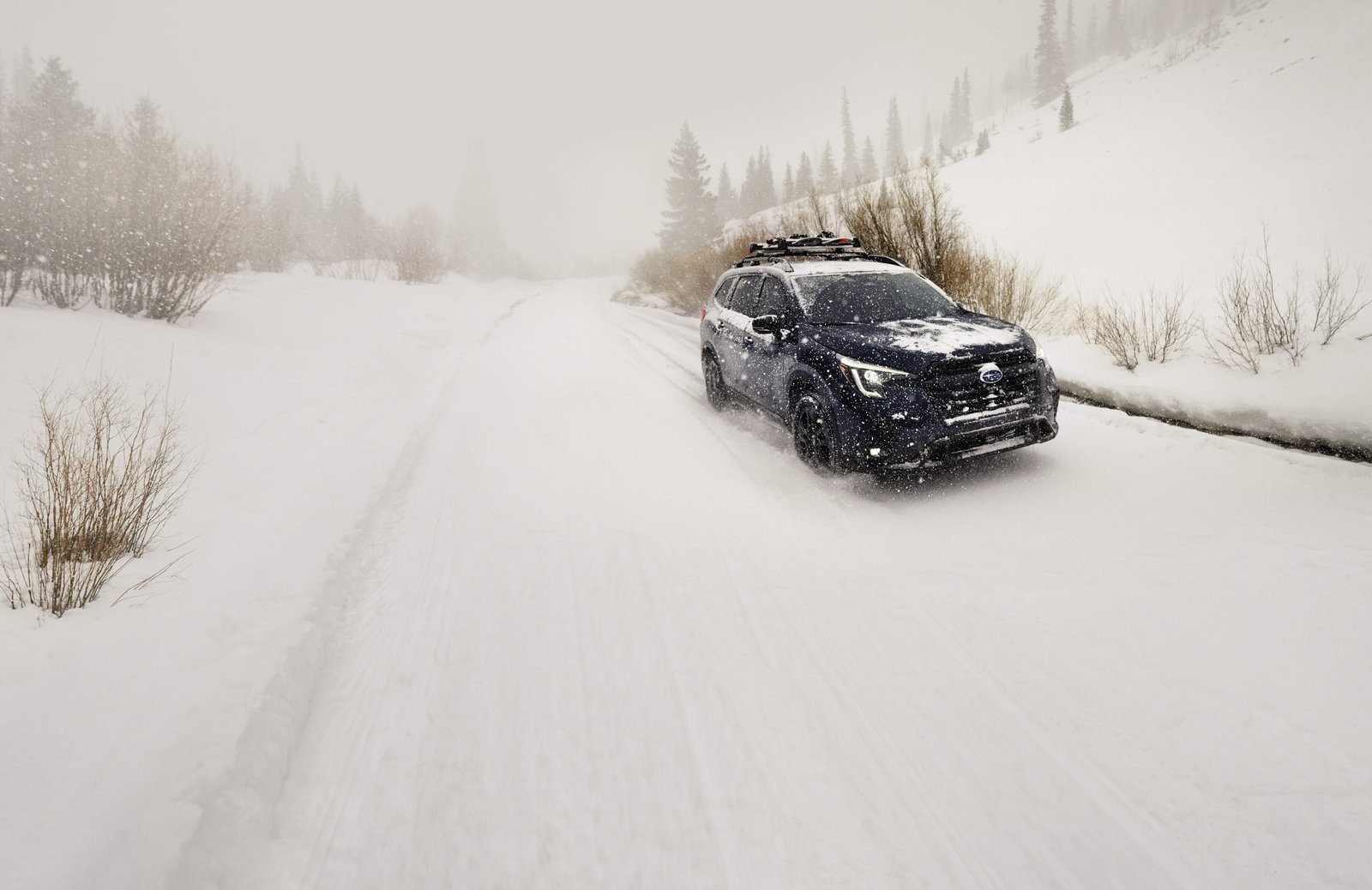
The easy acceleration can work against you. Because an AWD car pulls away from a snowy stop sign without drama, drivers tend to carry more speed than the road allows and discover the problem when they try to slow down. CR's advice is that AWD drivers need to be more careful in slippery conditions, not less.
The numbers: winter vs. all-weather tires on the same car
The most useful recent data comes from a Tire Rack test published in May 2026. The retailer ran ten tires in a common 215/55R17 size on a 2025 Toyota Camry in near-freezing temperatures. Five were dedicated winter tires; the other five were touring tires, three of them "all-weather" designs with the mountain-snowflake symbol and two ordinary all-seasons without it.
Braking on snow from 25 mph is the headline. The best winter tire stopped in 56.1 feet, and the winter tires as a group came in between 56 and 63 feet. The two plain all-seasons needed 81.1 and 84.5 feet, roughly two car lengths more from parking-lot speed. Tire Rack's own extrapolation is that from 50 mph the gap would exceed 100 feet, which the testers describe as the difference between stopping at an intersection and sliding through it.
The honest complication: the all-weather tires were not alike. One stopped in 58.6 feet, within about two and a half feet of the best winter tire and ahead of two winter tires. The other two needed 72.4 and 73 feet. On ice, though, the picture was clear. Braking from just 12 mph, the top winter tires stopped in under 40 feet; the best all-weather needed 50.6 feet and the non-snowflake all-seasons 55 and 57.7. Every winter tire beat every non-winter tire on ice by more than ten feet. Snow acceleration from 0 to 12 mph followed suit: 23.6 to 25.6 feet for the winter tires against 25.9 to 36.4 for the rest.
Now the trade-off. On wet pavement, braking from 50 mph, the best all-weather tire stopped in 93 feet and the best winter tire needed 129 feet. Winter compounds are built to stay soft in the cold, and on a rainy 45-degree day that softness gives up grip to the touring tires. The wet spread across the whole group was about 30 to 36 feet, versus 100-plus feet on snow. That is the case for running winter tires only in winter, not for skipping them.
AWD on all-seasons vs. FWD on winter tires
The question most buyers actually face is "AWD on the tires that came with the car, or FWD on a winter set." The clearest head-to-head we found is a test by the UK channel Tyre Reviews, reported by Motor1: two Mini Countryman S models, one with on-demand AWD on all-season tires, the other front-wheel drive on winter tires.
The AWD car won the acceleration runs easily, on level snow and on a hill start. That advantage is real, and any explainer that calls AWD useless is wrong. But in the snow braking test the front-drive car on winter tires stopped about a car length shorter, and on a snow-covered handling course it was slightly quicker, because it braked later and turned in better even though the AWD car pulled harder out of corners. Two of the three things a car does in a corner went to the tires. Two caveats: Motor1 published no distances or lap times, and the all-seasons in that test were a strong European design that itself carries the snowflake symbol. A cheaper original-equipment all-season would likely have fared worse.
Reading the sidewall: M+S is not a winter rating
Almost every all-season tire is stamped "M+S," which reads like a promise. It is not. According to Tire Rack's explainer, M+S describes tread geometry only, with no performance test behind it.
The three-peak mountain snowflake, or 3PMSF, is a performance standard the U.S. and Canadian tire industry associations agreed on in 1999. To earn it, a tire must score at least 110 on the ASTM F1805 packed-snow traction test against a reference tire rated 100 (112 against the newer 16-inch reference). The test measures acceleration traction on medium-packed snow and nothing else: no braking, no cornering, no ice. Every dedicated winter tire carries the symbol, but so do a growing number of all-season and all-terrain tires, which is exactly how one all-weather tire in the Camry test braked nearly like a winter tire on snow while trailing badly on ice.
When to switch, and why four tires and not two
Michelin's rule of thumb, shared across the industry, is to install winter tires once daily temperatures consistently fall below 45°F (7°C). The reasoning is chemistry rather than snow: all-season compounds stiffen in the cold and lose grip on dry and frosty pavement well before the first storm. In much of the northern half of the country that puts the swap in late October or November, not after the first plow goes by.
Buy four, not two. Michelin says two winter tires on one axle create an imbalance that leads to unpredictable handling and longer stops, and an older Tire Rack track test on rear-drive Lexus IS300 sedans showed why: winter tires on the rear with all-seasons up front produced oversteer and fishtailing in a 40 to 45 mph lane change, because the winter tires hit their dry-pavement limit first. On snow the balance flips and the same car understeers. You end up with a car whose behavior at the limit depends on the weather.
What it costs to get this wrong
The Federal Highway Administration counts an average of 744,911 weather-related crashes a year in the U.S. over 2019 through 2023, about 12 percent of all crashes, with 268,239 people injured and 3,807 killed. Rain accounts for most of that. Freezing precipitation, which FHWA defines as snow, sleet, hail, and freezing rain or drizzle, is tied to 219,942 crashes, 34,206 injuries, and 407 deaths in an average year. The figures describe the weather at the time of the crash, not what was on the tires, so they do not say how many were preventable. They do say how often the conditions the Camry test simulated actually show up.
The practical part
- Get a second set of wheels. Winter tires on their own steel or basic alloy wheels turn the seasonal swap into a driveway job and spare the summer wheels from salt. Prices depend heavily on size, so quote your exact fitment rather than trusting a national average.
- Check pressure all winter. Michelin's figure is a loss of about 1 psi for every 10°F drop, so tires set correctly in September can be several psi low by December. Use the door-jamb number, not the sidewall, and check monthly when the tires are cold.
- Store the off-season set clean, dry, and out of sunlight.
- Treat AWD as a traction aid, not a safety system. It will get you out of an unplowed driveway that a front-drive car cannot leave. It will not shorten your stopping distance by a foot.
- If you can afford only one thing, the data points to tires over drivetrain for anyone whose winter includes ice or regular snow. AWD plus winter tires is the combination that does everything well.
What we don't know
The Tire Rack results come from one sedan in one tire size. A heavier crossover such as a Forester or a body-on-frame pickup will produce different absolute numbers, and the gap between tire types may change with them. We have not found a recent published test that puts numbers on AWD-with-all-seasons against FWD-with-winter-tires; the Tyre Reviews comparison is qualitative and used one tire brand on one small crossover. And the cost of a winter set with wheels varies so much by size that any single dollar figure would mislead, so we have left one out.
The bottom line
All-wheel drive earns its money on the way up the hill. Winter tires earn theirs on the way down, and at the stop sign at the bottom. If your winters bring ice or more than an occasional dusting, the tires are the safety purchase and the drivetrain is the convenience. Buy four, mount them when the thermometer settles below 45°F, take them off when it climbs back, and watch the pressure in between. If the car already has AWD, spend the extra confidence on caution rather than speed.