The Best Day to Buy a Used Car Isn't Black Friday. iSeeCars Says It's MLK Day
Across 42 million sales, MLK Day gave shoppers the best odds of a below-market price. Black Friday ranks sixth, and Memorial Day and July 4 are among the worst.
If you are shopping for a used car, the best day of the year to find one priced below market is not Black Friday. It is Martin Luther King Jr. Day, which falls on January 18 in 2027. That is the headline of a new iSeeCars study of more than 42 million used-car sales from 2025 through October 2026.
This is a different question from the one we tackled in our guide to timing a new-car purchase, where December quotas and model-year clearance drive the math. Used cars have no model-year changeover and no factory incentives. What moves the odds is simpler: how many people are shopping.
How iSeeCars measured a "deal"
iSeeCars counts a listing as a deal when it is priced at least 10% below the company's own estimate of fair market value. On an average day, 11.5% of listings clear that bar. Every figure in the study is a percentage difference from that 11.5% baseline, not a discount.
That distinction matters. When iSeeCars says MLK Day offers 52.7% more deals than average, it means your odds rise from about 11.5% to roughly 17.6%. It does not mean cars are 52.7% cheaper. With the average used car listed at $27,157, a qualifying deal on a typical vehicle works out to at least $2,716 below its estimated value.
The best times to buy a used car
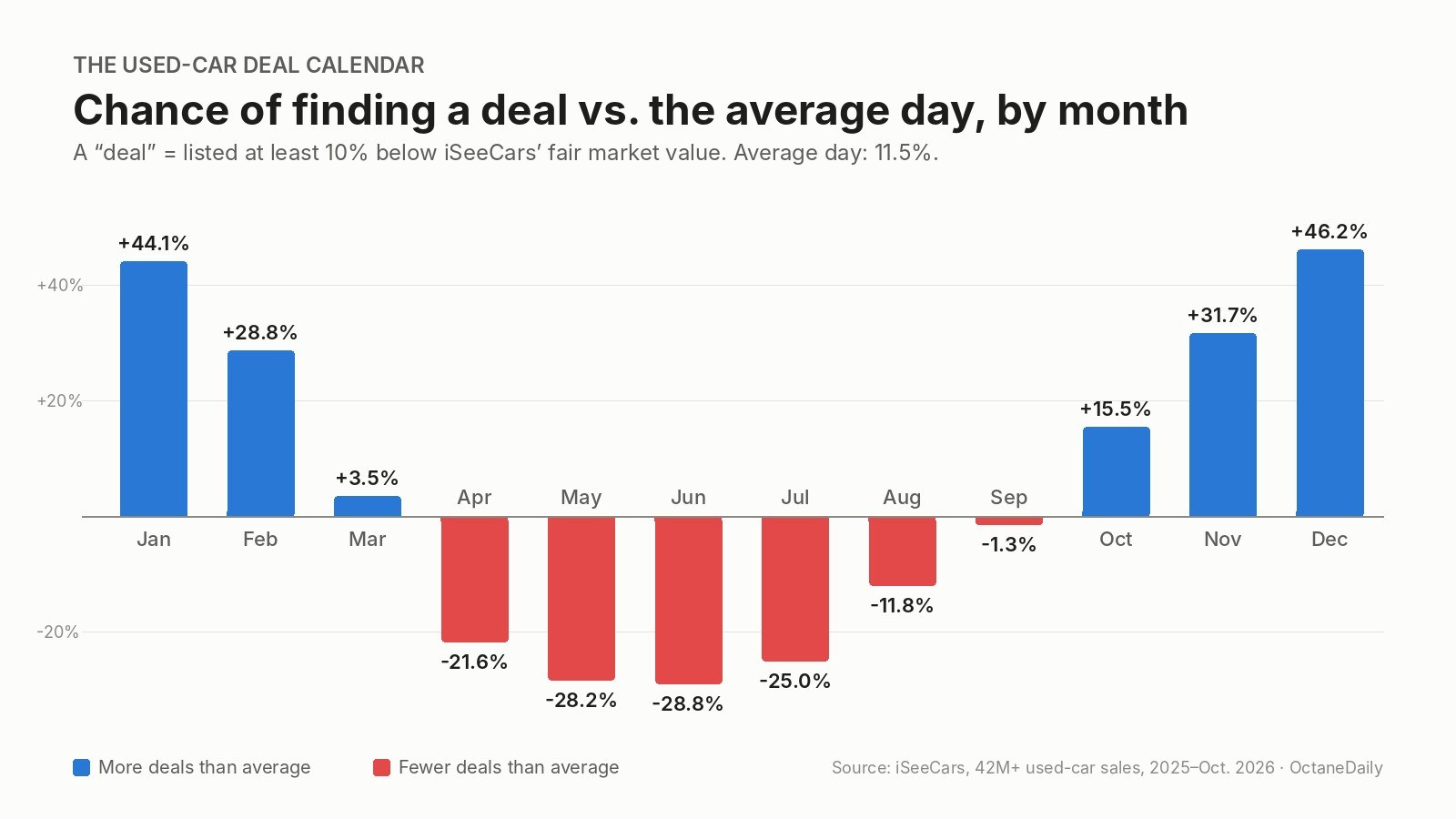
All ten of the study's best periods fall between October and February. The top five:
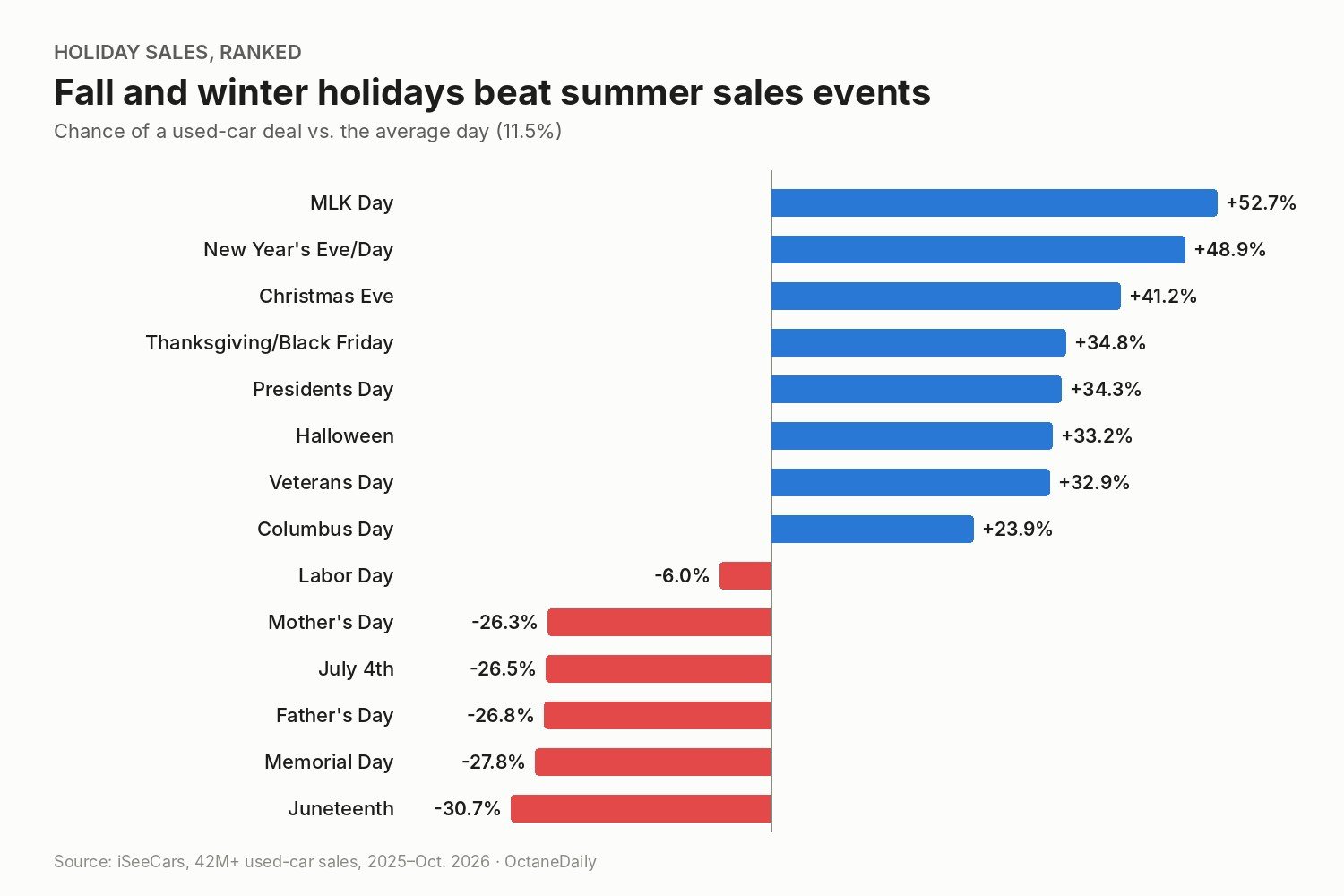
- MLK Day: +52.7% (about a 17.6% chance per listing)
- New Year's Eve and New Year's Day: +48.9% (about 17.1%)
- December: +46.2% (about 16.8%)
- January: +44.1% (about 16.6%)
- Christmas Eve: +41.2%
Presidents Day (+34.3%), Halloween (+33.2%), Veterans Day (+32.9%), and November as a whole (+31.7%) round out the top ten. February is the fourth-best month at +28.8%, and October sits at +15.5%.
Where Black Friday lands
iSeeCars groups Thanksgiving and Black Friday together, and the pair ranks sixth overall at +34.8%, or roughly a 15.5% chance of finding a deal. With Black Friday on November 27, that is two weeks away, and it is a genuinely good window. It is just not the best one. A shopper who misses it gives up little, because December and January both score higher.
The worst times, including the big sales weekends
The spring and summer holidays that dealers advertise hardest are the weakest days to find a used-car deal. Juneteenth is the worst day in the study at −30.7%. Memorial Day (−27.8%), Father's Day (−26.8%), July 4 (−26.5%), and Mother's Day (−26.3%) are close behind. Labor Day is the mildest of the group at −6.0%, essentially an average day.
By month, June is the worst at −28.8%, followed by May (−28.2%), July (−25.0%), April (−21.6%), and August (−11.8%). At the bottom, your odds fall to roughly 8%, less than half of what MLK Day offers. iSeeCars executive analyst Karl Brauer points to demand: "Warmer weather and tax refunds bring more shoppers to dealer lots in the spring." In winter, by his account, cold weather and holiday spending thin the crowd, and sellers have to price more aggressively to move cars.
What about used EVs, trucks, and SUVs?
This study does not break the numbers out by vehicle type, so there is no separate calendar for EVs, pickups, or SUVs. Don't assume the averages apply evenly. iSeeCars' September data showed that one- to five-year-old EVs now list for more than comparable gas cars and sell almost two weeks faster. A segment that turns over that quickly gives buyers less room to wait for a markdown.
The calendar also offers no tax angle for EV shoppers. The federal used clean vehicle credit of up to $4,000 expired on September 30, 2025, so there is no year-end incentive deadline to chase. If you are weighing a used EV, battery health and charging costs matter more than the date. Our used EV buying guide covers what to check, and our used EV vs. gas car payback math shows when the price premium pays for itself.
How to use the deal calendar
The study measures odds across the whole market, not the price of any specific car. Waiting until January to buy whatever is on the lot is a weaker strategy than it sounds. A better approach is to pick two or three target models now, track specific listings, and act when one drops into deal territory.
- Start tracking before the window opens. Price drops are easier to spot when you have watched the same cars for a few weeks.
- Read a price drop as a question. A car listed well under market may have sat because of its history, condition, or options. Get a vehicle history report and an independent pre-purchase inspection.
- Line up financing early. MLK Day, New Year's Day, and Presidents Day are federal holidays, so banks and many credit unions are closed. Get preapproved before you shop.
- Don't stall a good deal for a better date. In June, a deal still shows up on about one listing in twelve. If the right car is priced right, the calendar is irrelevant.
Buying on December 31: the paperwork side
Closing on New Year's Eve can pay off on price, but the year-end date has administrative side effects. Sales tax is generally due on the purchase regardless of the day. In states that levy an annual vehicle or personal property tax, the date of ownership can decide which tax year the car counts toward. Registration timing, temporary tags, and DMV holiday closures also vary by state. Check your state's DMV and tax rules before you assume a December 31 purchase saves or costs anything. If you buy a vehicle for business use, ask a tax professional how the purchase date affects that year's return.
Price is only the first number you pay. Depreciation, insurance, and fuel decide what the car really costs, as our breakdown of AAA's 2026 ownership costs shows.
What the study can't tell you
The data window runs from 2025 through October 2026, so November, December, and the late-year holidays are measured on a single year of sales, while January through October include two. One season of data can be shaped by that year's supply and interest rates. "Fair market value" is also iSeeCars' own estimate, and the study does not publish results by region, by day of the week, or by vehicle type. The pattern is clear. Your odds still depend on the car, the market, and the seller.