New-Car Ownership Hit $12,863 a Year. Two of the Six Costs Are Yours to Choose
AAA's 2026 study puts annual ownership at $12,863, with depreciation at $4,422 and hybrids cheapest in every category. We sort all six lines by how much a buyer actually controls.
AAA's 2026 edition of Your Driving Costs puts the average cost of owning and operating a new vehicle at $12,863 a year, or $1,071.92 a month, for a driver covering 15,000 miles. That works out to about 86 cents per mile. The number has been passed around since AAA published it in September, usually with the same two takeaways: it's up from $11,577 in 2025, and depreciation, not gasoline, is the biggest line. Both are true. Neither tells you what to do about it.
So this is a different kind of read. Below is the study taken apart line by line, using AAA's own brochure and fact sheet, with one question asked of every line: is this a cost a buyer can actually move, or one they can only absorb? The answer matters more than the headline, because the controllable lines turn out to be the big ones, and they connect directly to the trends we've been tracking all fall, from slipping gas-car resale values to the record share of 84-month loans.
First, a caveat AAA itself insists on
The $1,286 jump from 2025 looks like an 11 percent increase. AAA's release says the 2026 methodology was updated and the result is not directly comparable with 2025, which in turn wasn't directly comparable with 2024. Treat the year-over-year gap as a direction, not a measurement.
The study's assumptions are worth knowing before the numbers mean anything. AAA averages costs over five years and 75,000 miles for five top-selling 2026 models in each of seven categories, 34 vehicles in all, with a sales-weighted average sticker of $39,376. Financing assumes a five-year loan with 15 percent down at the national average rate, which AAA doesn't publish. Insurance assumes full coverage for a suburban or city driver under 65 with a clean record. Fuel uses a 12-month average through May 2026 of $4.152 a gallon for regular, and 18 cents per kWh for home charging.
That fuel price is already stale. AAA's national average for regular was $4.02 on November 8, down from $4.36 a month earlier, with diesel at $6.19. We'll come back to what that does to the fuel line.
Where the $12,863 goes
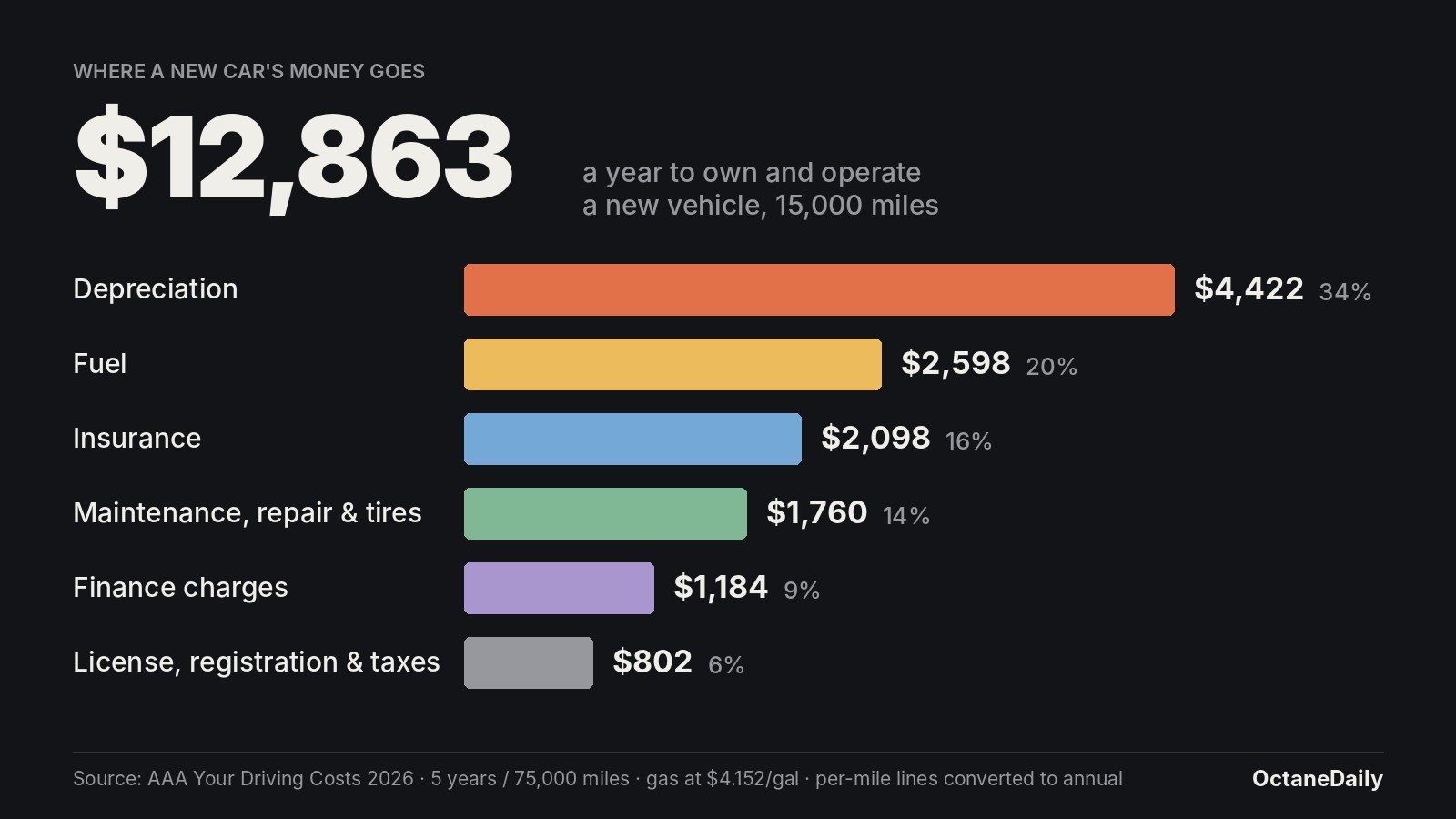
AAA splits the total into ownership costs, which you pay whether or not the car moves, and operating costs, which scale with mileage. At 15,000 miles a year the weighted averages look like this:
- Depreciation: $4,422 (34 percent of the total). The gap between the purchase price and the trade-in value after five years and 75,000 miles.
- Fuel: $2,598 (20 percent). 17.32 cents a mile at $4.152 a gallon.
- Insurance: $2,098 (16 percent). Full coverage, clean record.
- Maintenance, repair, and tires: $1,760 (14 percent). 11.73 cents a mile, including routine service at retail prices, an extended warranty, wear items, and one set of replacement tires.
- Finance charges: $1,184 (9 percent). Interest on a five-year loan after 15 percent down.
- License, registration, and taxes: $802 (6 percent). Purchase taxes and fees spread over five years, plus annual registration.
Depreciation plus fuel is more than half the bill. Insurance plus maintenance is another 30 percent. Finance, the line everyone argues about at the dealership, is less than a tenth, which is exactly why stretching the loan is such a tempting and such a poor fix.
What moved since 2025
With the comparability warning in mind, lining the 2025 fact sheet against the 2026 one still shows where the pressure came from. Fuel went from 13.0 to 17.3 cents a mile, as AAA's gas assumption climbed from $3.151 to $4.152 a gallon, roughly $645 a year at 15,000 miles. Insurance went from $1,694 to $2,098, another $404. Depreciation rose only from $4,334 to $4,422, maintenance from 11.04 to 11.73 cents a mile, and finance from $1,131 to $1,184. License and registration actually fell $11.
Two things stand out. The first is that fuel and insurance, not depreciation, explain most of the increase. Depreciation is the biggest line, but it was already the biggest line last year. The second is that AAA's 24 percent insurance jump is far steeper than what the market data shows. Insurify's mid-year report put the national average for full coverage at $2,237, up about 1 percent since the end of 2025. Some of that AAA gap is almost certainly the methodology change, and AAA doesn't break out how much. That's the honest limit of a year-over-year read here.
The longer view is less ambiguous. In 2019, the last pre-pandemic edition, AAA's total was $9,282, with depreciation at $3,334 and finance at $920. The study has changed since, but a $3,600 move in seven years isn't a rounding artifact.
The category spread is bigger than the powertrain spread
AAA's seven vehicle categories run from $9,259 a year for a small sedan to $16,449 for a half-ton pickup, a $7,190 range. A compact SUV, the segment most Americans actually shop, lands at $11,670. A medium SUV is $14,447, a midsize pickup $13,089.
Depreciation drives most of that spread: $2,745 a year on the small sedan against $6,248 on the half-ton. Fuel is the second lever, from 11.7 cents a mile for medium sedans to 23.9 cents for half-ton trucks. Insurance is flatter than you'd expect, from $1,623 to $2,469, and it's actually lower on the midsize pickup ($1,867) than on the compact SUV ($2,294).
The practical reading: choosing one category down saves more than any powertrain choice within a category. Moving from a medium SUV to a compact SUV is worth about $2,800 a year on AAA's math. Moving from a gas compact SUV to the hybrid version is worth $455.
Why hybrids won, and the part that's usually misread
AAA ran a separate comparison of electric, gas, and hybrid versions across four categories, and the hybrid came out cheapest in every one: $10,204 against $10,582 for a gas medium sedan, $11,201 against $11,656 for a compact SUV, $13,698 against $14,431 for a medium SUV, and $16,117 against $16,626 for a pickup.
The common explanation is that hybrids win on fuel and on resale. The first half is right. The second needs care. In the sedan and compact SUV categories, the hybrid actually loses more dollars to depreciation than the gas version ($3,739 versus $3,330 for sedans, $3,845 versus $3,568 for compact SUVs), because it costs more to begin with. Only in medium SUVs and pickups does the hybrid hold value better in absolute terms. Hybrids win overall because the fuel savings ($779 a year in sedans, $651 in compact SUVs, $979 in medium SUVs) outrun the extra depreciation, insurance, and finance cost of the higher sticker. That's a more durable argument than "hybrids hold value," and it holds up even as gas slides back toward $4.

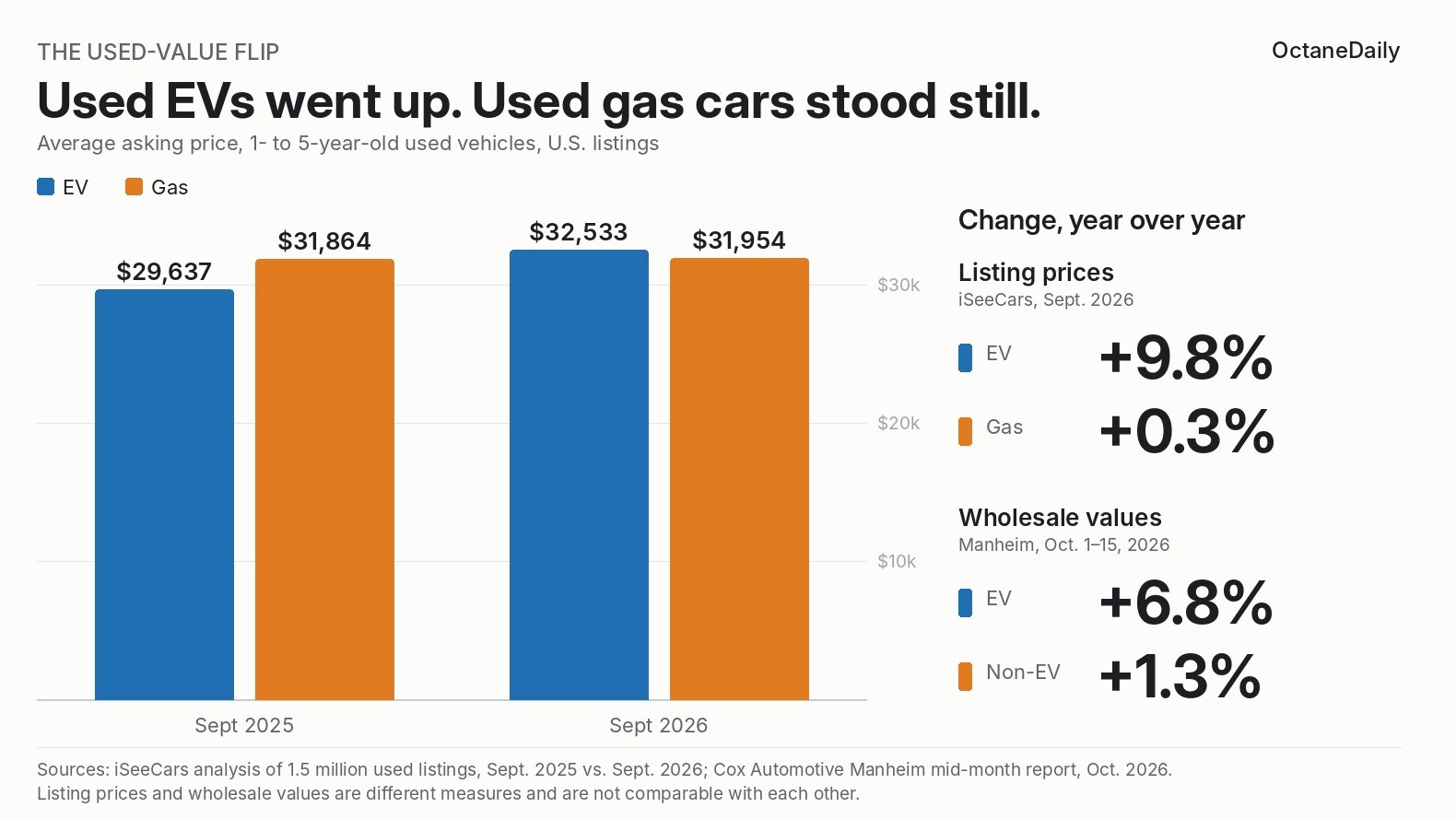
EVs tell the opposite story. Charging came in 66 to 70 percent cheaper than gasoline across the four categories, but the electric medium sedan still cost $13,662 a year, $3,080 more than the gas car, because its depreciation ran $6,786 against $3,330, with higher insurance, fees, and finance stacked on top. The electric compact SUV was the closest contest, $11,888 against $11,656 for gas, and the electric medium SUV was $99 cheaper than its gas counterpart. If you're weighing a used EV against a used gas car, that depreciation line is precisely what the second owner inherits as a discount.
What the fuel line looks like at today's prices
AAA's 17.32 cents a mile assumes $4.152 regular. Scaling to the November 8 national average of $4.02 gives roughly 16.8 cents a mile, or about $2,515 a year instead of $2,598. That's an $83 difference, and it's a rough adjustment because AAA's figure blends regular and premium across the model set.
The bigger point is the sensitivity. Every 10 cents a gallon moves the average fuel line by about $63 a year at 15,000 miles. The per-vehicle math at $4 gas varies far more by what you drive than by where the pump settles this winter. A half-ton at 23.9 cents a mile pays $3,580 a year in fuel; a medium sedan pays $1,755.
Diesel is a separate conversation. At $6.19 a gallon it sits about 54 percent above regular, and AAA's study doesn't include diesel light-duty vehicles at all. The reasons diesel costs so much more right now are structural, not seasonal.
Which lines you can actually move
This is where the study earns its keep. Sort the six lines by how much a buyer controls them:
Depreciation, $4,422: mostly controllable, before you buy. You don't manage depreciation; you choose it, with the category, the powertrain, and whether the car is new. Every one of AAA's category totals is a depreciation story first. The other lever is buying the car after someone else has taken the first-year hit. Our Q4 used-market check covers where late-model prices and days-to-sell stand.
Finance, $1,184: fully controllable, and the most misused. AAA assumes a 60-month loan with 15 percent down. The market has moved the other way. Edmunds' Q3 data puts the average new-car loan at 70.5 months and 7.0 percent APR, with 25.5 percent of buyers signing for 84 months or longer and the average down payment at $5,554, under 13 percent of the $44,664 average amount financed. Stretching from 60 to 84 months lowers the payment and raises the total interest; it also leaves the buyer underwater against a depreciation line that doesn't slow down to match. The arithmetic of that trade is in our 84-month loan analysis linked above.
Fuel, $2,598: controllable through the car, not the pump. You can't negotiate with the station. You can pick a vehicle that uses 11.7 cents a mile instead of 23.9.
Insurance, $2,098: partly controllable. Vehicle choice, deductible, and shopping the policy annually all move it. Insurify's state data shows a wide spread, including EVs costing 54 percent more to insure than gas cars in Massachusetts but less in three states. We're not going to forecast where premiums go from here; the public data is contradictory enough that anyone who tells you confidently is guessing.
Maintenance and tires, $1,760: barely controllable within a category. AAA's figure includes an extended warranty, which many buyers skip, and the per-mile cost is remarkably flat across categories, from 11.1 to 12.2 cents. Hybrids and EVs ran slightly cheaper to maintain than gas versions in most of AAA's pairs.
License, registration, and taxes, $802: not controllable, except by price. It scales with what you paid. The electric medium sedan's $1,051 against the gas car's $609 is mostly a sticker-price effect.
The bottom line
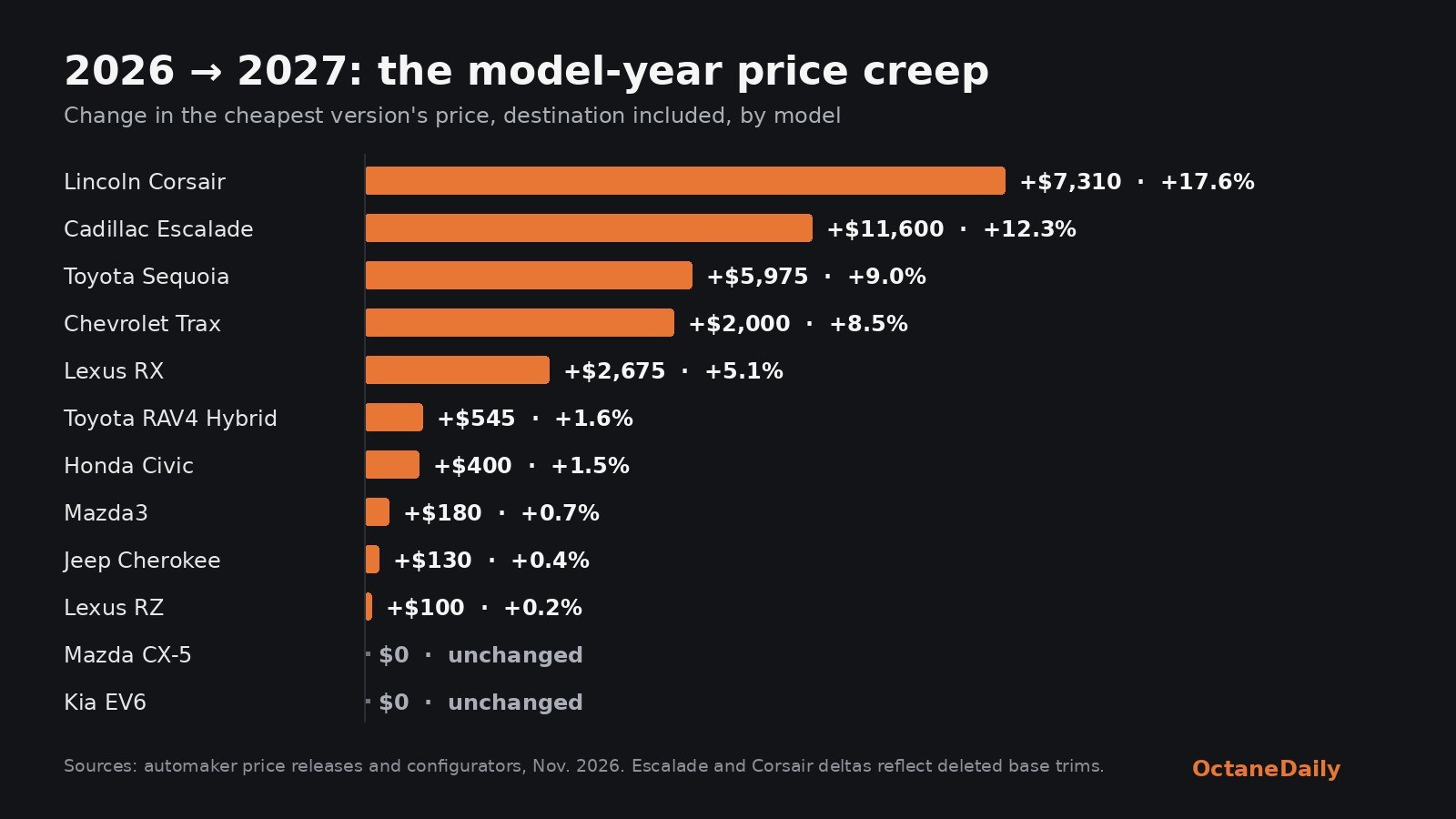
AAA's advice in the release is to budget the full ownership and operating picture before buying, negotiate price, finance rate, and trade-in separately, and get pre-approved before talking to a dealer. All sensible. The study's own numbers suggest a sharper version: the two decisions that set your annual cost are made before you sign anything, in the category you shop and the powertrain you pick, and the decision most buyers use to make the payment fit, the loan term, is the one that costs them more over time. With 2027 sticker prices moving in both directions depending on the brand, that order of priorities matters more this fall than it did when gas was $3.
AAA updates Your Driving Costs each September. We'll revisit this breakdown when the 2027 edition arrives.