Chery Says It Can "Definitely" Sell a Car in America. Here Are the 5 Walls in Its Way
Chery says it can build a car that meets U.S. content rules and wants an American partner. Two of five barriers still look like hard stops.
Chery, China's biggest car exporter, says it can build a car America will let in. Charlie Zhang, a Chery vice president, told Reuters at the company's Wuhu headquarters this week that Chery is open to partnering with an American automaker, and that it can engineer a "China-free solution in terms of hardware and software." He gave no timeline, no partner, and no models.
That last part matters. We've already explained why you can't buy a BYD in America, and almost every wall in that story stands in front of Chery too. The difference is that Chery is now saying out loud which door it wants to try. So here is the checklist: five barriers, and our read on whether each one can be cleared.
Why Chery is worth taking seriously
Chery Group sold 2,806,393 vehicles in 2025, and 1,344,020 of them went abroad, up 17.4 percent, according to company figures reported by Gasgoo. It has led Chinese brands in passenger-car exports for 23 straight years and sells cars under the Chery, Omoda, and Jaecoo brands. Reuters reports a brand launch in Canada is planned for early 2027.
This isn't the first time Chery has talked about America. In May, Chery International president Zhang Guibing said the company hoped to enter the U.S. when the timing suits, with policy in both Washington and Beijing as the deciding factor, Carscoops reported from the same Reuters briefing. What's new in October is the shape of the plan: a partner, and a car engineered to meet U.S. content rules. The Drive's write-up quotes Zhang saying Chery will "definitely" be able to sell such a car.
Barrier 1: The Connected Vehicle Rule. Verdict: no, unless someone else sells the car
This is the wall that decides everything else. The Commerce Department rule bans connectivity and automated-driving software tied to China from the 2027 model year and the matching hardware from 2030. Our Connected Vehicle Rule explainer covers how it works and why it ended Polestar's U.S. sales; the short version is that it looks past the factory to the software and the ownership behind it.
That second half is the problem for Zhang's pitch. A China-free software stack answers the software ban. It doesn't answer the separate clause that bars a manufacturer owned by, controlled by, or subject to the jurisdiction of China from selling connected cars here at all, no matter where the code comes from. Chery is headquartered in Wuhu. A Chery-badged car sold by Chery doesn't pass this test without a specific authorization from the Bureau of Industry and Security, and BIS has turned down Polestar, a Geely brand with a plant in South Carolina.
The opening is that the rule regulates the company that imports, assembles, or sells the car in the U.S. If that company is an American automaker running non-Chinese software, the picture changes. There's a precedent of sorts: Ford says the China-built Lincoln Nautilus, made by its Changan Ford joint venture and running software Ford says was developed in the U.S., no longer needs special Commerce approval to stay on sale, Reuters reported in August. That's a U.S. brand using a Chinese factory, though. It's not the same as a Chinese brand using a U.S. partner, and BIS hasn't said how it would treat that.
Barrier 2: Tariffs. Verdict: no for China-built cars
Even a fully compliant car can't be priced competitively if it ships from Wuhu. Chinese-built EVs carry a 100 percent Section 301 duty, as our BYD analysis details, and other duties can stack on top, including the 25 percent Section 232 tariff on imported cars in force since April 3, 2025. The real-world all-in number for a gas or hybrid crossover is visible in Ford's own books: Ford says it pays 52.5 percent on every Nautilus it brings in from China, and it plans to move U.S.-market Lincoln production home from 2030. That decision also explains why the 2027 Lincoln Corsair now costs thousands more.
Chery's mainstream crossovers compete on price. Add 52.5 percent to that price and the advantage disappears, which is why every serious route into the U.S. ends with North American production.
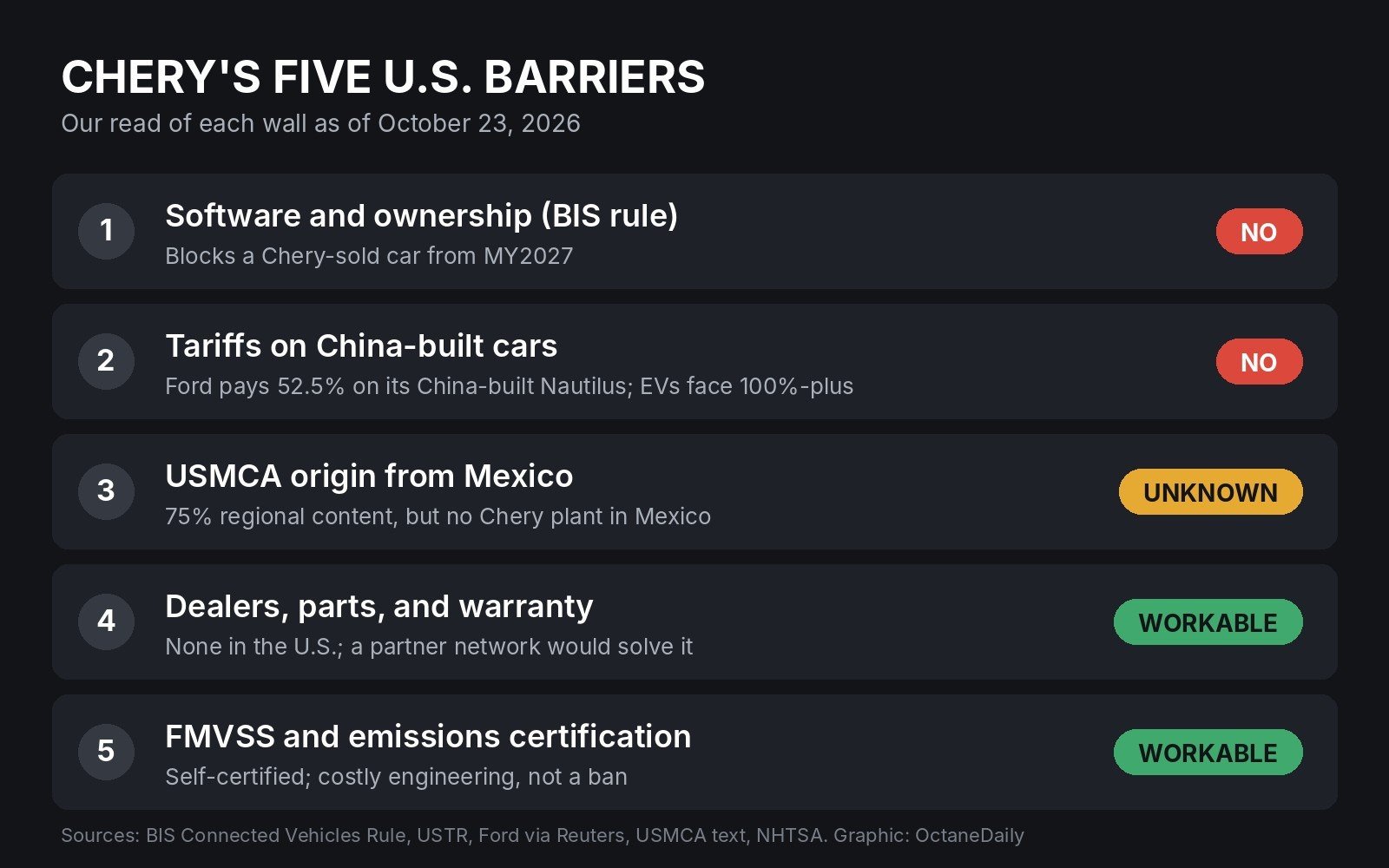
Barrier 3: Building in Mexico under USMCA. Verdict: unknown
Mexico is the obvious next step on paper. Chery already sells there, under the Chirey name. But a car only qualifies for duty-free USMCA treatment if 75 percent of its value is regional, its seven core parts (engine, transmission, body and chassis, axle, suspension, steering, and an advanced battery where applicable) originate in North America, 70 percent of its steel and aluminum is bought in the region, and 40 percent of its value comes from production at wages averaging at least $16 an hour, according to the USTR's 2026 report to Congress on USMCA autos. Even a qualifying car still pays the 25 percent Section 232 tariff on its non-U.S. content.
Chery has no Mexican plant to start from. The Chirey cars it sells today are imported, and Mexico raised its tariff on Chinese-built cars from 20 to 50 percent on January 1, 2026, Mexico News Daily reported. In April, Chirey said it was looking for local joint-venture partners to build cars in Mexico, but Mexico Business News listed Chery in early October among six Chinese automakers that have paused or delayed plant plans there. The trade deal itself is less certain than it was: at the July 1 joint review, the U.S. declined to renew USMCA in its current form, which triggers annual reviews until the parties agree to an extension, according to law firm White & Case.
None of that rules Mexico out. It means a Mexican factory would take years and carries policy risk that no one can price today. And it still wouldn't fix Barrier 1, because building locally doesn't change who owns the manufacturer.
Barrier 4: Dealers, parts, and warranty. Verdict: workable with a partner
Chery has no U.S. dealers, parts warehouses, or service network. A brand can build those, but slowly and expensively, and a buyer taking a chance on an unfamiliar badge wants to know someone will honor the warranty in year five. Polestar's U.S. retreat shows how fast that question becomes the main one: we covered how Polestar's record U.S. quarter came from clearing inventory in the market it's leaving.
This is the barrier a partnership fixes most neatly. An American automaker brings dealers, a parts operation, and a warranty backed by a company American buyers already know. The closest model is Stellantis and Leapmotor: Stellantis bought about a fifth of Leapmotor and controls 51 percent of a joint venture that builds and sells Leapmotor cars in Europe, with Canadian imports from China planned, Carscoops reports. That deal doesn't touch the U.S., which is telling in itself.
Barrier 5: Crash tests and certification. Verdict: workable
This is the lowest wall. In the U.S., automakers certify their own cars to the Federal Motor Vehicle Safety Standards; NHTSA doesn't approve vehicles before they go on sale, though it tests cars and enforces recalls afterward. Emissions certification with the EPA, and with California's regulators for that market, is a separate but familiar process.
The cost is engineering time and money, not permission. Cars designed for Europe and other markets would still need U.S.-specific work on lighting, bumpers, airbags, and occupant protection. Any automaker with Chery's export reach can do that. It's a budget line, not a ban.
The scorecard
Add it up and two of the five barriers are hard stops for a Chery-built, Chery-sold car: ownership under the Connected Vehicle Rule and the tariffs on China-built imports. A third, building in Mexico, is uncertain and slow. The two that are clearly solvable, dealers and certification, are the ones that matter least until the first two are solved.
The only route where all five look passable runs through an American company that sells the car, runs non-Chinese software, and builds it in North America. In my view, that wouldn't really be Chery entering the U.S. It would be Chery's engineering entering the U.S. under someone else's name. That may still be worth a lot to Chery. It's just a smaller thing than a "definitely" suggests.
What we don't know
- Who the partner would be. Zhang named none, and no U.S. automaker has said it is talking to Chery.
- Which models, when, and where they'd be built. Chery has given no timeline, no product, and no plant for the U.S.
- How BIS would treat a "cleaned" Chery design. The agency hasn't said whether a Chery-engineered car sold by a U.S. company, with Chinese software replaced, would pass. It decides specific authorizations case by case and doesn't publish them.
- Whether Chery has applied for anything. We've seen no statement that it has sought a BIS authorization, and we found no official Chery release on U.S. plans.
- Where USMCA's rules of origin land. The U.S. and Mexico are negotiating automotive rules as part of the review process, and nothing has been adopted.
Any official announcement from Chery or a U.S. partner, a new BIS decision on a Chinese-linked brand, or a change in the tariffs would move one of these walls. We'll update the checklist when one does.