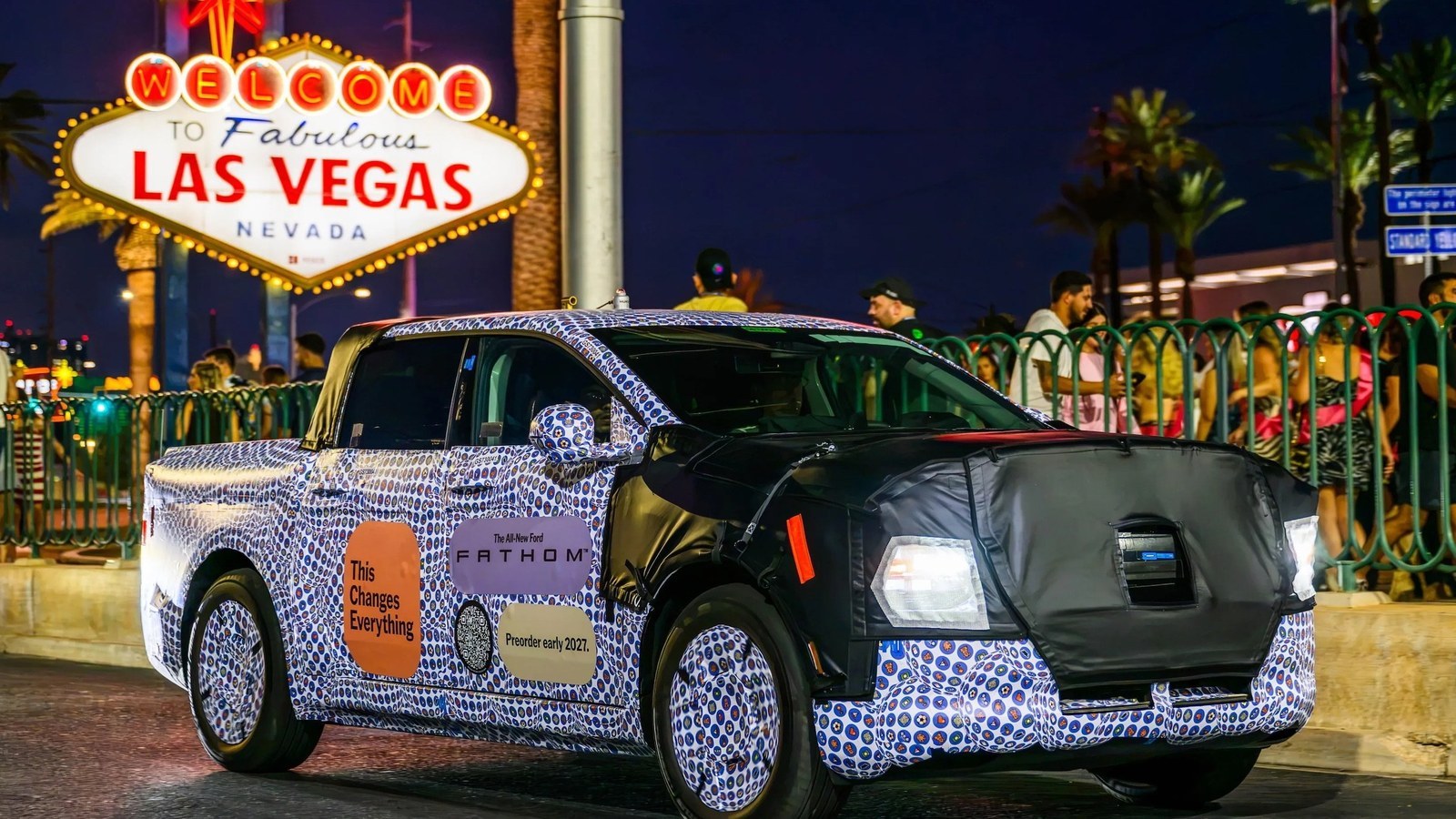
Why the Ford Fathom Uses an LFP Battery, and What It Changes for Owners
Ford is building the Fathom's cells itself in Marshall, Michigan. The cheaper chemistry holds the price under $30,000 and rewrites the usual charging advice.
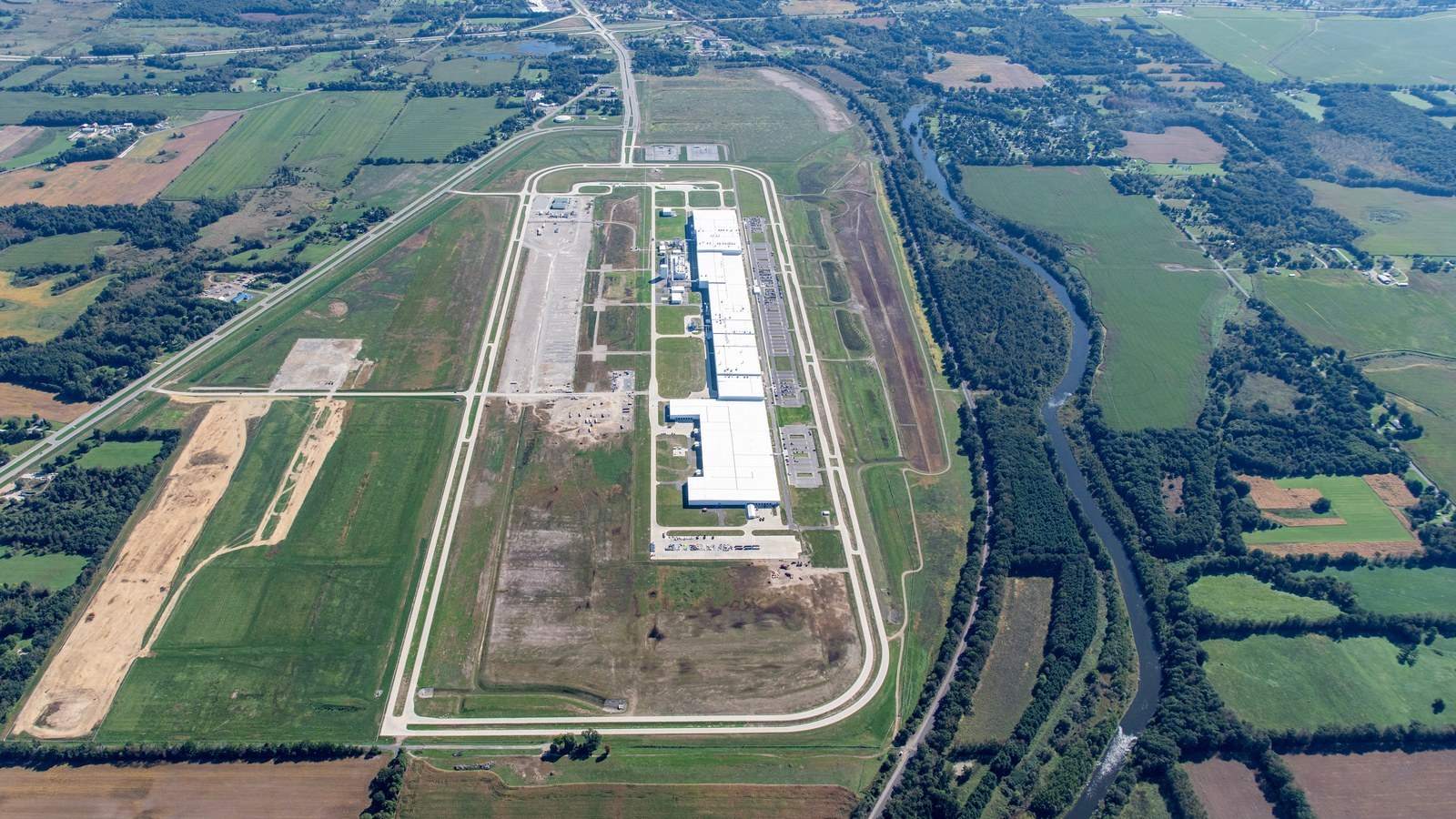
Ford's cheapest electric truck will run on a battery chemistry most American EVs don't use. On November 18, Ford said the first lithium iron phosphate (LFP) cells had come off the line at its plant in Marshall, Michigan, and were on their way to Louisville for Fathom prototypes.
For buyers, that choice explains the Fathom's $29,945 starting price. It also changes how the truck should be charged and how it may behave in winter. Here is what's confirmed, and what Ford hasn't said yet.
What Ford has confirmed about the Marshall plant
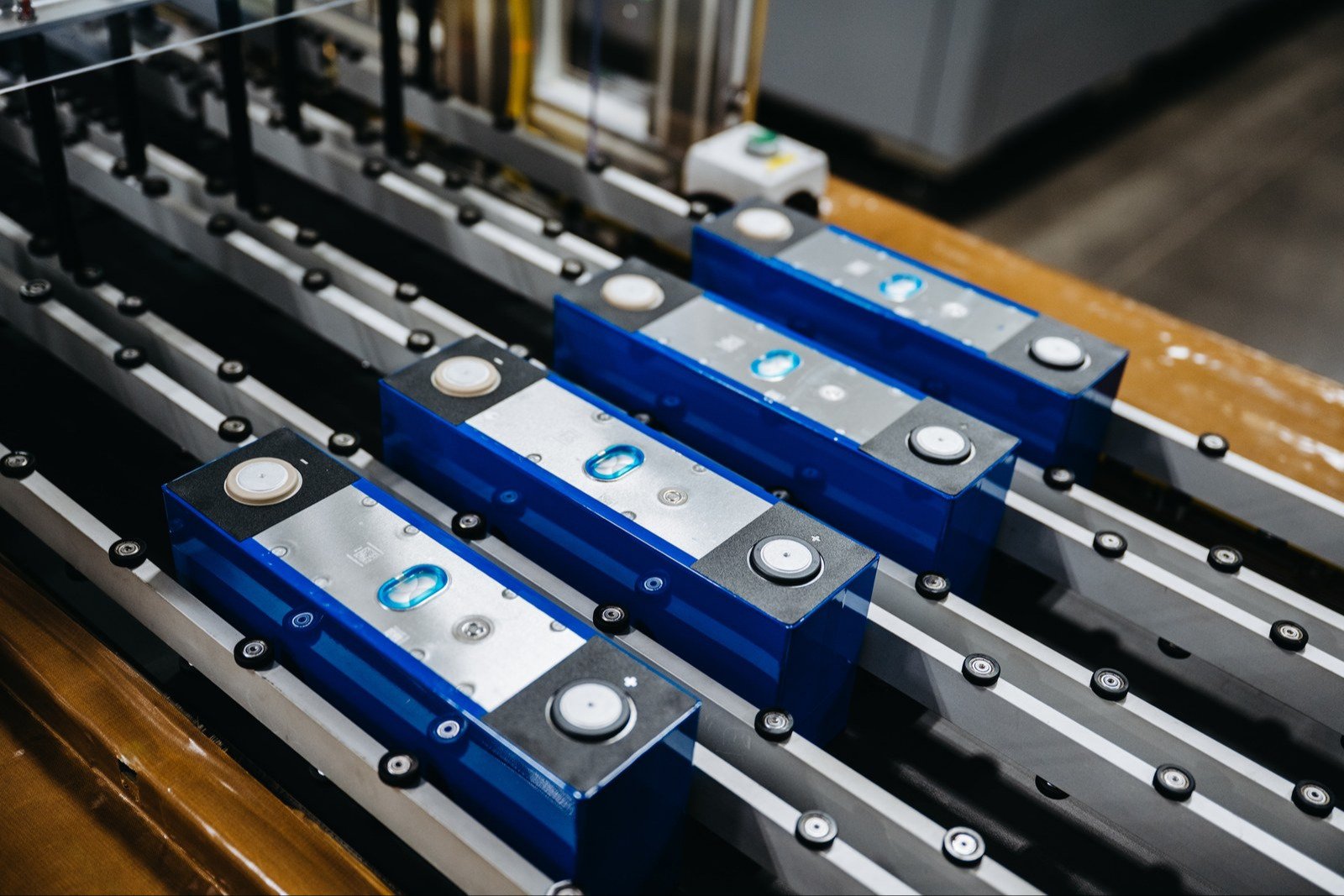
BlueOval Battery Park Michigan is owned and run by Ford and builds prismatic LFP cells with technology licensed from China's CATL. In its announcement, Ford said each line can turn out 40 cells a minute and that a pack plant on the same site should be running in 2027, before the truck launches.
The project is smaller than first planned. Ford announced it in February 2023 as a $3.5 billion, 35 GWh plant with 2,500 jobs, then cut it that November to about 20 GWh and 1,700 jobs. Ford executives now put the cost at $3 billion, according to MotorTrend, which toured the plant this month.
MotorTrend also reports that the Fathom's pack holds 108 cells and doubles as part of the truck's structure and as the cabin floor. Ford told the magazine the battery accounts for about 40% of an EV's cost, and that efficiency work let engineers remove enough cells to cut $1,300 from the price.
LFP vs. NMC: cheaper and tougher, but bulkier
Most EVs sold in the US use nickel manganese cobalt (NMC) cells. LFP swaps nickel and cobalt for iron and phosphate, which are cheaper.
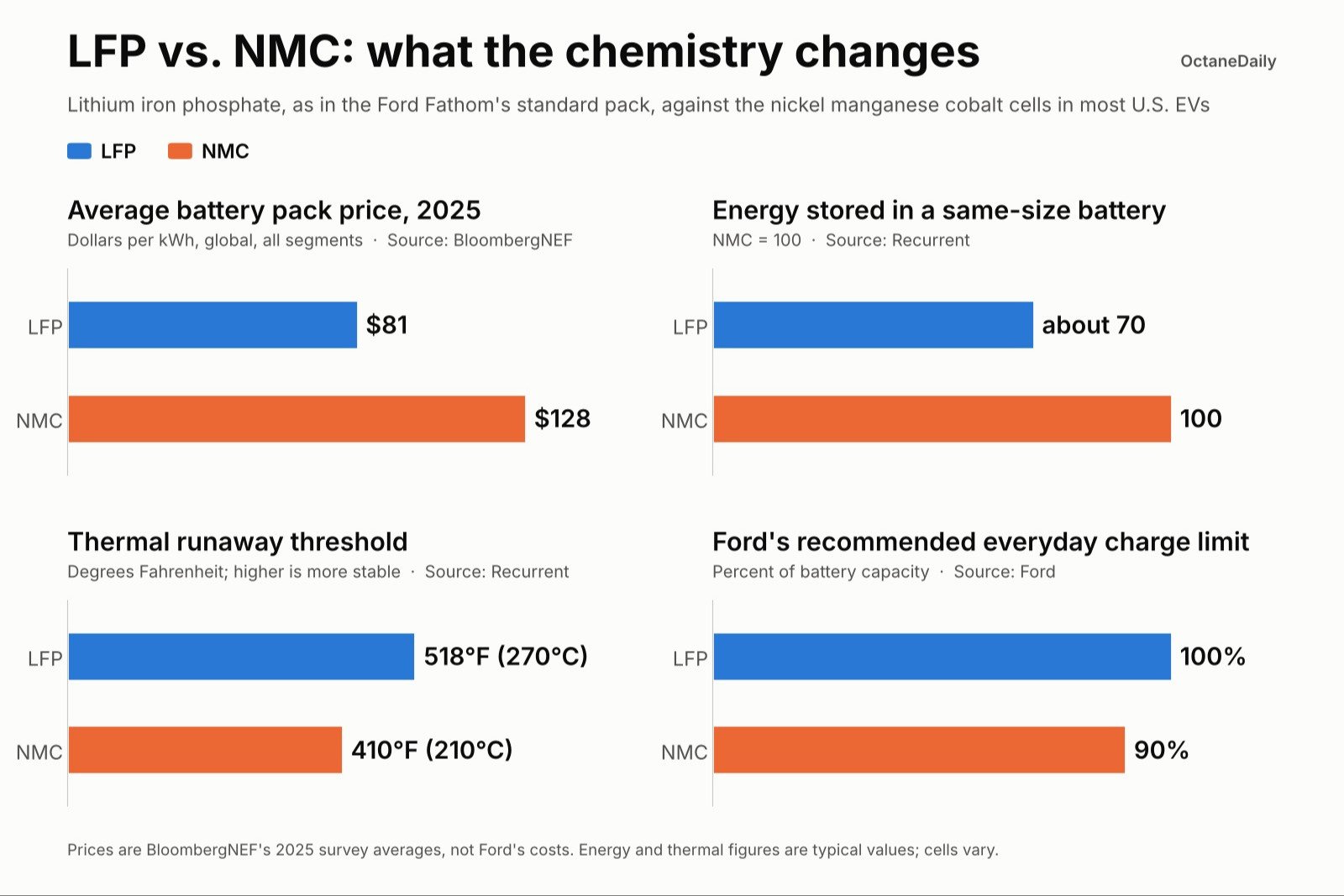
The gap is large. BloombergNEF's 2025 price survey put average LFP packs at $81 per kWh and NMC packs at $128. On a hypothetical 60 kWh pack, that's a difference of about $2,800. Those are global averages across all uses, not Ford's costs.
The trade-off is energy density. Battery analytics firm Recurrent says an LFP battery stores about 30% less energy than a nickel-based one of the same size, so matching the range takes a bigger, heavier pack.
In return, LFP is more stable. Recurrent puts its thermal runaway threshold at 518°F (270°C), against 410°F (210°C) for NMC, and cites studies showing two to four times the cycle life.
What it means for a Fathom owner
Range. Ford hasn't published a range or capacity for the standard LFP pack. Its roughly 300-mile target applies to a pricier extended-range version, and MotorTrend reports the pack can accept NMC cells for longer-range models. InsideEVs estimates the base pack at about 51 kWh, working from Ford's remark that it would be roughly 15% smaller than a BYD Atto 3's. That is an estimate, not a specification.
Charging to 100%. This is the habit that changes. For the LFP packs Ford put in standard-range Mustang Mach-Es from mid-2023, the company's support pages recommend a 100% charge limit, and a full charge at least once a month so the range estimate stays accurate. For its nickel-based packs, Ford recommends 90% for everyday use. The Fathom's owner's manual isn't out, so its guidance isn't confirmed, but the chemistry is the same.
Cold weather. Every EV loses range in winter. Recurrent's latest winter study of more than 59,000 vehicles found an average of 78% of ideal-weather range at 32°F and 69% at 20°F. The study doesn't split results by chemistry. Separately, Recurrent notes that LFP packs tend to lose a few more points of range than nickel-based ones in freezing weather and take longer to warm up for fast charging. No fleet data exists for the Fathom; our model-by-model winter ranking shows how widely results vary.
Longevity and home power. A longer cycle life suits a truck that Ford says will also send more than 10 kW to a house, since backup duty adds charge cycles. Ford hasn't published the Fathom's battery warranty.
Who else sells LFP in the US
- Chevrolet Bolt: a 65 kWh LFP pack and an EPA-estimated 262 miles. GM says the cells are imported for now. InsideEVs reports they come from CATL and that GM plans to build its own LFP cells in Tennessee.
- Slate Truck: a 65 kWh LFP pack with 205 miles of range. That is Slate's estimate, not an EPA rating, as our Slate guide explains.
- Ford Mustang Mach-E: standard-range versions switched to LFP midway through the 2023 model year.
- Rivian R2: a smaller-battery Standard trim is due in late 2027, but Rivian hasn't disclosed its chemistry.
The politics around the CATL license
CATL appears on the Pentagon's list of companies it says have ties to China's military, and the license has drawn repeated scrutiny in Washington.
The 2025 tax law kept the 45X manufacturing credit, worth $35 per kWh for cells, but added restrictions on "prohibited foreign entities," including limits on licensing deals. Ford said in July 2025 that Marshall remained on track to qualify.
In January 2026, Rep. John Moolenaar, chairman of the House Select Committee on China, wrote to CEO Jim Farley asking for the license terms and whether Ford intends to claim the credit. In September, Transportation Secretary Sean Duffy wrote that his department was "deeply alarmed" by the arrangement and urged Ford to cut ties with Chinese partners, Reuters reported. Ford rejected the letter as a bid for headlines.
Ford's position is that it owns and operates the plant, and company officials told InsideEVs its raw materials don't come from foreign entities of concern. How Marshall compares with other sites is in our US battery plant tracker.
What we don't know yet
- The standard pack's capacity and EPA range.
- DC fast-charging speed and whether a heat pump is standard.
- Ford's charging guidance and battery warranty for the Fathom.
- The price and chemistry of the extended-range pack.
Ford plans to open preorders in early 2027, and Farley has said the truck launches in the fourth quarter. Those answers should arrive with the full reveal.