BMW and VW Say Gas-Car Resale Values Are Slipping. Here's What It Does to Your Lease
BMW and Volkswagen told investors combustion residual values are softening while used EVs climb. Here is what that does to a lease payment, a trade-in, and the banks behind them.
Two of Europe's biggest automakers spent their third-quarter earnings calls on a subject that rarely makes the headlines: what their cars are worth when they come back off lease. BMW told analysts on Nov. 4 that residual values on its combustion models have slipped a little, while its electric cars have been holding value better since February. Volkswagen said a week earlier that residual-value risk at its finance arm had risen and that it was watching combustion cars in particular. Both companies make money twice on a leased car: once at the sale, and again when the lease ends and the car is sold on. The second sale is getting harder on the gas side.
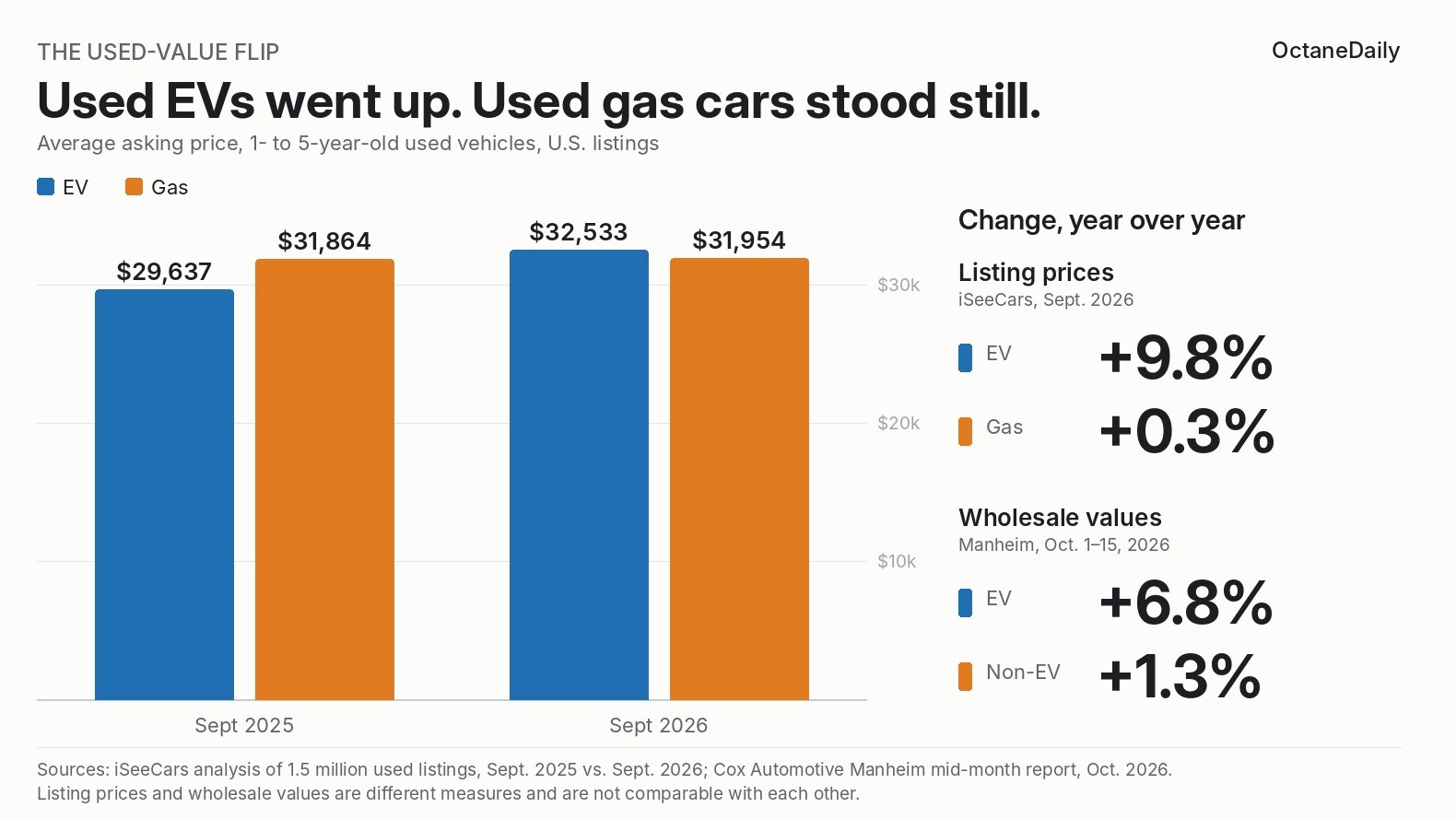
Set that against the U.S. used-car data and a pattern emerges. One- to five-year-old used EVs listed for $579 more than comparable gas cars in September, after being $2,227 cheaper a year earlier, according to iSeeCars. Wholesale EV values at Manheim auctions were up 6.8% year over year in the first half of October while everything else gained 1.3%, as we laid out in our Q4 used-car price and trade-in breakdown. The curve has not inverted for gas cars in America; BMW's own CFO said U.S. used prices are rising for both powertrains. But the gap between the two is closing from the wrong direction for anyone who priced a gas-car lease two or three years ago, and that includes the banks that wrote them.
What BMW and VW actually said
BMW's numbers first. Automotive EBIT fell 39.7% to €901 million in the quarter, and the segment's margin dropped to 3.4% from 5.2%, according to the company's quarterly statement. Group EBIT was down 29.7% to €1.59 billion, and BMW now expects a full-year automotive margin between minus 0.5% and plus 0.5%, cut from 1% to 3%. The reasons are mostly elsewhere, as we covered in our report on BMW's Q3 results and second guidance cut: a one-quarter collapse in Chinese demand, tariffs, and a restructuring charge landing in the fourth quarter.
The residual-value story sits in the Financial Services segment. Pre-tax profit there was flat at €639 million in the quarter, and BMW says the larger portfolio and higher interest income were partly offset by lower revenue from selling returned lease vehicles. Its outlook says the downward price trend in used-car markets is expected to continue, and with it a further year-over-year decline in remarketing revenue. Nine-month Financial Services profit is down 10.3%, mainly because of a provision for a U.K. motor-finance compensation scheme, not residuals. Other operating expenses in the segment tripled to €399 million over nine months on additions to provisions, but the statement does not say how much of that is residual-value exposure.
On the call, CFO Walter Mertl was asked directly about combustion residuals, which the analyst asking said Audi had flagged a week earlier. According to the transcript, he acknowledged a slight deterioration in ICE residual values and said the company had expected it. He added that EV lease returns are performing better than six months ago, and that the trend varies by market, with the U.K. and Germany moving differently. His U.S. comment is the one that matters for American readers: BMW sees a positive used-car price trend there across both ICE and EVs.
Volkswagen's version is blunter because its balance sheet is in worse shape. The group booked €7.8 billion of special charges in the third quarter, most of it at Porsche, as we covered in VW's $6.5 billion Q3 loss and the end of the U.S. ID.4. Against that, Volkswagen Financial Services posted a nine-month operating profit of €3.0 billion, 3% below a year earlier, which CFO Arno Antlitz described as robust despite higher residual-value risks. He said that risk had grown particularly as the European market shifts toward battery-electric cars, and that the division's full-year outlook had been adjusted to more than €3.5 billion with that caution in mind. Asked about combustion cars specifically, he said, "We see some risk on the combustion engine cars," and added that in VW's view it remains well managed.
Neither company published a dollar or euro figure for combustion residual-value losses. Both said the risk is managed. Both also cut or trimmed guidance in the same breath.
How a residual value becomes a monthly payment
A lease is a bet on depreciation. The bank sets a residual value, usually expressed as a percentage of MSRP, that it expects the car to be worth at the end of the term. The customer pays the difference between the purchase price and that residual, plus interest and fees, spread over the months. The higher the residual, the smaller the slice the customer covers each month. When used values come in below the residual at lease end, the bank eats the gap. When they come in above it, the bank books a gain, which is the "revenue from sold returned lease vehicles" that BMW says is shrinking.
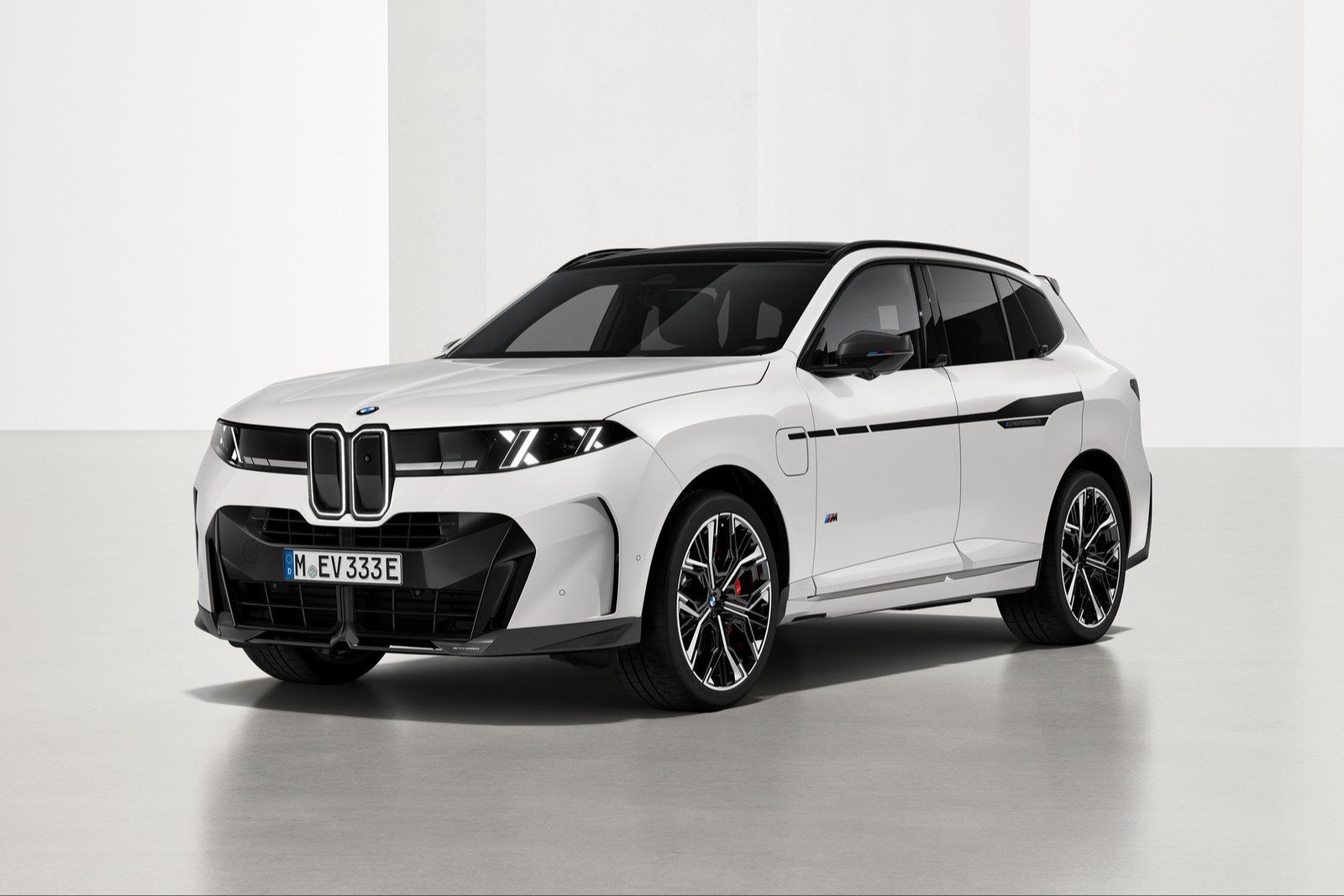
Take BMW's current national offer on a 2026 X3 30 xDrive: $549 a month for 39 months with $5,299 due at signing, listed on bmwusa.com through Nov. 30. The X3 30 xDrive carries a $51,300 MSRP plus $1,350 destination, or $52,650. BMW Financial Services does not publish the residual percentage behind that number, so here is the arithmetic in the abstract. Every three points of residual on a $52,650 sticker is $1,580. Over 39 months, that is about $40 a month before interest. A bank that sees combustion resale values softening has two choices: lower the residual and let the payment rise, or hold the residual and subsidize the difference out of the marketing budget. In the second case the payment looks unchanged, but the automaker is paying for it somewhere, which is exactly the pressure BMW and VW described.
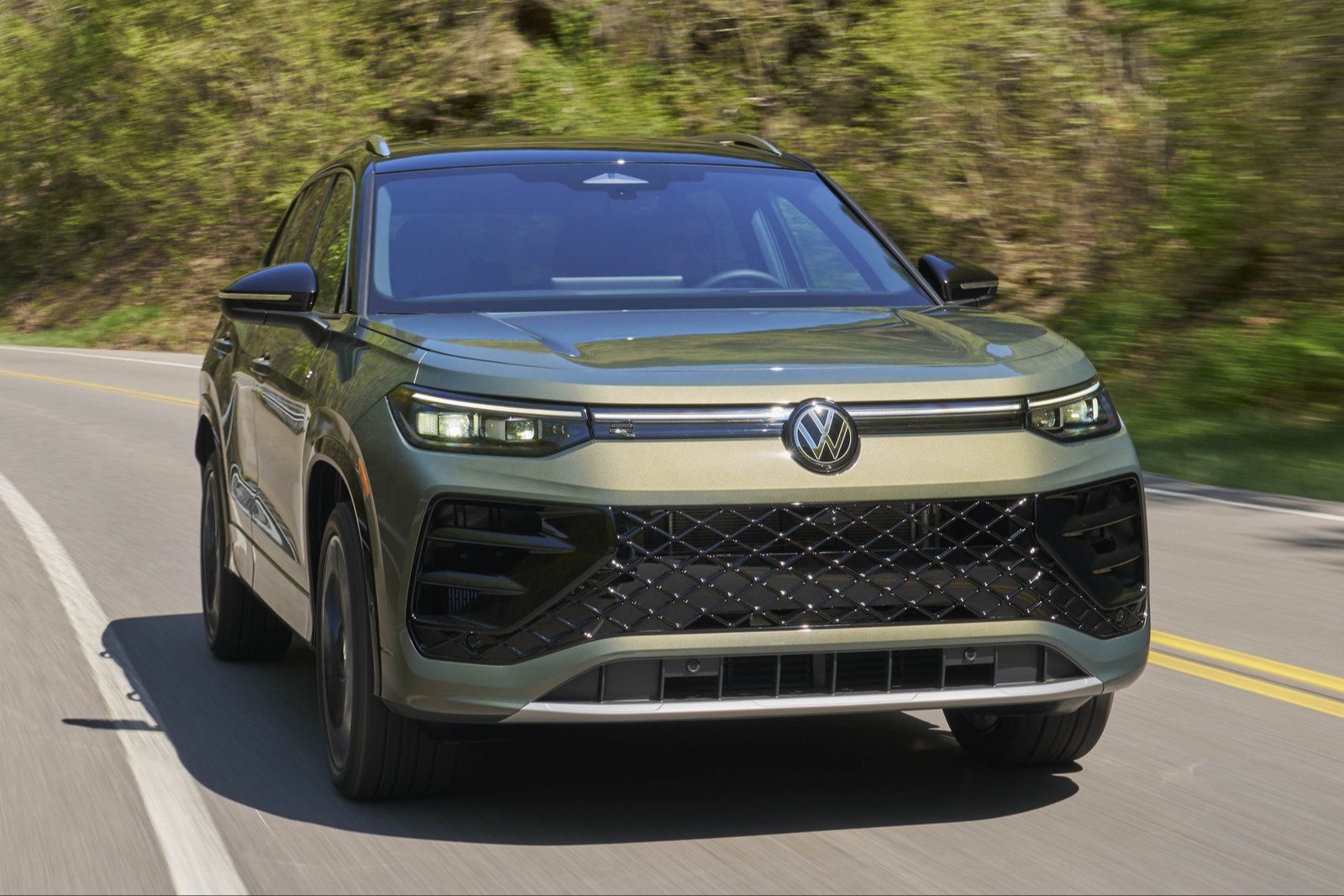
Volkswagen's math runs the same way at a lower price point. The current vw.com offer on a 2026 Tiguan SE is $349 a month for 36 months with $3,999 at signing, through Nov. 30, per Carfax's roundup of the national offers. On a sticker of roughly $33,600 with destination, three residual points are about $1,000, or $28 a month over the term. That is not a dramatic number on its own. It becomes one across a portfolio of hundreds of thousands of contracts, and BMW's finance arm wrote 426,575 new lease and financing contracts in the quarter alone.
The U.S. numbers behind the flip
The retail side is the clearest. iSeeCars' September analysis of 1.5 million listings put the average one- to five-year-old used EV at $32,533, up 9.8%, or $2,896, in a year. Gas cars of the same age averaged $31,954, up 0.3%. Used EVs also sold in 41.9 days against 54.8 for gas cars, a reversal from a year earlier. We covered the model-level winners and losers in our report on the used EV discount disappearing; three Teslas led the gainers, and big electric trucks sat at the bottom.
The wholesale side points the same way with smaller numbers. Cox Automotive's Manheim index had EVs up 6.8% year over year in the first half of October and non-EVs up 1.3%. In September the split was EV plus 4.3% against minus 1.6% for everything else. Used EVs were a record 4.9% of Manheim transactions in the third quarter. The full October reading is due Nov. 6, and Cox has already warned that lease returns are rising from about 190,000 a month in the first half of 2026 to about 220,000 in the second, with EVs' share of that flow expected to approach 19% by next summer. More EVs coming back should eventually cap their used prices; more gas cars coming back at the same time does the opposite for combustion residuals.
Fuel is doing a lot of the sorting. Regular gasoline averaged $4.17 a gallon on Nov. 3 and diesel $6.29 by AAA's count, as we broke down in our look at the diesel-gas price gap. Cox ties the strength in compact cars and the weakness in diesels and big trucks directly to the pump, and iSeeCars credits seven months of high fuel prices for the EV demand it sees. A reader should hold one caveat in mind: the EV comparison is flattered by the base. Used EVs were cheap a year ago because the federal credit had just ended and new-EV prices were being cut, so a 9.8% rise partly undoes a prior collapse. It is a recovery, not proof that an EV is now the better buy; that depends on the specific car, the loan rate, and how each firm measures prices, and no survey here tracks transaction prices.
Who pays, and who benefits
Combustion lessees on new contracts are the most exposed. If a bank marks residuals down, the payment rises, and if it does not, the automaker has to find incentive money to cover the difference, which it is less likely to do in a quarter when it has just cut guidance. Our roundup of who is cutting prices and who isn't shows how narrow those cuts have been.
Combustion owners heading to trade-in are in a more mixed spot in America than in Europe. Wholesale values for non-EVs were still up slightly in early October, so the average gas car has not lost ground against a year ago. The exceptions are diesels and large trucks, where Cox reports falling demand and values. Anyone deep into a long loan on one of those should run the equity math before assuming a trade-in will cover the balance; our 84-month loan breakdown shows how slowly those balances fall.
EV lessees are the quiet winners, at least for now. Rising used EV values let banks raise residuals, and higher residuals mean lower payments or the same payment with fewer incentive dollars behind it. That is why Mertl could tell analysts that EV returners are doing better than six months ago in the same quarter he conceded ICE softness. Whether the EV advantage survives a doubling of EV lease returns next year is the open question.
Certified pre-owned operations and dealers holding late-model EV inventory also come out ahead, because the cars they took in at last year's prices are worth more today. Dealers who stocked up on diesels and big pickups do not.
What we don't know
The internal residual tables at BMW Financial Services, VW Credit, and every other captive lender are not public, and neither company disclosed a residual-value loss figure for the quarter. We also could not find a published 2026 lease-penetration rate for BMW or Volkswagen in the United States. BMW's global Financial Services penetration was 55.4% in the quarter, but that counts financing as well as leasing, covers every market, and now includes young used cars for the first time, which BMW says adds about three points. Treat any claim about "how many BMWs are leased in America" that lacks a source accordingly.
What is on the record is enough to act on. Two automakers that write a large share of their own leases have said gas-car residuals are softening and that their finance arms are absorbing it. The U.S. used-car data say the softening is relative, not absolute, and that EVs are the ones moving. If you are about to lease a gas car, ask the dealer for the residual percentage and the money factor, not just the payment; if you are returning an EV, check what the buyout price is against current listings before you hand back the keys. The arithmetic is the same one the CFOs are doing, just with one car instead of a portfolio.