After the Midterms: What Each Branch Controls on Tariffs, EV Credits and Fuel Rules
Democrats will control both chambers from January 3. Tariffs, EV credits and fuel rules each change through a different procedure, and most still run into a presidential veto.
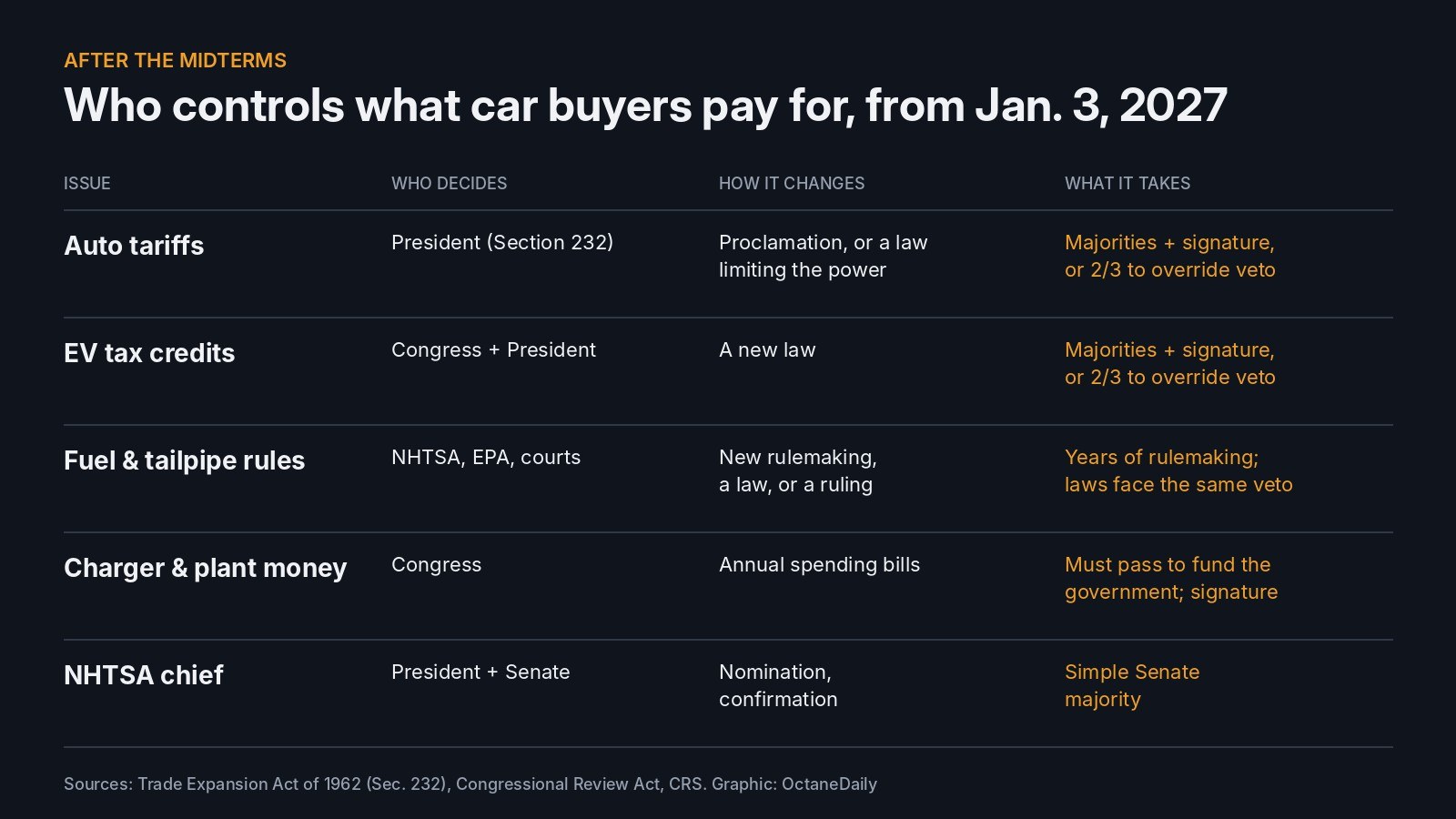
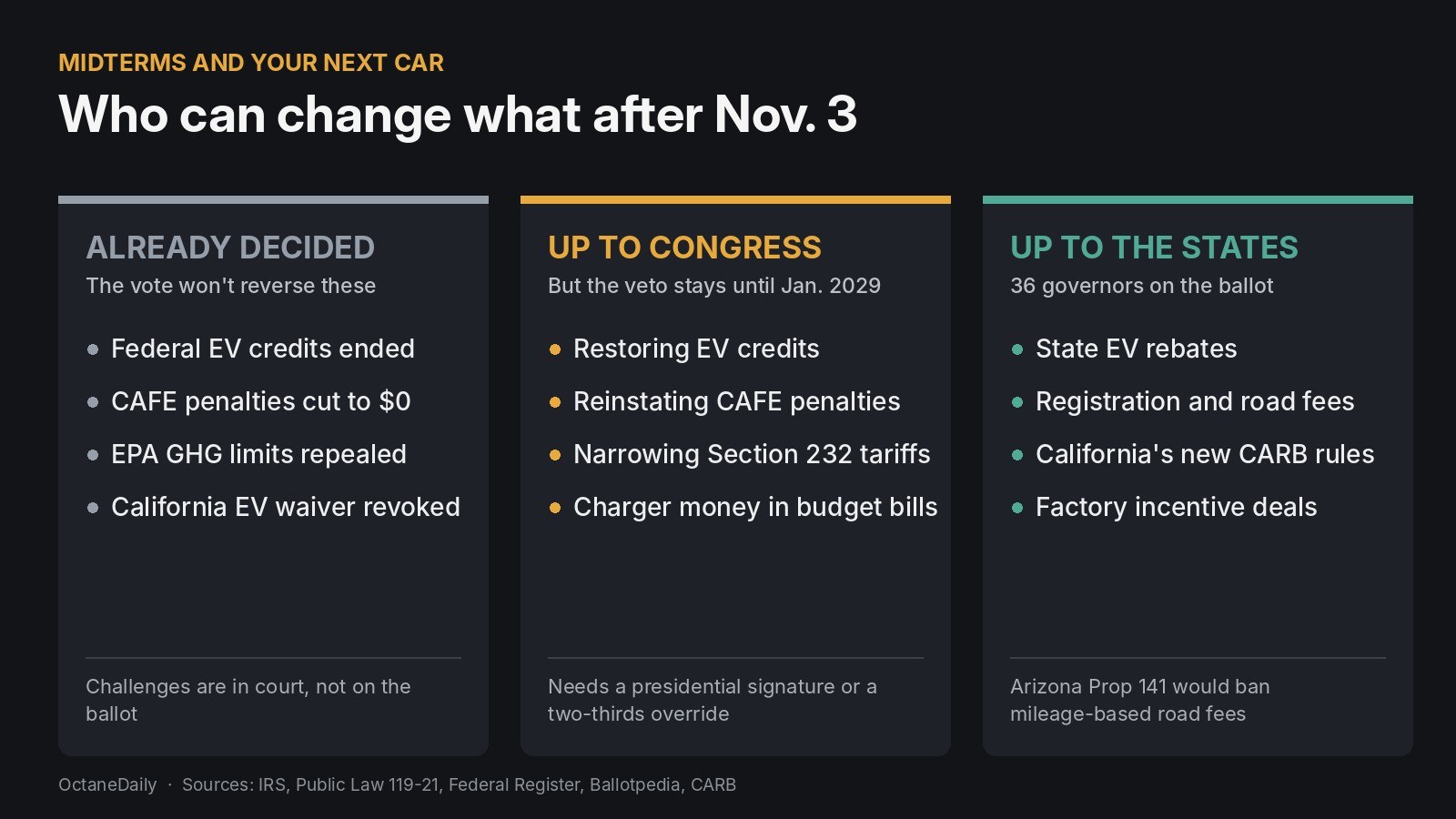
Tuesday's midterms changed who runs both chambers of Congress. The Associated Press called the Senate for Democrats late on election night and the House early Wednesday. Before the vote, we laid out what the midterms could and couldn't change about your next car. This is the follow-up: with the results in, what can each part of government actually do on tariffs, EV credits and fuel rules, and through what procedure.
We are not forecasting what the new majorities will pass. We are describing the rules they will work under.
Where the count stands
As of Wednesday's tallies, Democrats had won at least 54 Senate seats, with the races in Mississippi and Alaska still too close to call. In the House, the AP reported that Democrats had passed the 218 seats needed for a majority, while dozens of individual House races remained uncalled. We will update this paragraph when every race is decided.
None of this takes effect yet. The current Congress keeps working through the end of its term, and the new one is sworn in on January 3, 2027. Until then, the House and Senate majorities that exist today are the ones voting.
The rule that frames everything: the veto
A new law needs a majority in both chambers and the president's signature. If the president vetoes a bill, Congress can still enact it, but only with two-thirds of the members voting in each chamber. The president's term runs to January 2029, so that math applies to every item below that requires a new law.
The Senate adds one more layer. Most legislation there needs 60 votes to end debate, while budget reconciliation bills and resolutions under the Congressional Review Act can pass with a simple majority. Reconciliation is how the current EV-credit and CAFE-penalty changes became law in 2025.
1. Tariffs: set by the president, limited only by a new law
The car tariffs rest on Section 232 of the Trade Expansion Act of 1962, which lets the president restrict imports after the Commerce Department finds they threaten national security. Most imported vehicles pay 25%, while cars from Japan, the European Union and South Korea pay 15% under trade deals, according to a Congressional Research Service summary. The president can change those rates by proclamation without a vote in Congress.
Congress can narrow that power only by passing a law, which would face the veto math above. Bills to do that have been introduced in the current Congress, including S. 1272 and H.R. 2665, but bills that are not enacted expire when a Congress ends. Any such measure would have to be reintroduced after January 3. Congress also has a consulting role in the 2026 review of the USMCA trade agreement with Canada and Mexico.
For buyers, that means today's rates stay in place unless the president changes them or a law is enacted. Automakers are still planning around them, as Mercedes showed this week when it pushed U.S. production of the GLC to 2030.
2. EV tax credits: gone by law, back only by law
The $7,500 new-EV credit (Section 30D) and the used-EV credit of up to $4,000 (25E) ended for vehicles acquired after September 30, 2025, under Public Law 119-21. We tracked the effect in our look at the first year without the credit. No agency can bring them back. A new credit would need a new law, signed by the president or passed over a veto.
As of today, no bill reviving the credits has been introduced in the incoming Congress, because it has not convened yet. If one is filed after January 3, we will report it with its bill number.
3. Fuel and tailpipe rules: agencies and courts first
Three separate changes are in effect, and each one is undone a different way.
- CAFE penalties. The 2025 law cut the fine for missing federal fuel-economy targets to zero. Only another law can restore it. The targets themselves come from NHTSA, which finalized a lower standard in September, as covered in our guide to the new CAFE rules. Changing those targets again would take a new rulemaking, a process that typically takes years.
- EPA greenhouse-gas limits. EPA's rescission of the vehicle standards was published in the Federal Register on February 18, 2026. Reversing it would take a new EPA rulemaking, a court ruling against it, or a new law. Legal challenges are pending.
- California's waiver. Congress used the Congressional Review Act to cancel the waiver behind California's Advanced Clean Cars II rules, signed into law on June 12, 2025. California and 10 other states sued, in a case filed in federal court in Northern California that is still pending.
Why can't the new Congress simply use the Congressional Review Act in reverse? The law gives Congress a limited window, measured in days of session, after a rule is submitted. Rules issued near the end of a session get a second window in the next one, but a rule published in February 2026 falls outside it. A disapproval resolution also needs the president's signature, so it faces the same veto.
The act also cuts the other way. Once Congress disapproves a rule, an agency cannot issue it again in "substantially the same form" without new authority from Congress. That provision is one reason the California waiver dispute is in the courts rather than back at EPA.
4. Money: the part Congress controls directly
Spending is different, because it has to pass. The government is currently funded through December 11 under a stopgap law, so the outgoing Congress must act again before the new members arrive, and the new Congress will write the next full-year bills.
Those bills decide how much is available for programs such as the federal fast-charger fund, from which Congress rescinded about $503 million in a January 2026 budget law, according to Atlas Public Policy. They also fund the Energy Department's factory grants, like the $500 million award behind GM's hybrid plans at Lansing Delta Township. A spending bill still needs the president's signature, and if no funding law is in place when the current one expires, agency funding lapses.
Committee chairs also change with the majority. That gives the new leadership control over hearings, investigations and requests for documents from agencies such as NHTSA and EPA. Hearings and investigations do not change any rule on their own.
The Senate also confirms the head of NHTSA by simple majority. The current administrator, Jonathan Morrison, was confirmed in September 2025, so the question would arise only if the post opens or a new nominee is named.
5. The states: three new governors
Michigan, Georgia and California each elected a new governor on Tuesday. Based on race calls, Jocelyn Benson won in Michigan, Keisha Lance Bottoms in Georgia and Xavier Becerra in California. Official certification is still to come in each state.
Governors and legislatures control state EV rebates, registration and road-use fees, and the incentive packages offered to factories. In California, the Air Resources Board is writing replacement light-duty emissions rules without the federal waiver, and the next governor appoints its members.
What changes for you before January
Nothing. Tariff rates, the end of the EV credits, CAFE rules and state rebates are exactly where they were on Monday. Sticker prices, incentives and lease deals this month are set by automakers and dealers, not by the election result.
What we don't know yet
- The final House and Senate seat counts, until every race is called.
- Which bills on tariffs, credits or charging money will be introduced after January 3. We will cover each one by its bill number, not by expectation.
- How the pending lawsuits over the EPA rescission and the California waiver will be decided.