New York's Car Subscription Ban: What's Illegal, What's Exempt, and Who It Hits
The statute names heated seats, then exempts navigation, Wi-Fi, telematics, and driver assistance. We checked it against what BMW, Toyota, GM, Ford, Tesla, and Rivian charge today.
New York has outlawed subscriptions for car features that run on hardware already in the vehicle and cost the automaker nothing to keep switched on. Gov. Kathy Hochul signed the bill, S.9348-A/A.10411-A, on November 23, according to her office.
Heated seats are the one example written into the statute. The exemption list is longer, and it covers most of what drivers pay for monthly today, from hands-free highway driving to extras such as Rivian's subscription-only pet cam. Below is what the text says and how it lines up with subscriptions on sale right now.
What the law bans
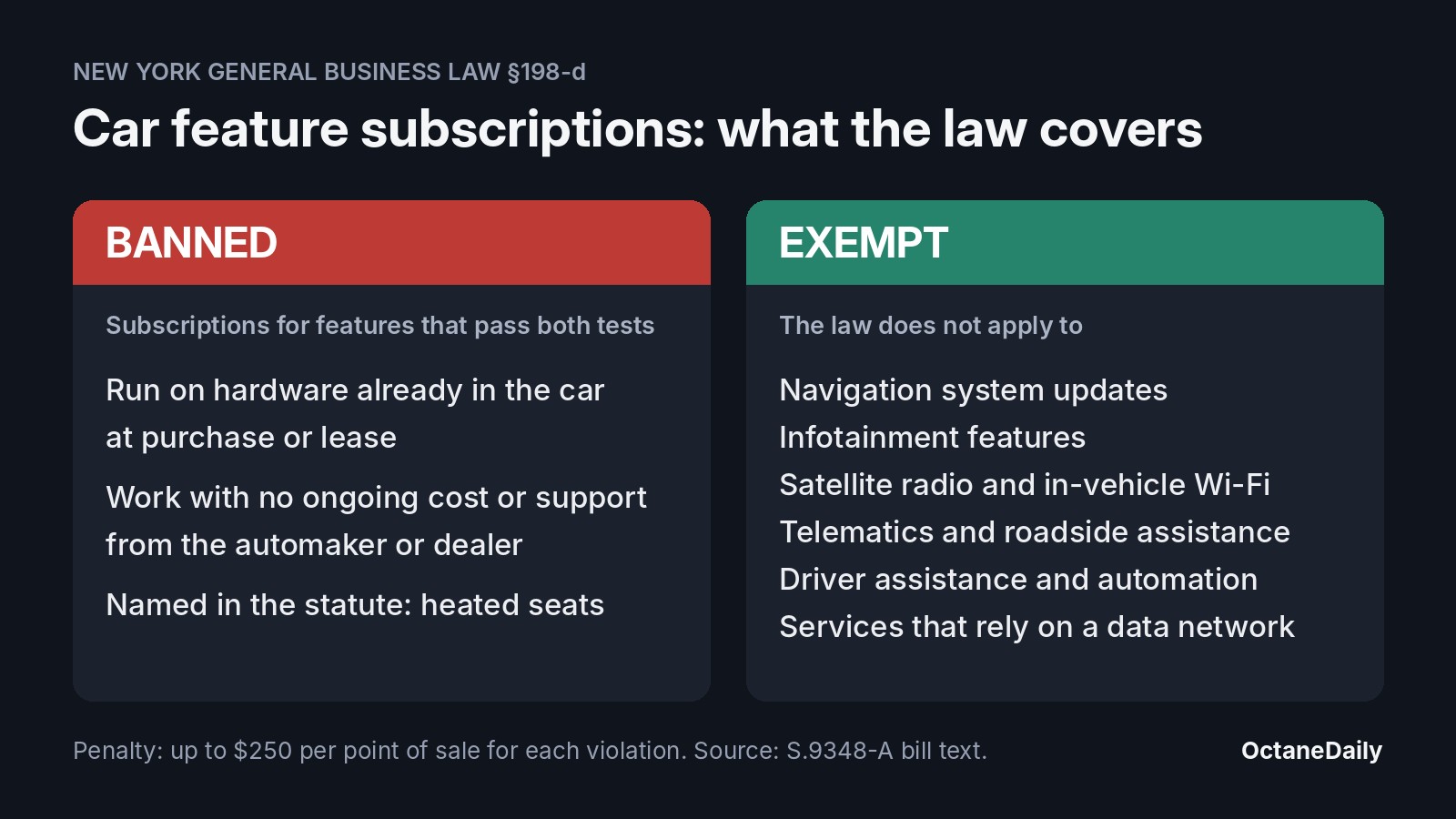
The act adds Section 198-d, "Vehicle feature subscriptions," to New York's General Business Law. Under the bill text, no manufacturer, dealer, or agent of either may offer a consumer a subscription service for a motor vehicle feature that meets two tests at once:
- it uses components and hardware already installed on the vehicle when the consumer bought or leased it; and
- once activated, it would work without ongoing cost to, or support by, the dealer, the manufacturer, or a third-party provider.
A "motor vehicle feature" is any convenience or safety function typically sold as an upgrade at purchase or lease. A "subscription service" is anything billed on a recurring basis, whether weekly, monthly, or annually. Loan and lease payments on the car itself do not count.
One detail matters for the table below. The operative paragraph names subscription services only. It does not mention a one-time payment to unlock a feature for good.
What is exempt
Paragraph (c)(1) says the section does not apply to:
- navigation system updates
- infotainment features
- satellite radio
- in-vehicle Wi-Fi
- telematics services
- roadside assistance
- software-dependent driver assistance or driver automation features
- connected services that rely on cellular or other data networks to keep working
A second carve-out, (c)(2), confirms that automakers and dealers can keep delivering software updates. They cannot charge for an update that fixes a safety defect covered by federal recall rules.
The governor's announcement lists enhanced navigation and hands-free driving among the built-in features the law is aimed at. The statute's own text excludes navigation updates and software-dependent driver assistance. How regulators will read those two together is not settled.
Which subscriptions it appears to touch
We checked the offers listed on automakers' own U.S. sites on November 25 against the two tests and the exemption list. The right-hand column is our reading of the text, not a legal finding. No regulator or court has applied the law yet.
| Brand | Subscription | Listed price | Status under §198-d |
|---|---|---|---|
| BMW | Remote Engine Start, Adaptive M Suspension (ConnectedDrive Upgrades) | Not shown publicly; set per vehicle in the ConnectedDrive Store | Unclear. Both run on installed hardware, so a recurring term appears to fall under the ban; a one-time purchase is not addressed |
| BMW | Driving Assistant Plus, Parking Assistant Professional | Not shown publicly | Appears exempt (driver assistance) |
| BMW | BMW Digital Premium | Monthly or annual; price not shown publicly | Unclear. Mostly infotainment, but the bundle also includes Drive Recorder and Welcome Light Animation |
| Toyota | Remote Connect | $8 per month | Unclear. App commands rely on a data network and appear exempt; Toyota also ties key-fob remote start to an active trial or plan |
| Toyota | Premium (Drive Connect, streaming); Wi-Fi Connect | $15 per month; $25 per month | Appears exempt (navigation, infotainment, Wi-Fi) |
| GM | Super Cruise plan | $39.99 per month after the included three years | Appears exempt (driver assistance) |
| GM | OnStar Connect, Connect Plus, Protect | $14.99, $24.99, $29.99 per month | Appears exempt (infotainment, Wi-Fi, telematics, roadside assistance) |
| Ford | BlueCruise | $49.99 per month or $495 per year | Appears exempt (driver assistance) |
| Tesla | FSD (Supervised) | $99 per month | Appears exempt (driver assistance) |
| Rivian | Connect+ | $14.99 per month or $149.99 per year | Appears exempt (Wi-Fi, streaming, connected services) |
| Audi | Themes pass | $39.99 per year | Appears exempt (infotainment) |
Two patterns stand out. First, every hands-free system we checked sits behind the driver-assistance exemption, including GM's Super Cruise, which the company plans to fold into a single OnStar app in 2027. Cosmetic software such as Audi's annual wallpaper pass falls on the same side of the line as an infotainment feature.
Second, the open questions cluster around remote start. Sen. James Skoufis, the Senate sponsor, named remote start and heated seats in the governor's release as features drivers should be able to use without a monthly fee. App-based remote start travels over a cellular network, which the law exempts. A key fob does not.
Penalties and enforcement
A violator faces a civil penalty of up to $250 "per point of sale for each violation." The statute does not define a point of sale or say whether each car, each customer, or each billing cycle counts as a separate violation.
The Department of State may write rules to carry out and enforce the section. None have been published.
When it takes effect
The governor's office gives the effective date as February 27, 2027. The bill itself says it takes effect on the 90th day after becoming law, and 90 days from a November 23 signing is February 21. We have not seen an explanation for the gap. Either way, the ban arrives in late February.
What it means if you buy or lease in New York
- Ask the dealer which features on the car need an active plan after the trial ends, and get the answer in writing.
- Separate hardware features (seat heaters, suspension modes, remote start by fob) from connected ones (app commands, Wi-Fi, streaming, hands-free driving). Only the first group is covered.
- Expect to keep paying for hands-free systems. They are exempt, a line Mercedes-Benz buyers will also meet as its driver-assistance lineup changes.
- If you already pay for a feature that seems to meet both tests, keep the billing records. Whether the law reaches existing plans is one of the open questions below.
What we don't know yet
- How the state will count violations, and what "per point of sale" means in practice.
- Whether the law reaches cars sold before the effective date. The text bars offering a subscription to a consumer and has no clause about vehicles already on the road.
- Whether one-time unlock fees are covered. The announcement mentions post-purchase fees; the operative paragraph mentions subscriptions.
- How automakers will respond. We found no public statement from the brands in the table or from the Alliance for Automotive Innovation as of November 25.
- Whether other states follow. A New Jersey bill with similar wording, S568, has been in committee since January.
What's next
Watch for Department of State rules before late February, the first enforcement action, and any change to the U.S. subscription menus above. We will update this explainer as each lands.