Millions of Recalled Cars Never Get Fixed. Here's What NHTSA Is Trying to Change
Recall completion falls from 68% on a 3-year-old car to 18% at 15 years. NHTSA's Recalls Next meeting weighed DMV notices, OTA fixes, and e-mail letters; only one has funding.
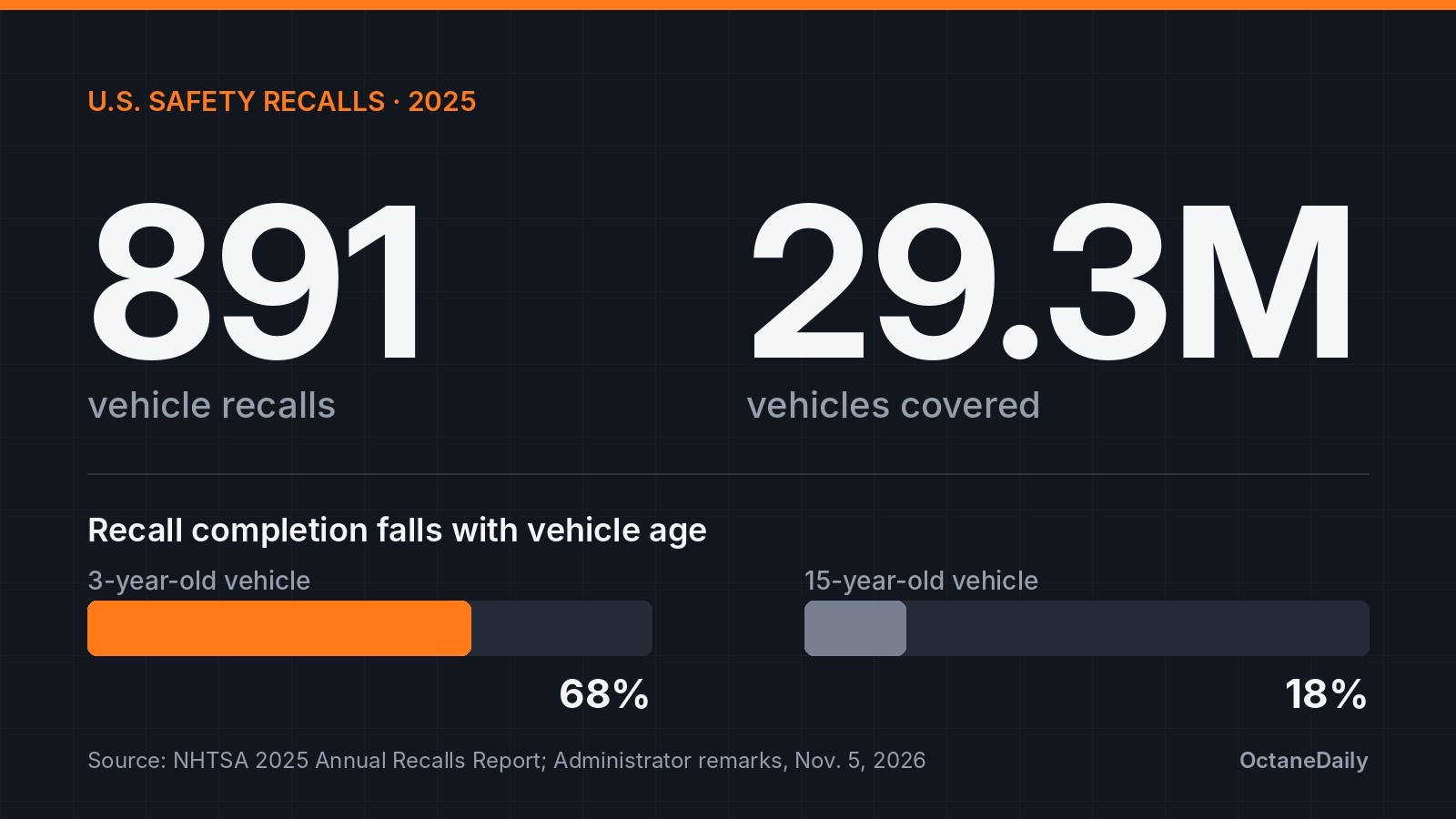
U.S. automakers recalled 29.3 million vehicles in 891 campaigns in 2025, by NHTSA's count, and a large share of those cars will never see a shop. On November 5, the agency brought automakers, dealers, state DMVs, and researchers to Transportation Department headquarters for a daylong meeting called "Recalls Next" to work out why repairs stall.
It produced no rule and no deadline for one. It did produce a clearer picture of where repairs get lost, a small pot of money for states, and a docket open until December 5. Here is what was on the table and which pieces are likely to reach you. For the baseline, start with why the raw recall count says little about a car.
How big the gap is
The headline stat is how fast completion collapses with age. In his opening remarks, Administrator Jonathan Morrison said a new campaign on a 3-year-old vehicle averages about 68% completion, while the same campaign on a 15-year-old vehicle averages 18%. NHTSA's published text of the remarks is the only official record of the day; the meeting was not streamed, and no summary of the panels has been released.
The agency's 2025 annual recalls report puts the average completion rate for vehicle recalls at 73.4% in 2024, up from 67.0% a year earlier. The April 2026 report to Congress that set up this meeting calls vehicle age "the predominant factor" and gives the weighted average for 2012–2022 campaigns as 65.8%.

Why used cars are where recalls go to die
Three things break down once a car leaves its first owner.
The letter never arrives. Manufacturers mail notices to the address on the registration, and one automaker's review cited in the report found roughly 45% of owners with open recalls may never have received one. A NHTSA pilot found nearly half of the registration data it worked with was inaccurate. In older campaigns, up to 30% of unrepaired vehicles change owner or address every year, so each round of letters chases a moving target.
The letter arrives and gets ignored. About four in ten owners who skip a repair cite inconvenience as the main reason: the fix is free, but the trip to the dealer costs a workday, a ride, or childcare. In the Takata airbag campaign, Morrison said, plain-language risk messaging plus mobile repair, loaners, and free towing lifted repair rates, while some owners treated notices as junk mail or scams.
The law stops at the dealer lot. The Safety Act bars selling a new vehicle with an open recall, but there is no federal ban on selling a used one. Independent lots and private sellers have no obligation to fix anything first; rental fleets do.
The fixes NHTSA actually put on the table
Four approaches were on the agenda. They are not equally close to reaching you.
State DMV notices. This is the one with money behind it. Morrison announced $1.5 million in grants for states to flag open recalls at registration or renewal, with applications due February 4, 2027. In an earlier pilot, Maryland, California, Texas, and Ohio notified owners of about 9.5 million vehicles with open recalls, and nearly 2 million were repaired during the grant period; a DMV letter on top of the automaker's notice lifted repair rates two to three times, per the remarks. The report to Congress does not recommend blocking registration over an open recall, noting that would fall hardest on low-income households and owners of older cars.
Over-the-air remedies. The morning panel put Zoox, Waymo, Rivian, and GM in one room. Morrison's framing: OTA remedies reach high completion because nobody has to drive anywhere, more recalls will be fixable this way as vehicles get more electronic, and NHTSA oversees an OTA recall the same way as a physical one. OTA cannot fix a seat frame or a brake hose, and it still requires a notice, so the agency says it is exploring more flexible ways to notify owners even when the fix is remote. In practice, GM's brake-software recall for the Lyriq, Vistiq, and Blazer EV SS goes out OTA only to owners who accepted GM's connected-services terms, with a dealer visit for everyone else; Rivian's backup-camera fix followed the same pattern.

Electronic notification. NHTSA has a proposed rule, published January 10, 2025, that would require electronic notice (email, text, in-vehicle message, or similar) alongside the first-class letter. As of this writing it remains a proposal; the report to Congress calls it one, and we found no final rule. If one is published, the requirement would apply to recalls filed a year or more afterward, so the earliest realistic effect is 2028.
Catching cars at the point of sale or service. Morrison cited a vehicle auction company working with several automakers that repaired about 90% of traded-in vehicles with open recalls, and a Virginia E-ZPass collaboration that produced Takata completion rates eight to ten times higher than comparable methods. NHTSA also launched a bulk VIN lookup tool that checks up to 100 VINs at once, aimed at dealers, rental companies, and fleets. None of this binds a used-car lot to fix anything, but it makes knowing cheap.
What we don't know
What the panelists said: only the administrator's remarks were published, and the sessions with Ford, NADA, IIHS, and the states were not streamed. What becomes policy: the grant program exists; everything else is a proposal or a practice NHTSA would like to see spread. How many vehicles are unrepaired right now: NHTSA says "millions" and gives no current total.
What to do as an owner
- Check your VIN at nhtsa.gov/recalls, and do it again after buying any used car. The mailed letter went to the previous owner.
- Update your address with your state DMV when you move. That record is what both the automaker and any future state notice rely on.
- If your car can take OTA updates, accept the connected-services terms. In GM's case, declining them means a dealer visit for a software recall.
- Read the hazard line of the notice before deciding it can wait. Some recalls carry a park-outside warning, and our running list of park-outside recalls explains what that means.
- If the repair is a hardship, ask the dealer about a loaner, mobile service, or pickup. Automakers used all three during Takata, and the report to Congress recommends them.
- Have a view on any of this? Comments go to docket NHTSA-2026-2014 at regulations.gov until December 5, 2026, per the Federal Register notice.
As with NHTSA's headlight-glare rewrite, the rulemaking is slow and the behavior that protects you is already available. For recalls, the habit that beats every policy on the table is checking the VIN yourself.