Rivian Buys Third Dimension AI to Simulate the Edge Cases Its Self-Driving Push Needs
The startup turns real camera footage into editable 3D driving worlds. Rivian needs those synthetic miles before Point to Point lands in December and Uber's 2028 robotaxi deadline arrives.
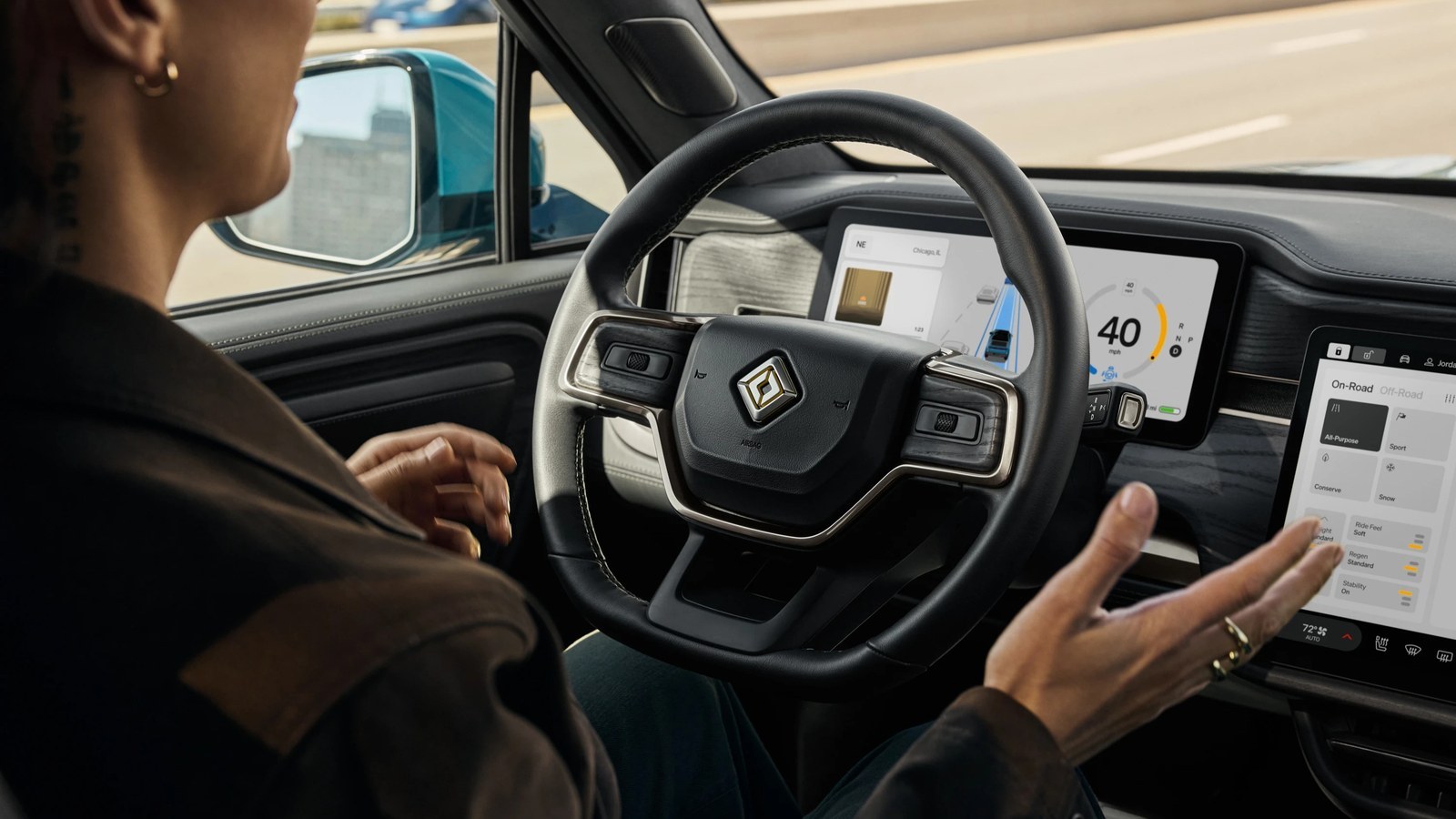
Rivian has bought Third Dimension AI, a two-year-old startup that turns camera footage into editable 3D worlds, and is folding its team into the Autonomy group. The timing is the story: the automaker is weeks away from putting Point to Point, its route-long hands-free mode, into early-access customers' hands, and it has promised Uber unsupervised robotaxis by 2028.
The deal was announced on October 22, and Rivian isn't disclosing what it paid. The company says the platform rebuilds real driving scenes as high-fidelity, controllable 3D environments, so engineers can take one recorded situation and vary the weather, traffic, and road layout at scale instead of waiting for a rare edge case to happen again on public roads.
Third Dimension's founders, Tolga Kart and Piotr Sokolski, will join Rivian's autonomy research and engineering teams. Kart ran simulation program management for Tesla Autopilot and spent seven years on Call of Duty at Activision; Sokolski built neural simulators for self-driving at Wayve. The company raised a $7 million seed round led by Felicis in October 2024, when its pitch was generating game worlds, with autonomous-vehicle developers listed as one target market.
Why Rivian needs synthetic miles now
Rivian's hands-free stack is still a supervised Level 2 system, and its next steps are on a public clock. Point to Point, which follows a navigation route through turns and city streets, is due to Early Access participants in December. CEO RJ Scaringe said in June that eyes-off driving slipped to 2027. And under the Uber partnership signed in July, 10,000 fully autonomous R2 robotaxis are supposed to start running in San Francisco and Miami in 2028, with Uber's investment of up to $1.25 billion tied to hitting autonomy milestones on schedule.
Every one of those steps requires proving the system handles situations that rarely show up in fleet data: a cyclist emerging from behind a double-parked truck, a washed-out lane line in rain, a construction zone that changed overnight. Rivian's real-world data flywheel is growing fast, with 19,248 vehicles delivered in the third quarter and third-generation hardware on R2 that packs 11 cameras, five radars, and one lidar. But a bigger fleet still can't manufacture rare events on demand. Simulation can.
James Philbin, Rivian's SVP of Autonomy and AI, framed it that way in the announcement: the technology lets the company recreate difficult situations, change the conditions, and improve how the system responds, across both the consumer and robotaxi roadmaps.
Catching up on a well-trodden path
Buying a simulation team rather than licensing one is the route Rivian's rivals took years ago. Waymo and Tesla have long run in-house neural simulators, and Hyundai laid out a similar data-flywheel roadmap this year. Rivian's current Universal Hands-Free already covers more mapped road than most, as our comparison of every hands-free system shows, but the gap between a wide Level 2 map and a driverless car is where simulation does the heavy lifting.
Rivian hasn't said how quickly Third Dimension's tools will feed into Point to Point or whether the December early-access date is affected. Nor has it said whether the acquired platform replaces or supplements the simulation tooling it already uses. The next concrete checkpoint is the December rollout itself, followed by the broader Autonomy+ release Rivian has promised for 2027.