Toyota Raises Its Profit Forecast as North America Climbs Back Out of the Red
The region earned ¥132 billion after a tariff-driven loss, while a weaker yen and electrified sales above 55% lifted first-half operating income 9% to ¥2.19 trillion.
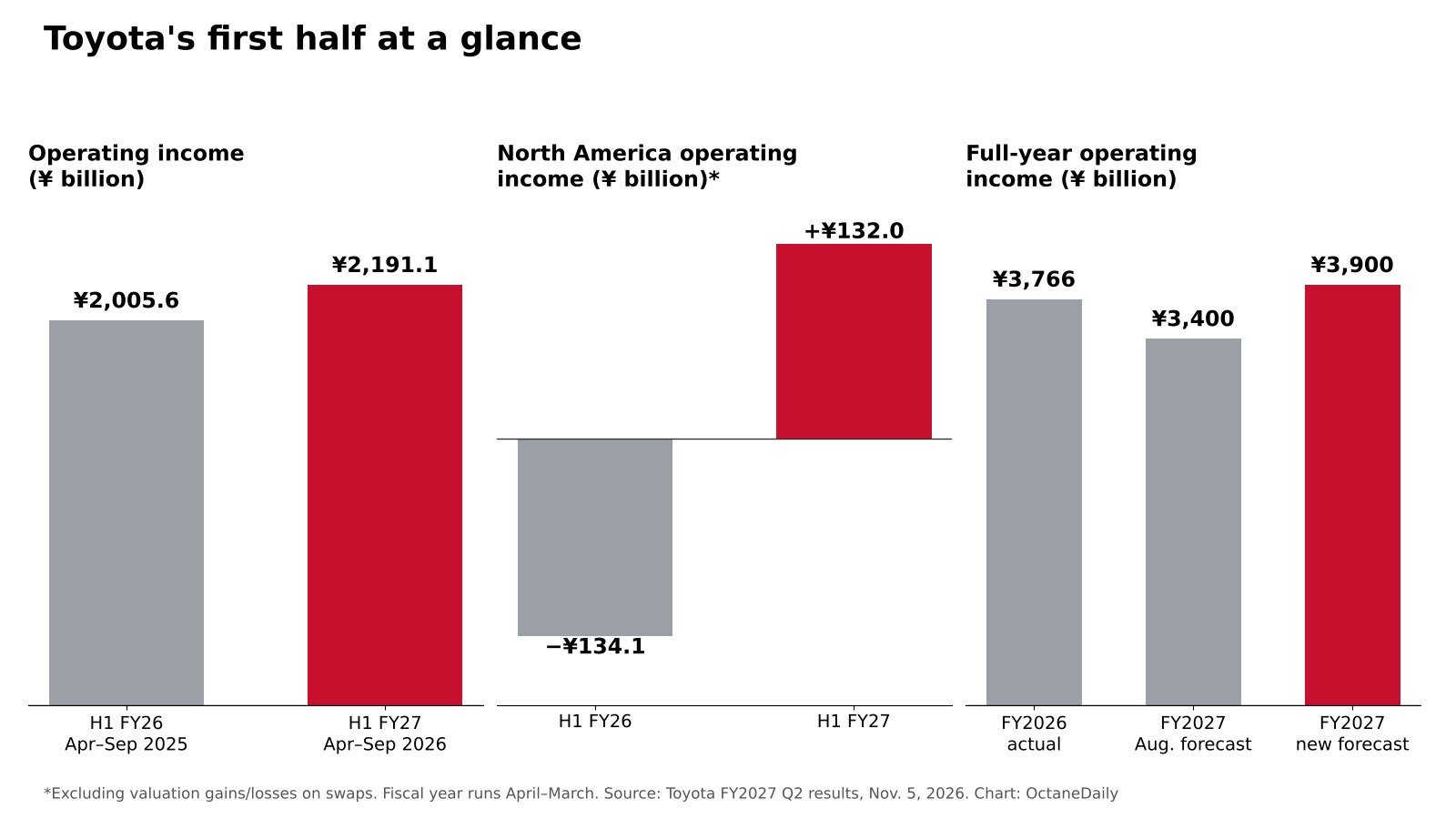
Toyota's North American business is back in the black. The region earned ¥132.0 billion (about $830 million) between April and September, after losing ¥134.1 billion a year earlier, and Toyota used its first-half results on November 5 to raise its full-year operating profit forecast by ¥500 billion, to ¥3.9 trillion.
The North American margin is still thin: 1.1% on 1.53 million vehicles, against 10.7% in Japan. But it's a turn from a fiscal year in which Toyota says tariffs pushed the region into a loss, and it puts the largest Japanese automaker on the board next to the Detroit and Tesla numbers in our Q3 2026 auto earnings scorecard. Toyota's fiscal year starts in April, so its second quarter is the calendar third quarter. Dollar figures here use ¥159, Toyota's own average rate for the half.
A weaker yen did most of the work
Revenue rose 9.5% to ¥26.96 trillion ($169.6 billion). Operating income climbed 9.2% to ¥2.19 trillion ($13.8 billion), the margin holding at 8.1%. Net income attributable to Toyota jumped 26.1% to ¥2.24 trillion ($14.1 billion), or ¥185.97 per share, helped by higher income from affiliates.
Currency was the biggest swing factor. The dollar averaged ¥159 in the half versus ¥146 a year earlier, which Toyota says added ¥685 billion. Strip out exchange rates and swap valuations, and operating income would have been ¥195 billion lower than last year. Raw materials cost ¥465 billion, ¥125 billion of it linked to the situation in the Middle East.
Volume didn't help either. Toyota and Lexus retail sales fell 4% to 5.06 million, with the Middle East and other markets down the most. Electrified models went the other way: 2.81 million units, up 14%, or 55.6% of the total versus 46.7% a year ago. Hybrids accounted for 2.45 million, plug-in hybrids 130,000, and battery EVs 231,000, more than double last year's 101,000. That mirrors Toyota's U.S. third-quarter sales, where electrified volume rose while the total stayed flat.
What changed in North America
Toyota's investor presentation shows how deep the hole was. For the fiscal year that ended in March 2026, North America lost ¥298.6 billion excluding swap valuations, a result the company labels as tariff-driven. Toyota hasn't put a yen figure on the tariff cost itself, either for that year or for the first half.
The recovery case rests on tight supply and fewer discounts. Toyota says it had 11 days of inventory in the region at the end of September, and just six for hybrids, against 42 days at the end of 2019. Per-vehicle incentives are down 60% from fiscal 2020. That's the flip side of the RAV4 wait times buyers have been dealing with.
Next, Toyota plans to build more hybrids in North America, run its North Carolina battery plant at higher utilization, and move Tacoma production from its plant in Baja California, Mexico, to a second line in Texas.
Why the forecast went up
The new ¥3.9 trillion ($24.8 billion at Toyota's assumed ¥157) outlook compares with ¥3.4 trillion in the previous forecast and ¥3.77 trillion last fiscal year. This time currency isn't the reason: excluding exchange rates and swaps, the revision is worth ¥510 billion. Toyota credits lower tariff-related costs and cost and pricing work, including more income from financing, parts, and used cars.
The tariff relief has a known source. The U.S. rate on Japanese vehicle imports fell to 15% in September 2025, down from 27.5%, so this fiscal year is the first to carry the lower rate in full. Our guide to what the midterms change for car buyers covers where that rate stands.
The volume outlook moved the other way. Toyota now expects 10.3 million Toyota and Lexus sales, down from 10.5 million, with battery EVs cut to 463,000 from 533,000. Revenue guidance slipped ¥0.5 trillion to ¥53.5 trillion, and full-year net income is still forecast to fall 7.2% to ¥3.57 trillion. Toyota also flags the Middle East and production disruptions from earthquakes and floods as risks.
Shareholders get a ¥50 interim dividend, ¥5 more than last year, with ¥100 expected for the full year, plus another ¥300 billion of buyback authority for a total of ¥1.3 trillion.
Toyota doesn't break out a U.S.-only profit figure in its results materials. The next check on North America comes with third-quarter results in February.