BMW Paid $1 Billion in U.S. Tariffs. Why Building in America Doesn't Erase the Bill
Exports don't count against import duties, and the 3.75% offset for U.S. assembly covers parts only. Here is the rule, BMW's request and the tools Washington has.
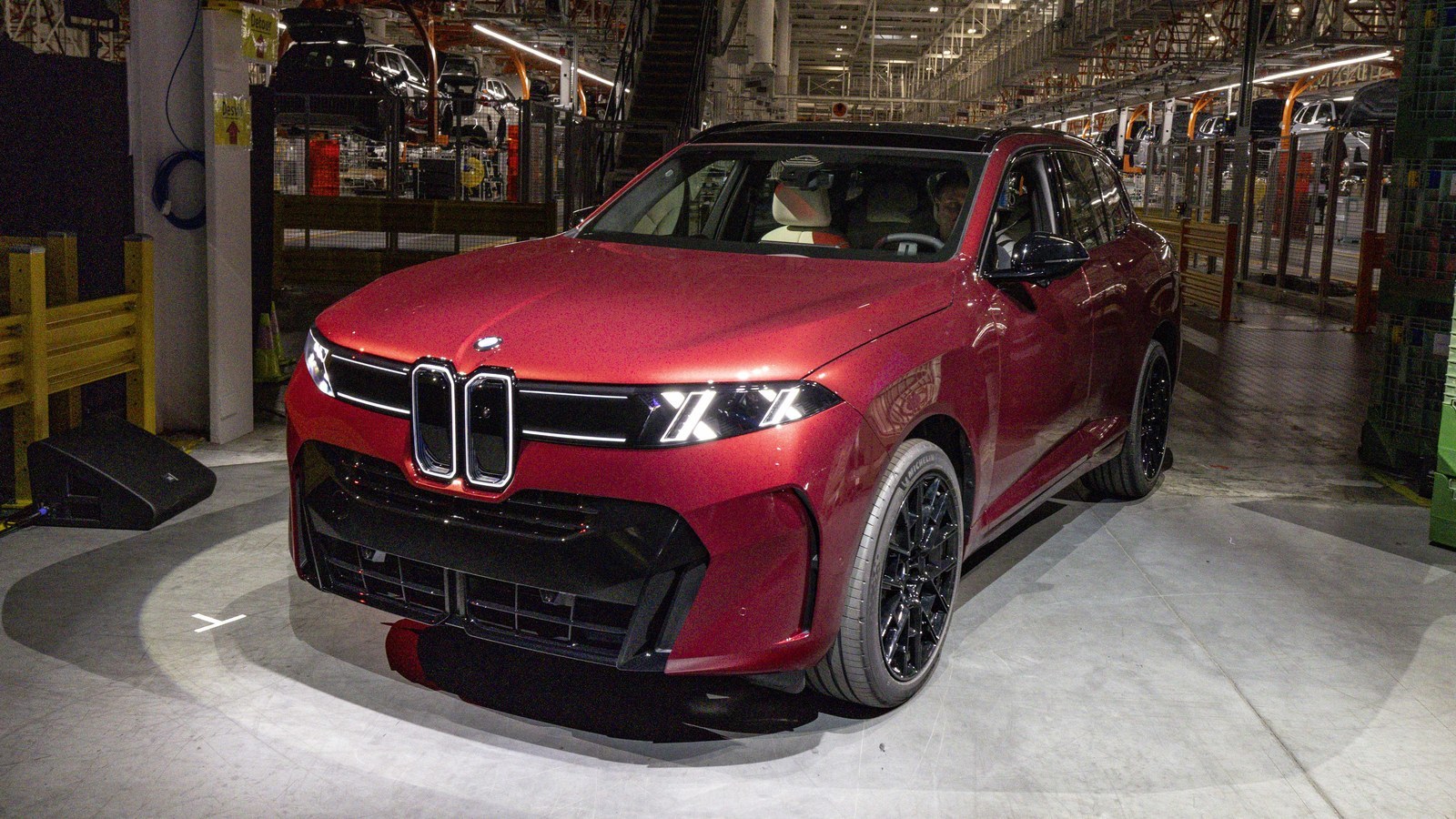
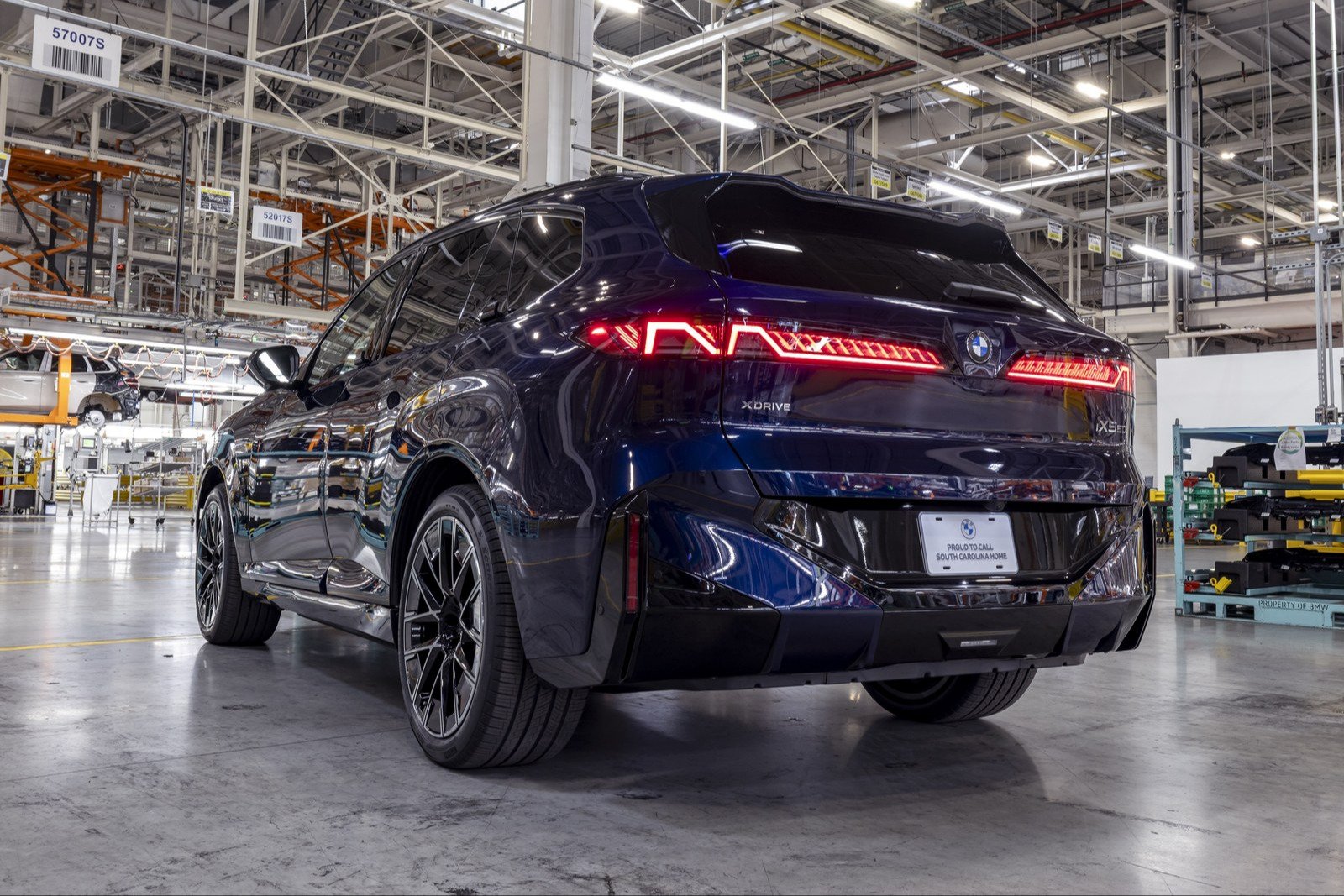
BMW builds more than 400,000 SUVs a year in South Carolina and ships about half of them abroad. It still paid more than $1 billion in U.S. import duties last year, Automotive News reported on November 17, days after the company opened its Woodruff battery plant for the U.S.-built iX5.
The head of BMW's U.S. manufacturing arm says the company is talking to Washington about lower tariffs. This explainer covers what has been said on the record, how the Section 232 auto tariff treats a company that both imports and exports, and which tools exist to change it. It makes no forecast of what the administration will do. For the wider picture, see our table of who can change each car tariff and by what procedure.
What BMW and South Carolina have said
Robert Engelhorn, president and CEO of BMW Manufacturing, told Automotive News that exporting is the plant's business model and that the company is in close contact with the federal government. "We are looking toward the lower tariffs," he said. His published remarks name no target rate and no mechanism.
The same report puts BMW's 2025 duty bill above $1 billion and says the company brought about 215,000 vehicles into the U.S. last year from Germany and other countries.
Gov. Henry McMaster told the publication he has raised the subject with officials in Washington over time, and that such things do not always move quickly. In BMW's own announcement of the Woodruff opening, his statement was limited to the investment: "BMW has been a strong partner to our state."
We found no written request from BMW Manufacturing or the governor's office in their press channels. What BMW has documented is the investment it points to: $1.7 billion committed in 2022, of which $700 million went to Woodruff and $1 billion to Plant Spartanburg.
Why a U.S. plant doesn't cancel the tariff
The duty comes from Proclamation 10908, issued under Section 232 of the Trade Expansion Act of 1962. It added 25% to imported cars and light trucks on April 3, 2025, and to listed auto parts on May 3, 2025. Trade deals later set an all-in 15% for vehicles and parts from the European Union (from August 1, 2025), Japan (September 16) and South Korea (November 1). Cars that qualify under USMCA pay the duty only on their non-U.S. content.
That leaves BMW with two separate bills:
- Finished cars. BMW says more than 52% of the BMWs sold in the U.S. in 2025 came from Spartanburg. The rest were imported, and each one is taxed at the border.
- Parts. Imported components for the X models built in Spartanburg are taxed too, whether the finished SUV is sold in Ohio or shipped to Germany.
Exports don't net against either bill. According to BMW, Commerce Department data show Spartanburg exported nearly 200,000 vehicles worth $9 billion in 2025, more than any other automaker by value. Nothing in the proclamation credits those shipments against the duty on a 3 Series arriving from abroad.
The offset: 3.75% of sticker price, for parts only
The one mechanism written for companies that assemble in the U.S. is the "import adjustment offset." Proclamation 10925, signed April 29, 2025, lets a manufacturer apply for an offset equal to 3.75% of the combined MSRP of the vehicles it assembles in the U.S. The figure is the proclamation's own arithmetic: a 25% duty on parts that make up 15% of a car's price.
Originally the offset was to fall to 2.5% in its second year and end in April 2027. Proclamation 10984, signed October 17, 2025, replaced that schedule with a flat 3.75% through April 30, 2030.
The Commerce Department's program rules set the limits:
- It can be used only against Section 232 duties on parts, and it is capped at the parts duty a manufacturer actually owes.
- Commerce states it is not a cash refund.
- Engine cost is deducted from the vehicle value; engine makers have a separate program.
- Manufacturers apply once per annual period with a production forecast, and Commerce adjusts the award against actual output in the next cycle.
- Knock-down kits don't count.
The eligibility test in the text is final assembly in the United States. It does not separate vehicles sold here from vehicles exported, so Spartanburg's export volume counts toward BMW's offset. What the offset cannot do is reduce the duty on an imported finished car.
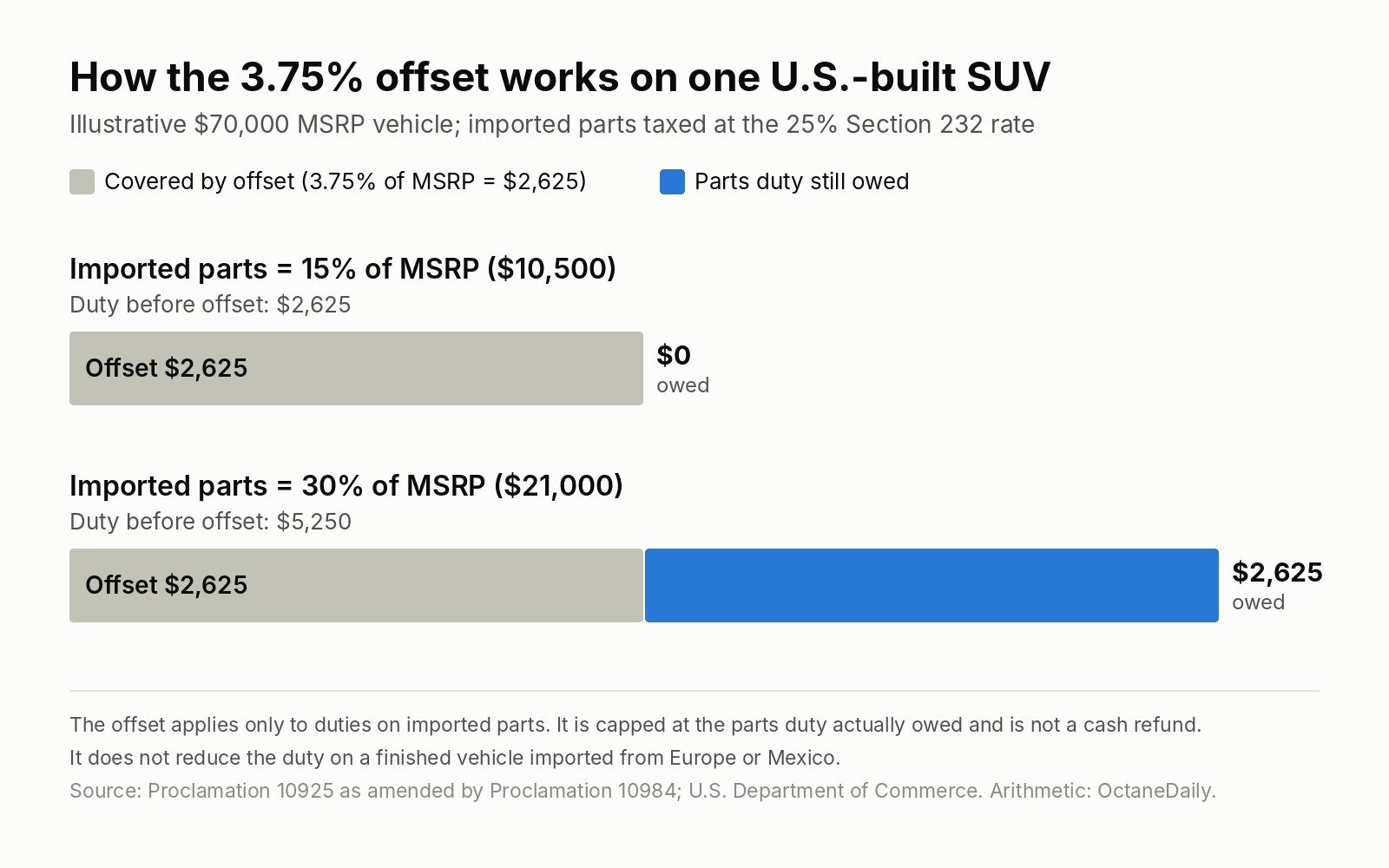
On an illustrative $70,000 SUV, the offset is worth $2,625. If imported parts are 15% of the sticker price and taxed at 25%, that covers the whole parts duty. If they are 30%, half remains. BMW does not disclose its imported-parts share or how much of its parts duty the offset covers.
What tariffs cost BMW, in its own numbers
BMW does not publish a dollar figure for U.S. duties. It reports the effect on its car division's operating margin: about 1.5 percentage points for 2025, and about 1.25 points in both the third quarter and the first nine months of 2026, down from roughly 1.75 points in the third quarter of 2025.
Applied to the division's reported revenue of €26.67 billion for the quarter and €80.99 billion for nine months, that works out to roughly €330 million ($375 million) and €1.0 billion ($1.14 billion). That is our arithmetic, not a BMW disclosure, and it measures added tariff expense, not total duties paid. The company expects the full-year drag to stay near 1.25 points, as covered in our report on BMW's third-quarter results and margin forecast.
Who else builds here and exports
BMW is the largest case, not the only one.
- Mercedes-Benz. The Tuscaloosa County, Alabama, plant builds the GLE and GLS. Mercedes says around two-thirds of its output is exported; other company statements say about 60%. Its top-selling GLC stays imported until Alabama production starts in May 2030.
- Toyota. In December 2025 it announced plans to sell U.S.-built Camry, Highlander and Tundra models in Japan from 2026. Toyota put its tariff cost for the current fiscal year at ¥1.38 trillion, then trimmed that estimate by ¥70 billion.
- Honda. On March 5 it said the Ohio-built Acura Integra Type S and the Alabama-built Passport TrailSport Elite would go on sale in Japan in the second half of 2026.
- Volkswagen. Chattanooga, Tennessee, builds the Atlas and Atlas Cross Sport. VW does not publish an export share for the plant, so it can't be compared on official data.
- Audi. It has no U.S. plant until its Georgia factory opens in the early 2030s. Reuters and The Wall Street Journal reported on October 29, citing unnamed sources, that U.S. officials promised Audi tariff relief and plan a broader program for automakers that invest in U.S. production. No such program has been published.
What tools the administration has
These are the procedures that exist on paper. Listing them says nothing about whether any will be used.
- Amending the proclamation. The president can change rates, scope or offsets by a new proclamation. That has happened twice for cars: the April 2025 offset and its October 2025 extension.
- Country agreements. The 15% rates for the EU, Japan and South Korea were put in place by executive action and Federal Register notices under the same authority.
- Commerce procedures. The department runs the offset and has amended its procedures by notice, most recently on May 15 and July 29, 2026.
- Monitoring. The proclamations direct the Commerce secretary to keep reviewing imports and to tell the president if circumstances suggest further action, or that the duty is no longer needed.
- Parts inclusions. A Commerce process can add parts to the tariff list. The auto proclamations we reviewed create no company-by-company exclusion process for finished vehicles.
- Congress. It can change Section 232 only by passing a law.
What we don't know
- What rate or mechanism BMW is asking for. Its executives have not said.
- Whether an investment-linked relief program will be published, and on what terms.
- How BMW's 2025 duty bill splits between finished cars and parts.
- BMW's dollar duty total for 2026.
We will update this explainer if a proclamation, a Federal Register notice or a formal BMW filing changes any entry above.