Nearly 30% of New Cars Worldwide Now Plug In. In America, It's About 7%
Plug-in sales hit 2.09 million worldwide in October. Europe grew 36%, China still buys more than half, and the U.S. sits between 6% and 8% depending on who counts.
Automakers sold 2.09 million vehicles with a plug worldwide in October, according to Benchmark Mineral Intelligence. China bought 1.14 million of them and Europe 510,000. The United States accounted for about 110,000.
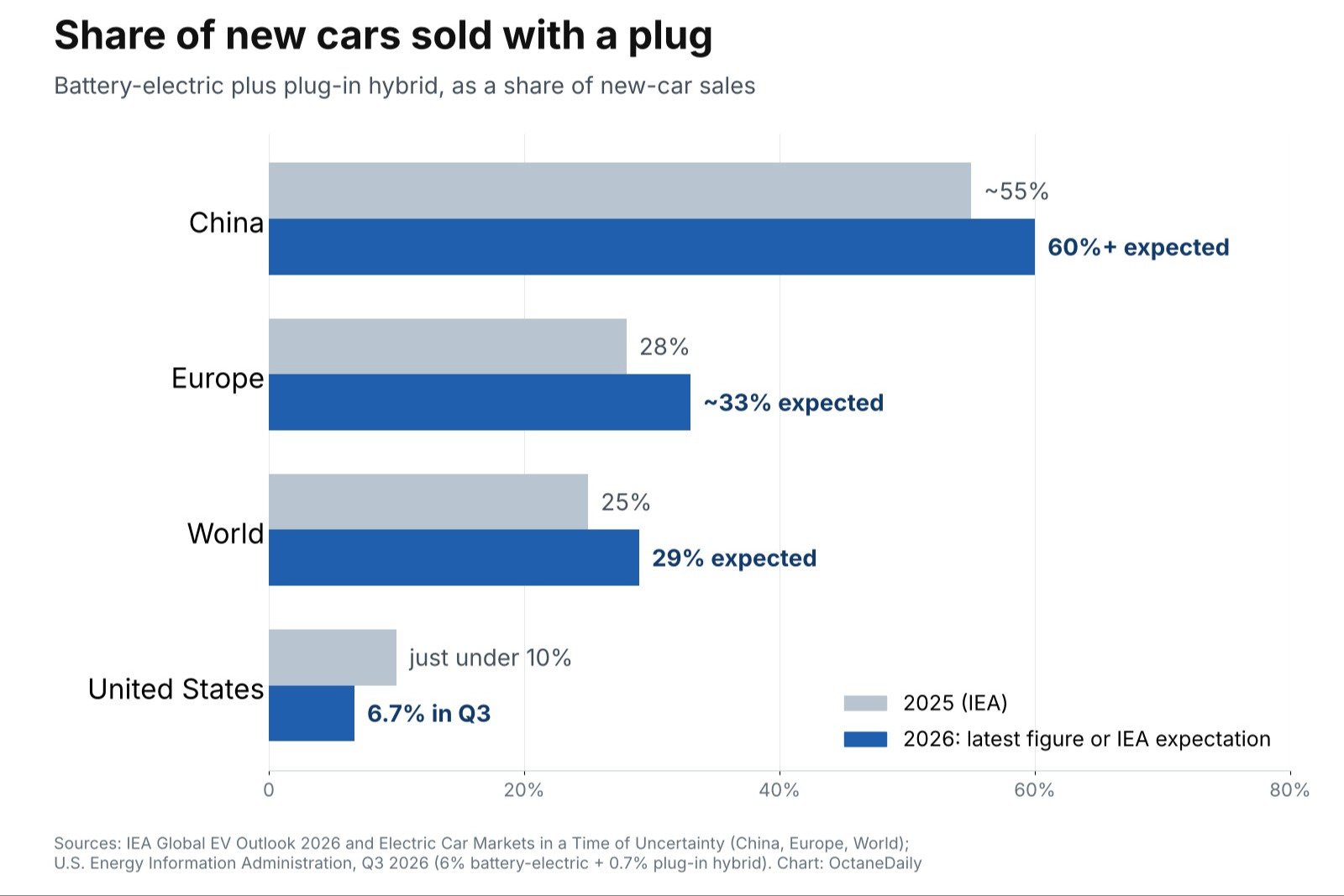
The International Energy Agency now expects plug-in cars to take 29% of global new-car sales this year. In the U.S., the Energy Information Administration put battery-electric vehicles at 6% of third-quarter sales and plug-in hybrids at 0.7%. A year ago, as we noted in our breakdown of third-quarter U.S. EV sales, EVs had just passed 10% of the American market for the first time.
So the gap has widened from both ends. The rest of the world kept climbing while the U.S. stepped down and stayed there. The October data shows how that happened, and it also shows that the three big markets are moving for very different reasons.
What the October numbers actually count
Benchmark's total covers battery-electric vehicles and plug-in hybrids across passenger cars and light-duty vehicles. That matters for headlines saying these cars can drive without gas. A plug-in hybrid can, for a while, but it still has an engine and a fuel tank. The IEA uses the same definition and counts range-extended EVs as plug-in hybrids; by its tally, battery-electric cars made up 65% of global electric-car sales in 2025.
One figure making the rounds needs a correction. A total of 1.9 million with 23% growth is October 2025's result, published a year ago by Rho Motion. It is the base that this year's 8% gain is measured against, not a competing estimate for 2026.
Here is how Benchmark splits October 2026:
- China: 1.14 million, down 12% from a year earlier; down 11% for the year to date
- Europe: 510,000, up 36%; up 31% for the year to date
- North America: 130,000, up 24%; down 21% for the year to date
- Rest of the world: 300,000, up 85%; up 93% for the year to date
Worldwide, sales for January through October reached 17.5 million, up 5%.
The U.S. number depends on who counts. Cox Automotive's Kelley Blue Book, which tracks battery-electric vehicles only, estimates 83,262 new EVs sold in October, or 6.2% of the market. Benchmark's figure of roughly 110,000 adds plug-in hybrids. Set against the total market implied by Cox's own share figure, that works out to about 8% by our math. On any of these measures the U.S. is below 10%.
The U.S.: a gain that is mostly a comparison
North America posted its first year-over-year increase of 2026 in October, and Benchmark itself cautions against reading it as a recovery. October 2025 was the first month after the $7,500 federal credit expired on September 30, so the comparison is against a collapsed month. Cox's October EV Market Monitor shows the same thing from the other side: sales rose 3% from a year earlier, yet EV share slipped from 6.3% to 6.2%.
Cox's corrected third-quarter count is 262,649 EVs and a 6.4% share, down 39.5% from the record quarter a year earlier. "What we're seeing now is a market finding its footing again," said Stephanie Valdez Streaty, Cox's director of industry insights.
That footing is narrow. Tesla took 57.5% of October's new EV sales, and the Model Y alone nearly 44%, Cox estimates. The average new EV sold for $56,221, which is $5,306 above the average for gas and hybrid vehicles, even with incentives averaging $6,375 a car. We covered one consequence when Tesla dropped its cheapest all-wheel-drive Model Y, and the supply side in our look at why most automakers still lose money on EVs.
The IEA points to two U.S. policy changes. The purchase credits ended, and the same 2025 law removed the penalties for missing fuel economy standards, which reduced the pressure on carmakers to sell EVs at all. Buyers moved to hybrids without a plug, which the EIA puts at 16% of third-quarter sales.
China: a shrinking market with a record share
China is the only region where plug-in sales fell in October, and it is still the one where they dominate. Benchmark's explanation is that the overall car market is contracting faster than EV sales, so the plug-in share keeps rising. China Passenger Car Association data reported by CnEVPost put new-energy vehicles at a record 67.5% of retail passenger-car sales in October.
Policy turned less generous this year. According to the IEA's Global EV Outlook 2026, China's full purchase-tax exemption became a 50% reduction in 2026. The agency expects Chinese EV sales to stagnate this year for the first time this decade while the share passes 60%, up from almost 55% in 2025.
Price is what holds the share up. Nearly 70% of battery-electric cars sold in China in 2025 cost less than their combustion equivalents before incentives, the IEA found. The cars that don't sell at home are shipped out: Benchmark counts almost 600,000 new-energy passenger-car exports in October.
Europe: subsidies, CO2 rules and fuel bills
Europe's 36% jump was almost entirely battery-electric. Benchmark has pure EVs up 49% and plug-in hybrids up 7%. In Germany, battery-electric sales rose almost 80% to more than 95,000.
Three drivers sit behind that, and none of them exists in the U.S. today. Germany brought back purchase grants of €1,500 to €6,000 for private buyers on cars registered from January 1, 2026, with a €3 billion budget. EU carmakers face a 2025 fleet CO2 target 15% below 2021 levels, averaged over 2025 through 2027, the IEA notes. And at April's oil prices, the agency calculates that the annual fuel savings from driving an EV in the EU were 35% higher than in 2025.
The sticker gap is also smaller than it is here. The IEA puts the average battery-electric premium in Europe at around 20% in 2025, with more than 30% of EVs selling below the average combustion-car price. Through September, battery-electric cars held 22.7% of the EU market and plug-in hybrids 10.1%, according to the European Automobile Manufacturers' Association (ACEA).
What it means for an American buyer
What strikes me in these numbers is that the three markets are not on one curve with the U.S. a few years behind. China's share rests on cars that cost less than gas models. Europe's rests on regulation and cash. The U.S. removed both the cash and the regulatory pressure within a few months, and its share now reflects what EVs earn at full price.
For shoppers, the practical effect is on choice. The IEA counts nearly 700 electric models on sale in China; in the U.S., electric models are a little under 30% of what's offered. Chinese brands supplied 60% of the world's electric cars in 2025, and the largest, BYD, sells no passenger cars here, for reasons we laid out in our explainer on why you can't buy a BYD in America.
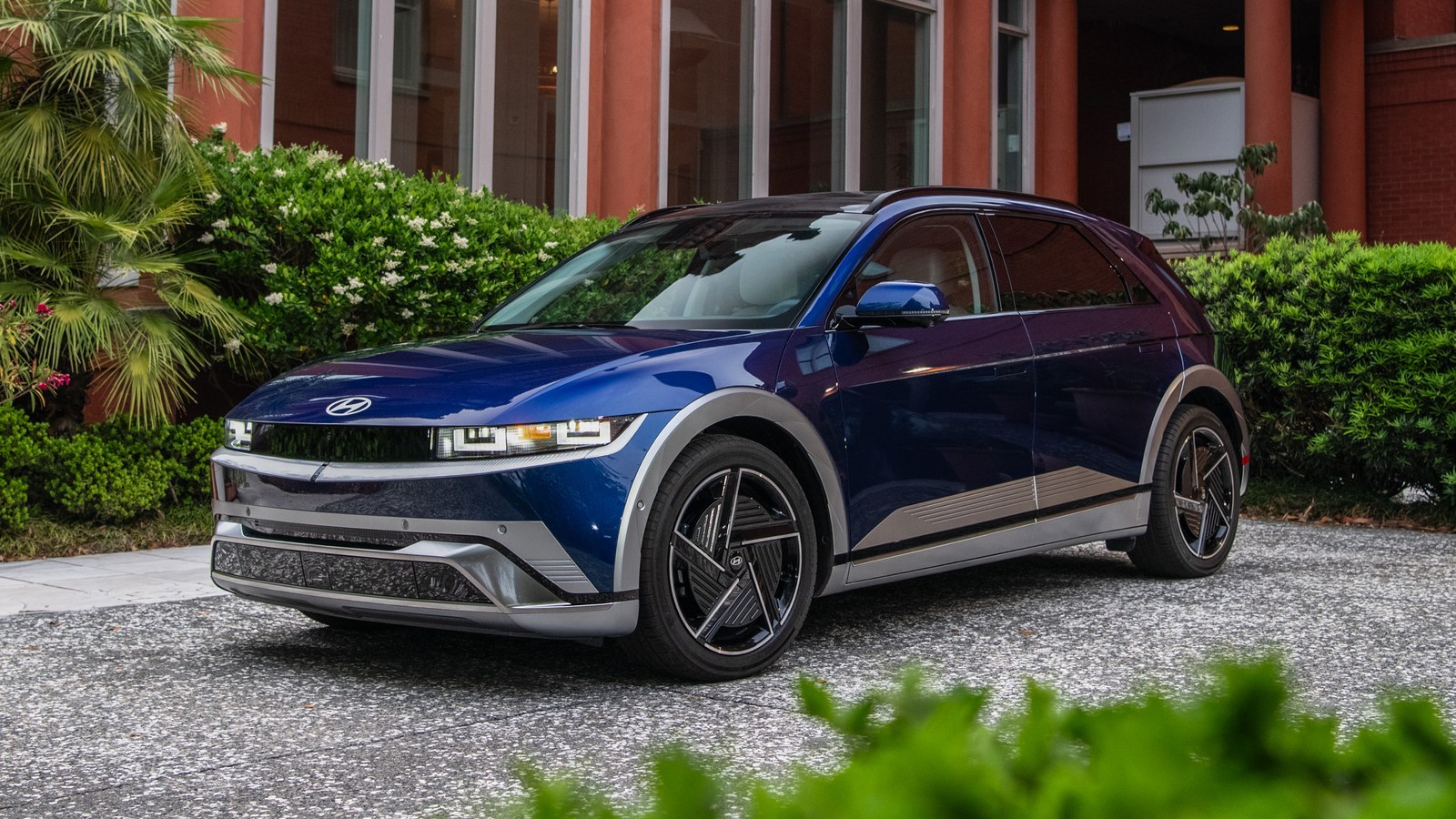
The EVs Americans can buy are mostly global products. Some are built locally, like the Hyundai Ioniq 5 from Georgia. Many are not: imports made up nearly 40% of U.S. electric-car sales in 2025, the IEA says. Volkswagen stopped building the ID.4 in Tennessee in April, and its replacement, the ID. Tiguan, has no U.S. date. Our tracker of U.S. battery plants follows how the factory side is adjusting.
My read, and it is only that, is that a market one-twentieth the size of the global total has less pull on what gets engineered. A car designed first for buyers in Europe or China arrives here later, in fewer versions, or not at all.
What we don't know yet
- Europe's official October figures. ACEA had not published its October registrations as of November 23. Benchmark's European numbers are its own estimates.
- A current full-year U.S. outlook. The IEA gives no 2026 projection for the U.S. share. Cox began the year estimating 8% for battery-electric vehicles; its quarterly counts have run near 6%.
- Whether the fourth quarter holds. The comparison base is the roughly 234,000 EVs and 5.8% share Kelley Blue Book counted in late 2025, so year-over-year gains will come easily and say little.
- How China's exports fare in 2027. Benchmark flags two headwinds: a cut in China's export VAT rebate from 13% to 9% on April 1, 2027, and an EU cap on Chinese-built hybrids.
We are not adding a forecast of our own. The next fixed points are ACEA's October release, Cox's November EV Market Monitor, expected in mid-December, and the fourth-quarter Kelley Blue Book count in January.