2027 Hyundai Tucson vs. 2026 Toyota RAV4: 242 HP, 185 Inches, and No Price Yet
Hyundai's fifth-generation Tucson is longer, wider, and rides a longer wheelbase than Toyota's best-selling hybrid. Everything else about the U.S. car is still blank.
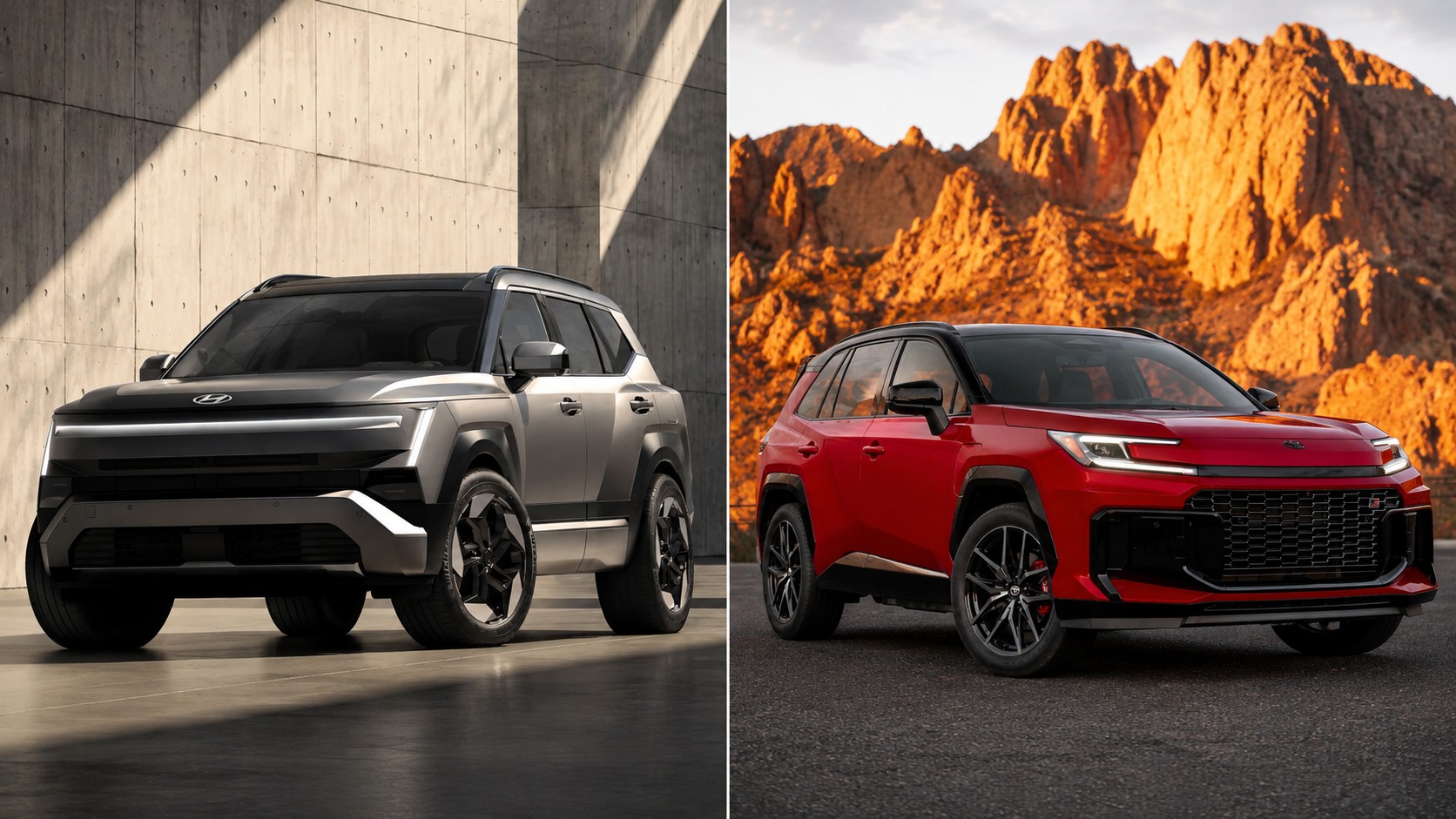
Toyota's sixth-generation RAV4 has been on sale since December, hybrid-only, and it currently runs from $33,350 to $49,950 with the $1,450 destination charge included. Hyundai's answer arrived on August 19, when the fifth-generation Tucson was revealed in South Korea.
A week later, at its 2026 CEO Investor Day, Hyundai put the first numbers to the new Tucson Hybrid. So this comparison is no longer just a styling exercise — but it is still missing the things American buyers actually shop on: trims, EPA ratings, a price, and a date.
Here is what can be compared today, and what can't.
The spec sheet so far
| 2027 Hyundai Tucson | 2026 Toyota RAV4 | |
|---|---|---|
| Status | Revealed August 19; launches in first markets in Q4 2026 | On sale now (hybrid since December, plug-in since spring) |
| Length | 185.0 in (4,700 mm) | 181.0 in (182 in for Woodland) |
| Width | 75.0 in (1,905 mm) | 73.0 in |
| Height | 66.3 in (1,685 mm) | Varies by grade; not directly comparable |
| Wheelbase | 109.6 in (2,785 mm) | 105.9 in |
| Powertrains | 1.6-liter turbo hybrid (TMED-II) confirmed; a non-hybrid 1.6 turbo is in the same investor materials. U.S. lineup: TBA | 2.5-liter hybrid (FWD or AWD) and 2.5-liter plug-in hybrid (AWD). No gas-only model |
| System output | 242 hp and 280 lb-ft (380 Nm), per Hyundai's investor-day figures | 226 hp (hybrid FWD), 236 hp (hybrid AWD), 324 hp (PHEV) |
| Acceleration | 0–62 mph (0–100 km/h) in 8.5 seconds, Hyundai claim | Not published by Toyota; PHEV measured at 5.3 seconds to 60 mph by CarBuzz |
| Efficiency | 17.4 km/L on Korea's cycle (about 41 mpg), Hyundai claim. EPA: TBA | EPA up to 47/40/43 mpg (hybrid FWD), down to 41/35/38 mpg (Woodland). PHEV: 52 miles of EV range, up to 102 MPGe |
| Ground clearance | TBA | 8.1 in (LE, XLE Premium, SE, XSE), 8.5 in (Woodland), 7.5 in (GR SPORT) |
| Infotainment | Pleos Connect with a large center display and a slim driver screen; physical controls retained. Screen sizes not confirmed | Toyota Audio Multimedia with 10.5- or 12.9-inch touchscreen, standard 12.3-inch cluster, onboard 5G |
| U.S. price | TBA | $33,350 to $49,950, destination included |
| U.S. on-sale | TBA; global rollout follows in 2027 | Now |
Size is the headline, and it isn't close
The new Tucson is four inches longer than a RAV4, two inches wider, and rides a wheelbase 3.7 inches longer. In a segment where rivals usually trade tenths of an inch, that is a deliberate move upward.
Hyundai spent the growth where families notice it. Rear headroom is up by 1.1 inches, and the rear doors now swing to 83 degrees instead of 73 — the difference between wrestling a car seat through a gap and simply loading it.
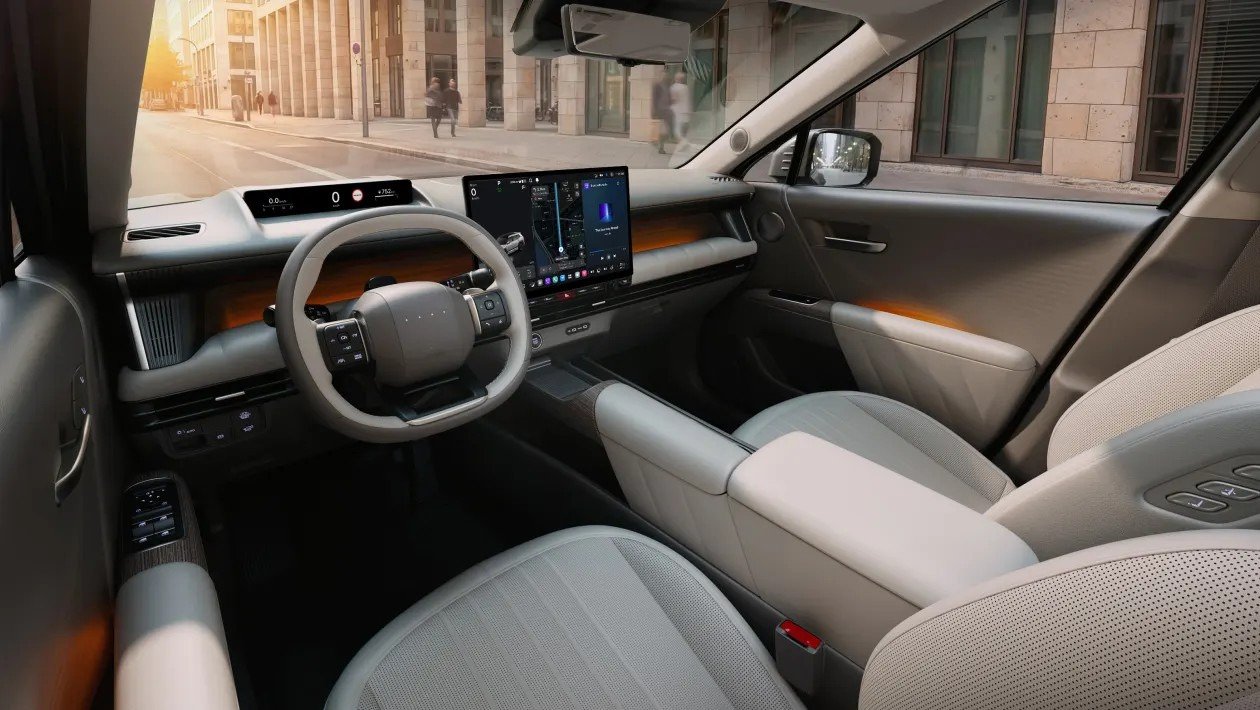
Toyota went the other way. The sixth-generation RAV4 kept its 105.9-inch wheelbase and spent its engineering budget on stiffening the body, retuning the suspension, and quieting the cabin. Nothing about the new Tucson's exterior numbers tells you how much of that extra length reaches passengers, because Hyundai has not published interior volume or cargo figures.
Powertrains: 242 hp against a 324-hp plug-in
Hyundai's investor materials, presented in Seoul on August 26 and reported by CarExpert, Motor1, and Autoblog, describe the next Tucson Hybrid as a TMED-II system pairing an updated 1.6-liter turbo with a new dual-motor transmission: 242 hp and 280 lb-ft, up 11 hp and 9 lb-ft on today's car.
That beats every non-plug-in RAV4. Toyota's hybrid makes 226 hp with front-wheel drive and 236 hp with all-wheel drive, and its torque figure isn't directly comparable, since Toyota quotes 163 lb-ft for the engine alone rather than a system number.
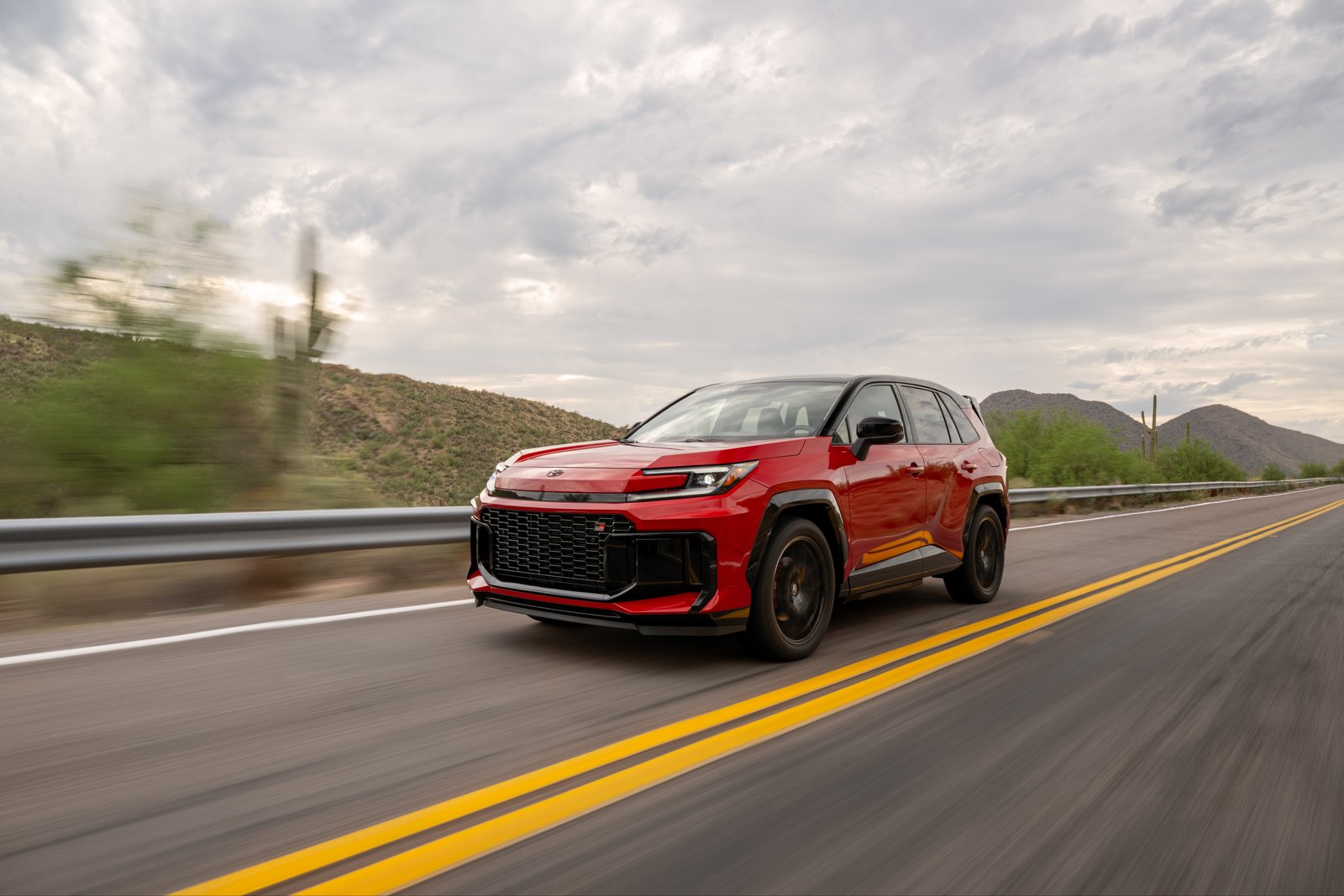
The picture flips at the top of the range. The RAV4 plug-in hybrid produces 324 hp, covers 52 miles on electricity, and in GR SPORT form has been timed at 5.3 seconds to 60 mph. Hyundai has said nothing about a plug-in Tucson for the new generation, and nothing about whether the base non-hybrid 1.6 turbo in its investor deck is destined for the United States at all.
Efficiency is the comparison to avoid for now. Hyundai's 17.4 km/L works out to roughly 41 mpg, but that is a Korean-cycle claim from a slide, not an EPA rating, and EPA numbers are consistently lower. Today's U.S. Tucson Hybrid is rated at 38 mpg combined against the RAV4 FWD hybrid's 43.
What we still don't know about the American Tucson
- Price. Nothing has been announced anywhere, and Hyundai's current U.S. Tucson starts near $30,800 with destination — a figure that says nothing about a bigger car on a newer hybrid system.
- Model year and timing. Hyundai confirms Q4 2026 for initial markets and a global rollout in 2027. It has not said when the car reaches U.S. dealers or which model year it wears.
- The U.S. lineup. An XRT appeared in the reveal images, but Hyundai hasn't confirmed any off-road hardware behind the styling, and no trim walk exists.
- EPA figures, interior volume, cargo space, and towing. All unpublished.
Which one should you buy — or wait for?
If you need a compact SUV in the next six months, this isn't a real choice. The RAV4 is a known quantity with published EPA ratings, a settled price, and cars on lots; the Tucson is a set of exterior dimensions and one slide of hybrid figures. Waiting for a car with no announced U.S. date, price, or model year means waiting an unknown length of time for an unknown amount of money.
Two groups should hold on anyway. Buyers who care most about back-seat space have a genuine reason to see the Tucson in person, because Hyundai's added length and wheelbase went somewhere, and the outgoing Tucson already had a reputation for room. Buyers who want a plug-in have the opposite answer: Toyota sells one now, with 52 miles of range, and Hyundai has committed to nothing.
Everyone else should watch the price. Toyota moved the RAV4 to a hybrid-only lineup and raised the floor to $33,350 with destination. If Hyundai answers a bigger, more powerful Tucson with a number that starts lower, this becomes the segment's most interesting decision in years. Until Hyundai USA publishes one, it isn't a comparison — it's a preview.