Where Your Next Car Will Be Built: The Southern Auto Belt After Audi's $4 Billion Bet
Audi's Georgia plant joins Hyundai, Kia, Rivian, BMW, Volvo, Scout and a dozen more. We mapped all 19, and what the belt means for import prices.
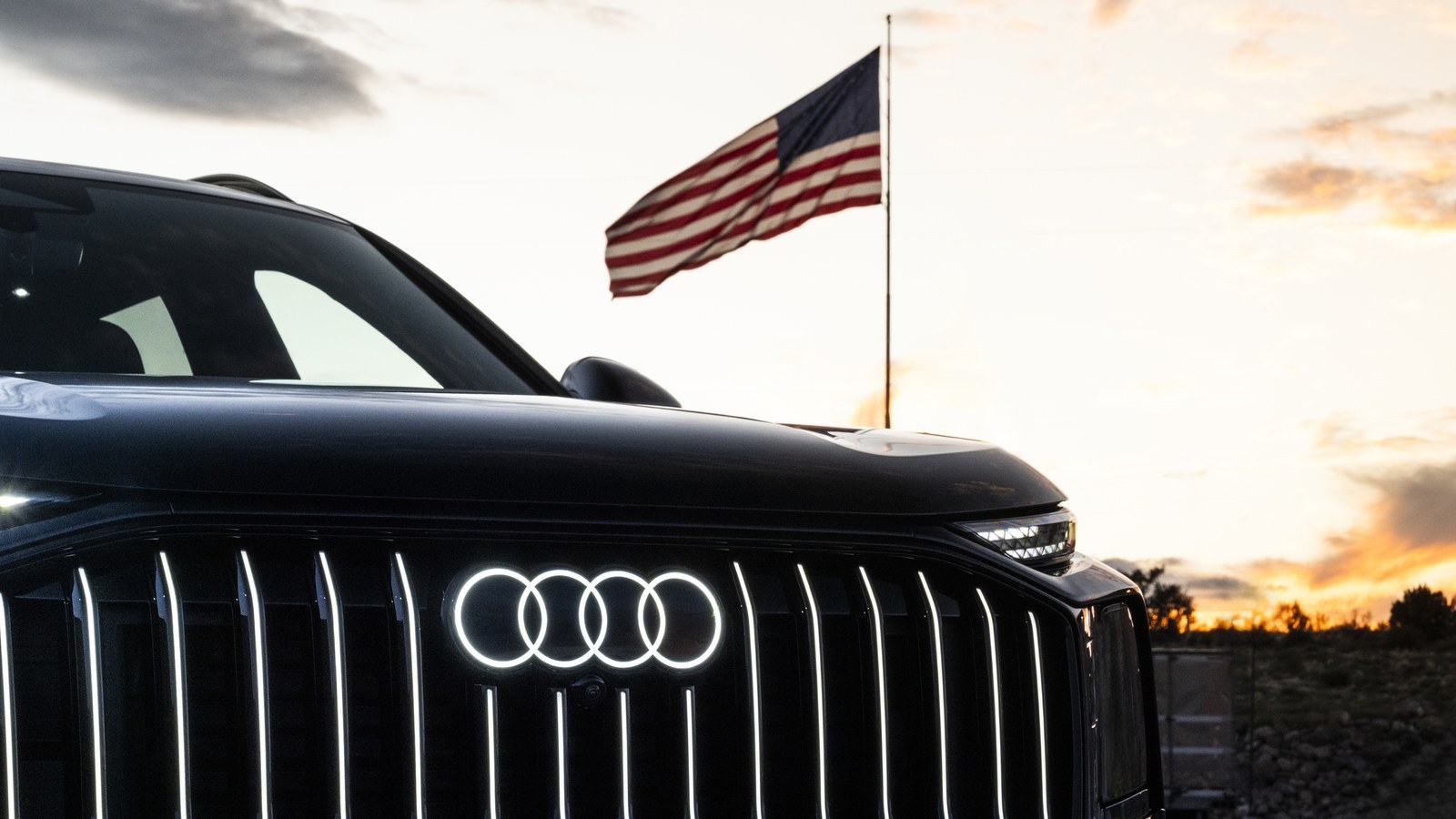
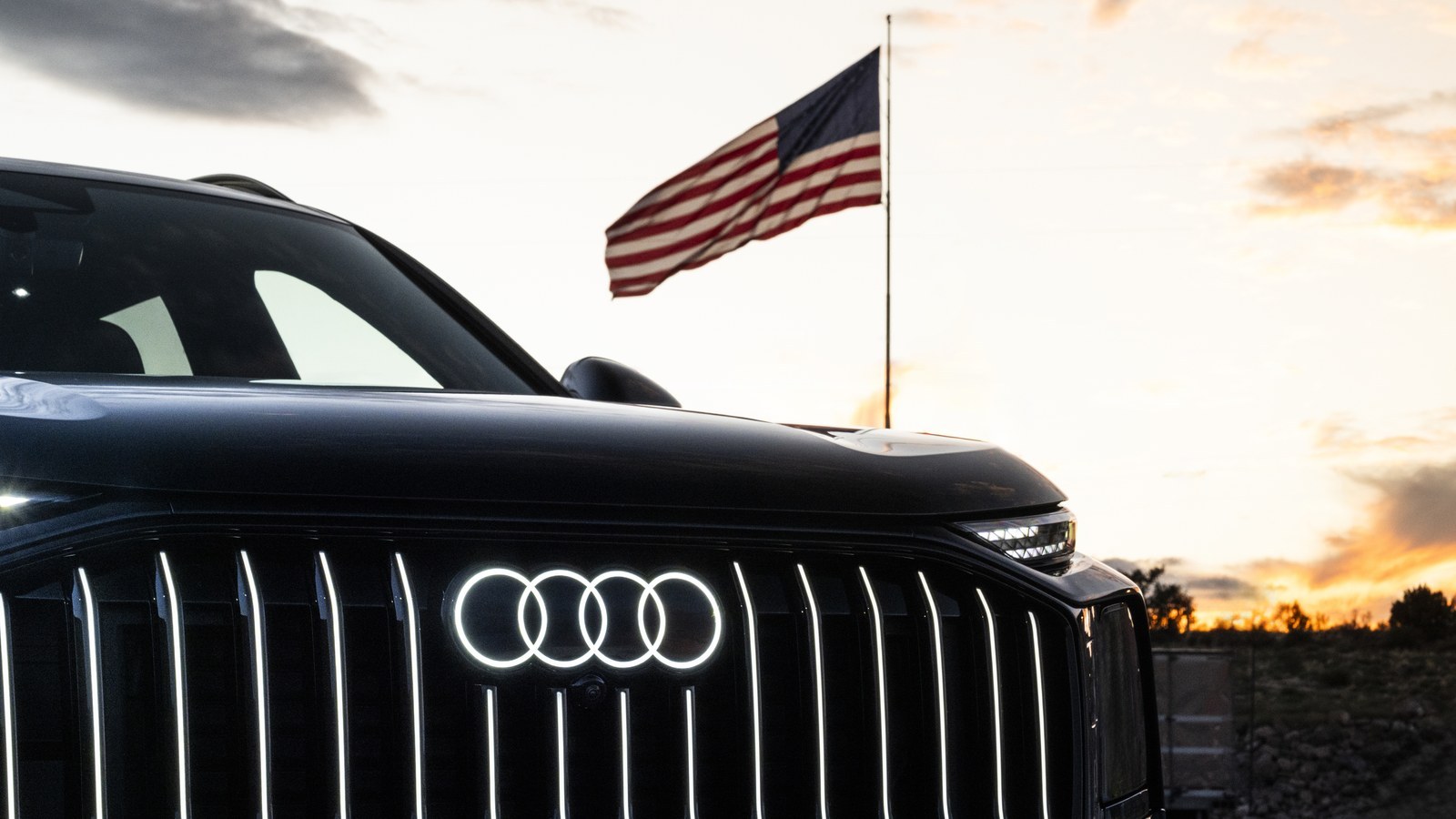
Audi's first American factory will rise on the Middle Georgia Mega Site, a roughly $4 billion plant with room for up to 200,000 SUVs a year. On its own, that is one more automaker coming late to U.S. production. On a map, it is something bigger: the newest pin in a belt of assembly plants that now runs from Indiana down through Kentucky and Tennessee to the Gulf and the Atlantic coast.
We covered the plant itself in our report on Audi's Georgia SUV factory. This piece zooms out. Below is every major light-vehicle plant in that belt that is building cars, under construction, or announced, followed by three things the map tells a buyer: who still has no U.S. plant, whose prices are better shielded from tariffs, and where the next announcements are likely to come from.
The map, state by state
Every capacity figure below is the company's or the state's own published number; where none has been published, the cell says so. Plants are listed by state, then by how far along they are.
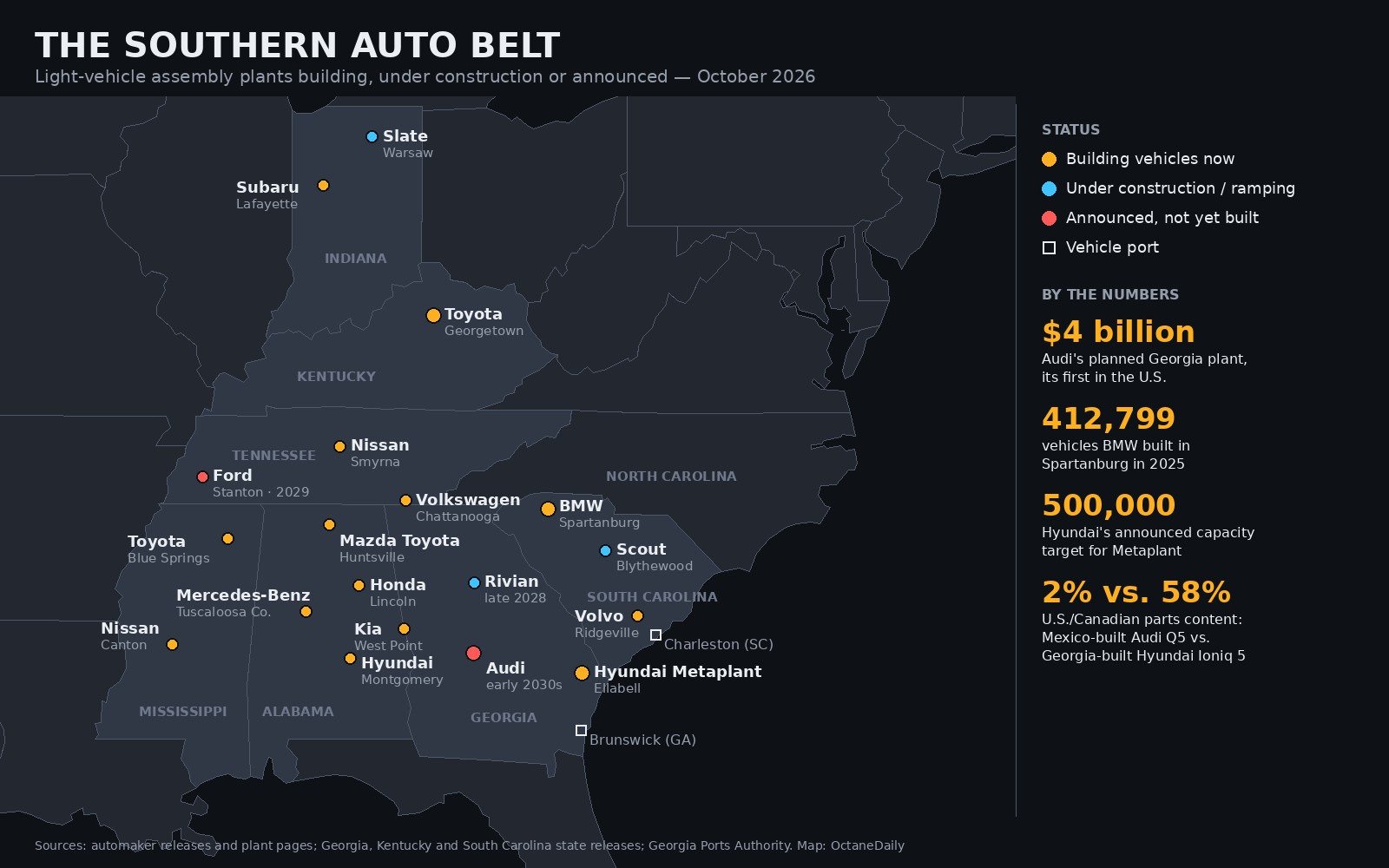
| State | Plant | Brand | What it builds | Timeline | Capacity per year |
|---|---|---|---|---|---|
| Georgia | Middle Georgia Mega Site, Peach County | Audi | Premium SUVs; models not named | Construction from 2027; production early 2030s | Up to 200,000 |
| Georgia | Metaplant America, Ellabell | Hyundai Motor Group | Hyundai Ioniq 5, Ioniq 9; Kia Sportage Hybrid | Building since October 2024 | 300,000; expansion to 500,000 announced |
| Georgia | West Point | Kia | Telluride (including hybrid), Sorento, Sportage, EV9, EV6 | Building since 2009 | 350,000 |
| Georgia | Stanton Springs North | Rivian | R2 | Under construction; production targeted for late 2028 | 300,000 (first phase) |
| South Carolina | Spartanburg | BMW | X3, X5, X6, X7, XM; iX5 from late 2026 | 412,799 built in 2025 | Up to 450,000 |
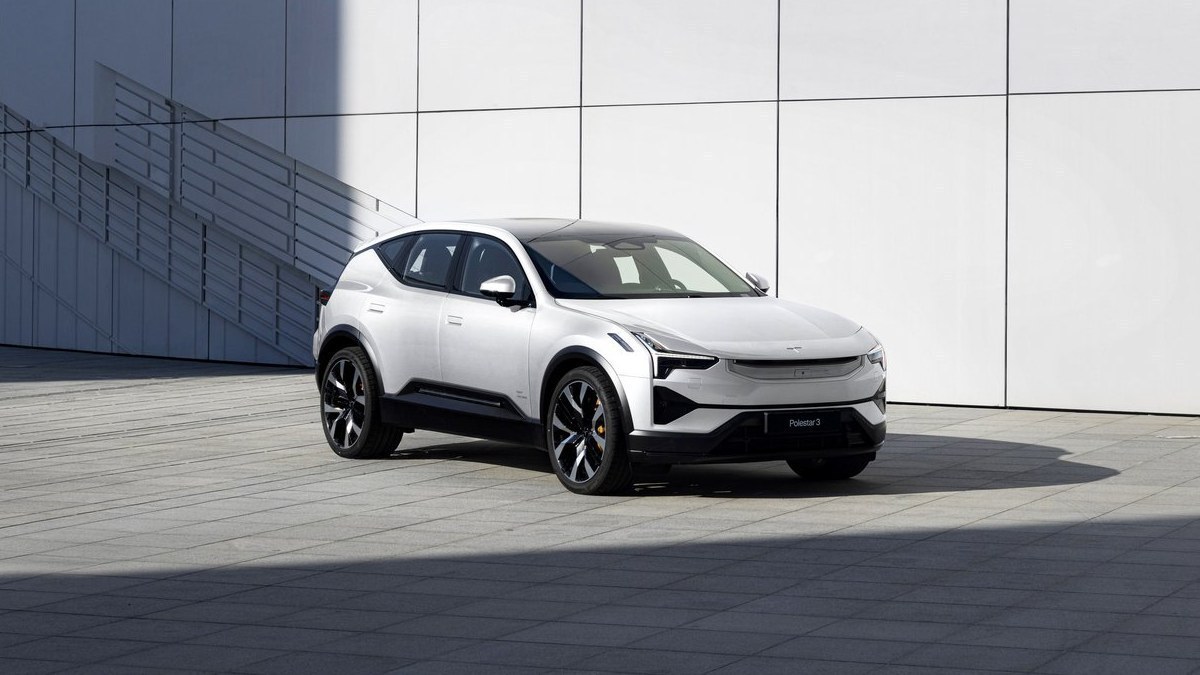
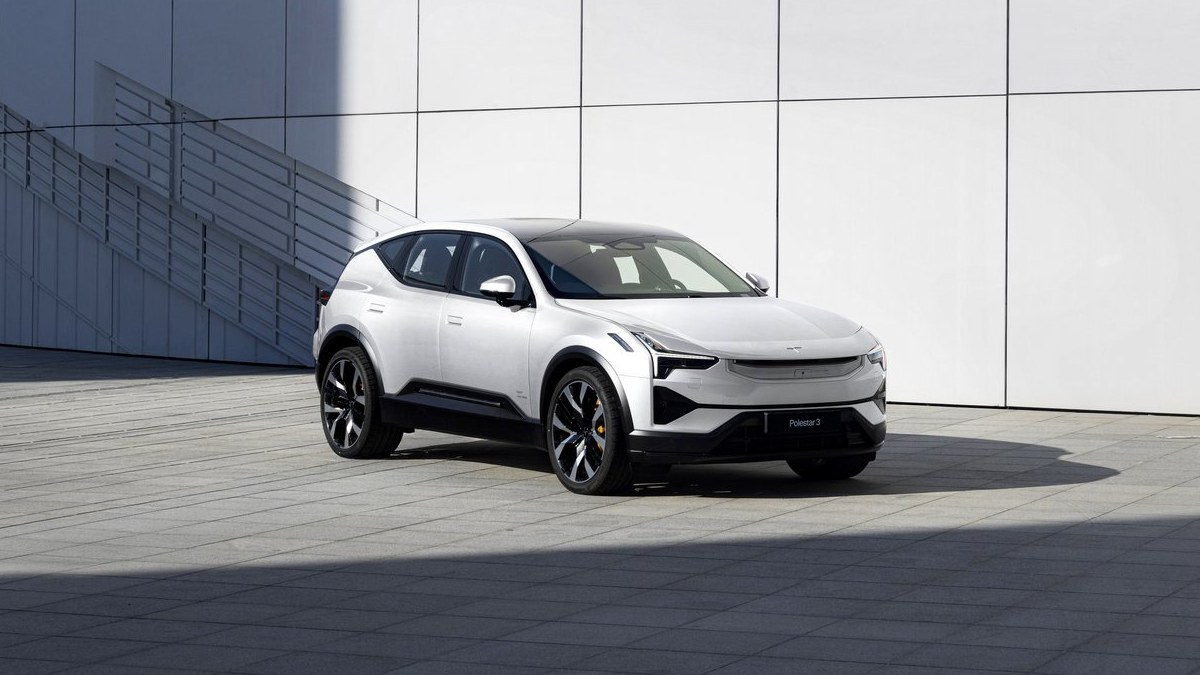
| South Carolina | Ridgeville, near Charleston | Volvo | EX90, Polestar 3; XC60 from Q1 2027 | Building | 150,000 installed |
| South Carolina | Blythewood | Scout | Traveler SUV, Terra pickup | Production 2027; deliveries 2028 | 200,000+ |
| Alabama | Tuscaloosa County | Mercedes-Benz | GLE, GLS, EQE SUV, EQS SUV; GLC "in the next few years" | Building | Not published |
| Alabama | Lincoln | Honda | Odyssey, Passport, Pilot; next-generation Ridgeline | Building | 340,000 |
| Alabama | Montgomery | Hyundai | Tucson, Santa Fe, Santa Cruz | Building | 390,000 |
| Alabama | Huntsville | Mazda Toyota Manufacturing | Toyota Corolla Cross, Mazda CX-50 (both including hybrids) | Building | 300,000 |
| Tennessee | Chattanooga | Volkswagen | 2027 Atlas; new Atlas Cross Sport due Q1 2027 | About 150,000 built in 2025 | Not published |
| Tennessee | Smyrna | Nissan | Rogue, Murano, Pathfinder, Infiniti QX60 | Building | Not published |
| Tennessee | Tennessee Truck Plant, Stanton | Ford | Gas-powered trucks | Production from 2029 | Not published |
| Mississippi | Canton | Nissan | Altima, Frontier | Building | Not published |
| Mississippi | Blue Springs | Toyota | Corolla | Building | Not published |
| Kentucky | Georgetown | Toyota | Camry, RAV4; Highlander EV and Subaru Getaway due 2027 | Building | About 550,000 |
| Indiana | Lafayette | Subaru | Ascent, Crosstrek, Forester (including hybrid) | Building | Not published |
| Indiana | Warsaw | Slate | Slate Truck | First deliveries planned for Q4 2026 | Not published |
Sources: company releases and plant pages, Georgia and Kentucky state economic-development releases, as of October 26, 2026. Indiana sits north of the South, but its Subaru and Slate plants belong to the same supply corridor along I-65.
The map has been redrawn in the last 12 months
Anyone working from a two-year-old list will get several of these rows wrong. Volkswagen ended ID.4 production in Chattanooga in April. Subaru built its last Indiana Legacy in September 2025, and the Outback now comes from Japan. Genesis is moving GV70 production from Montgomery back to Korea, a change it calls temporary. Ford's BlueOval City, once planned as an electric-truck plant, is now the Tennessee Truck Plant and will build gas trucks from 2029.
The additions point the other way. Hyundai's Metaplant added its first hybrid and its first Kia in June. Kia's West Point plant started building the 2027 Telluride Hybrid in February. Rivian reworked its Georgia plan in April to 300,000 vehicles in the first phase, with production targeted for late 2028. Volvo's own third-quarter report set XC60 production in South Carolina for the first quarter of 2027; the reasons are in our breakdown of Volvo's US losses.
Why the South keeps winning
Start with tariffs. Since April 3, 2025, imported passenger vehicles have paid a 25% duty under Section 232, according to the presidential proclamation. Trade deals have since lowered that to a 15% all-in rate for cars from Japan, the European Union, and South Korea, and to 10% for British cars within a 100,000-unit annual quota. Vehicles from Mexico and Canada that qualify under USMCA pay the 25% only on their non-U.S. content. Cars assembled in the U.S. pay nothing at the border, and their makers can claim an offset worth 3.75% of the vehicles' MSRP through April 2030, under a Commerce Department notice published in May.
Labor law is the second factor. All seven states on the map have right-to-work laws; Kentucky passed its law in 2017, Indiana in 2012.
The third is the coastline. Georgia's Port of Brunswick, which the Georgia Ports Authority calls the busiest U.S. gateway for autos and heavy equipment, handled 763,122 roll-on/roll-off units in the fiscal year that ended in June, down 12.4% from the year before. South Carolina's ports handled 165,949 finished vehicles in fiscal 2025. Those ports work in both directions: BMW says about half of what Spartanburg built last year was exported, and Mercedes says about 60% of its Alabama output goes overseas.
State money is the fourth factor, and the one hardest to compare. Georgia's Audi announcement lists no incentive figure; the state says it bought and prepared the megasite and will build a dedicated training program. Until Georgia publishes the package, any dollar figure you see for it is an estimate.
Takeaway 1: Who still builds nothing here
The clearest way to see the gap is the federal parts-content label. Under the American Automobile Labeling Act, every new car's window sticker lists its U.S. and Canadian parts content, and NHTSA's model-year 2026 report collects those figures. The Mexican-built Audi Q5 lists 2% U.S./Canadian content and 74% from Mexico. The Georgia-built Hyundai Ioniq 5 lists 58%, the Alabama-built Honda Pilot 70%, and the Tennessee-built Volkswagen Atlas 4Motion 61%.
That 2% is Audi's problem in one number, and it will not change until the early 2030s. Porsche has no U.S. plant. Genesis is losing the only one it had. Polestar is out of the picture entirely: federal rules bar its U.S. sales from the 2027 model year, even though the Polestar 3 is built in South Carolina. Mazda builds one model here, the CX-50, in its Alabama joint venture with Toyota; the rest of its lineup is imported.
U.S. assembly also isn't the same as U.S. content. The South Carolina-built BMW X5 lists 35% U.S./Canadian parts content, about half the Pilot's figure. A plant on the map is the start of localization, not the end of it.
Takeaway 2: Whose prices are shielded
On paper, buyers of Southern-built Toyotas, Hondas, Hyundais, Kias, BMWs, and Volkswagens are shopping cars that never paid an import duty. In my view, that protects those prices from future tariff shocks more than it lowers them today. Imported parts still pay duties, and a plant's cost advantage tends to show up in margins before it shows up on stickers.
The evidence cuts both ways. As we found in our look at who is cutting 2027 prices, Subaru lowered prices on the 2027 Outback, a car built in Japan that still pays the 15% duty. Price follows sales pressure as much as it follows the factory's address.
Takeaway 3: Where the next pins will go
Audi says it expects to announce more U.S. investments, without saying what or where. Hyundai has announced that Metaplant will grow from 300,000 to 500,000 vehicles a year; its chief executive has told CNBC he is weighing more, and the company says no decision has been made. Mercedes has said the GLC for North America will move to Alabama in the next few years, without a date. Volvo plans a second, all-new U.S.-built model by the end of the decade. Hyundai has also said it will build a midsize pickup in America by 2030 without naming a site, one of the trucks scored in our ranking of promised new pickups.
My bet is that most of the next pins land where existing ones already are. Suppliers, trained workers, and port contracts are already in place around Ellabell, Spartanburg, and the I-65 corridor, and every new plant makes the next one in that region cheaper to start.
What we don't know yet
- Which models Audi will build in Georgia, on which platform, and with which powertrains.
- The size of Georgia's incentive package for Audi.
- Whether Rivian's Georgia plant holds its late-2028 target; its federal loan has not been drawn yet, with the first draw expected by early 2027.
- When Scout's Traveler and Terra enter production; Scout says 2027, while an outside forecaster reported later dates that Scout disputes.
- When the Mercedes GLC starts in Alabama, and what Ridgeville does with Polestar 3 output now that U.S. sales are barred.
We will update the table as those answers arrive.