The 'EV Winter' Is a New-Car Story. Used EV Sales Just Hit a Record
New EV sales fell 41% in September while used EVs hit a record. Against a normal year, Americans bought more EVs in total, just not new ones.
Americans bought 86,632 new electric vehicles in September, 40.7% fewer than a year earlier. In the same month they bought 47,862 used ones, 21.2% more than a year earlier and a record 3.3% of all used-car sales, according to Cox Automotive's September EV Market Monitor. Put those two lines next to each other and the popular story of an "EV winter" starts to look like a story about one aisle of the store.
The comparison month matters more than usual here. September 2025 was the last month of the federal tax credits, $7,500 on a new EV and up to $4,000 on a used one, and buyers rushed to beat the September 30 deadline. We covered what the year since the credit ended has done to prices and leasing. This piece asks a narrower question: when buyers stopped signing for new EVs, where did they go?
The math: how much demand actually moved
Against last September, not much of it moved. New EV sales fell by about 59,400 units. Used EV sales rose by about 8,400. Add new and used together and EV transactions fell from roughly 185,600 to 134,500, a drop of about 27%. By our math from Cox's figures, the used lot picked up about one in seven of the sales the new-car side lost.
That comparison is rigged, though, because September 2025 was a deadline month. A fairer baseline is September 2024, before the rush. Cox doesn't publish that month in its current report, but its September 2025 monitor gives the year-over-year changes, which put September 2024 at about 102,000 new and 23,000 used EVs. Measured against that, new EV sales are down about 15%, used EV sales have roughly doubled, and the two together are up about 7%. Those 2024 figures are our derivation, not numbers Cox published, so treat them as close estimates.
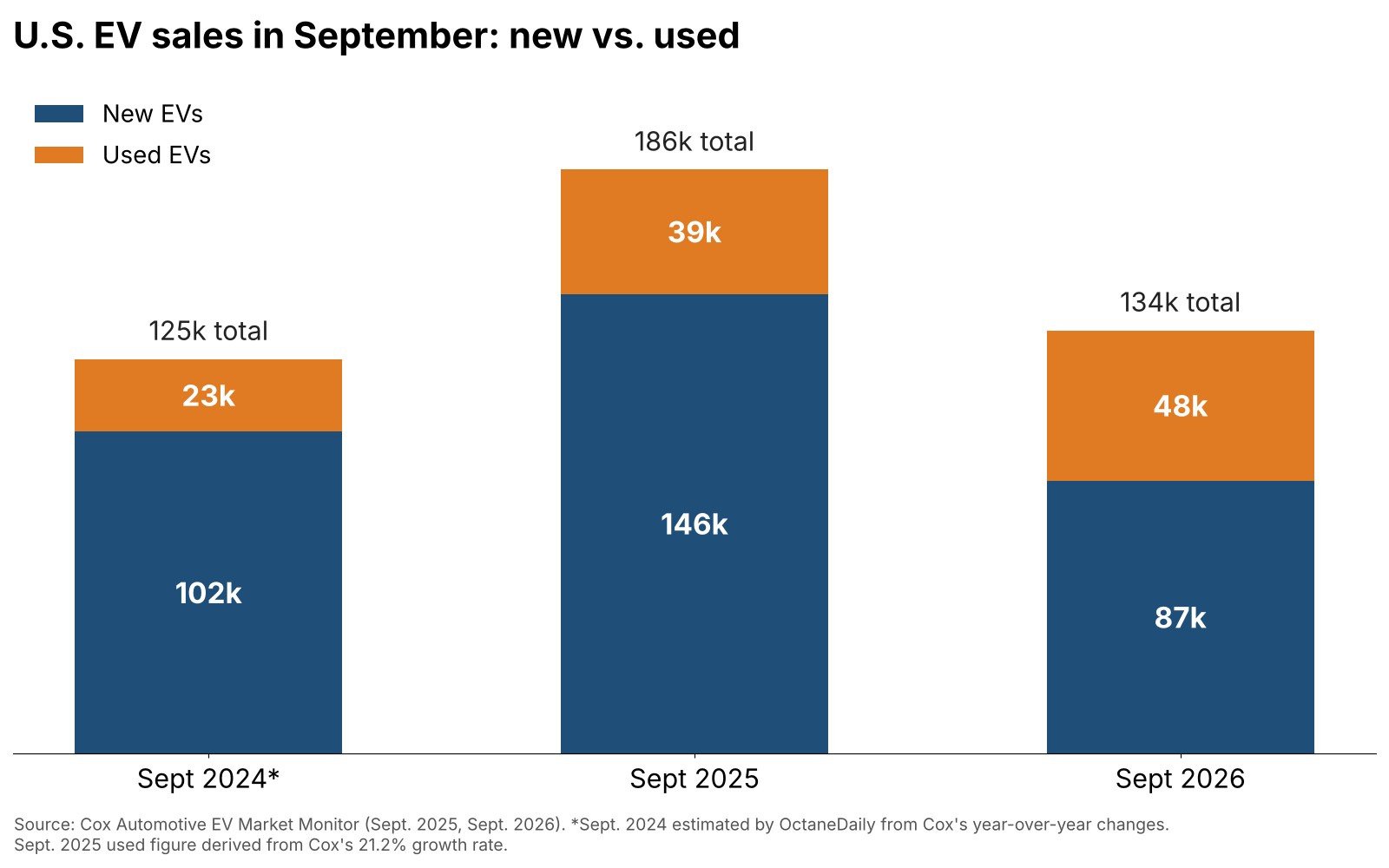
Both readings are true, and they say different things. Measured against the credit's last month, EV demand shrank and the used lot caught only a small share of it. Measured against a normal year, Americans are buying more electric cars than they were, just a much smaller share of them new. I'd argue the second comparison is the one that tells you where the market is heading.
New and used EVs, side by side
| September 2026 | New EVs | Used EVs |
|---|---|---|
| Sales | 86,632 | 47,862 (record) |
| Change vs. September 2025 | −40.7% | +21.2% |
| Change vs. September 2024 (our estimate) | About −15% | About +107% |
| Share of the market | 6.5% (11.5% a year ago) | 3.3% (record) |
| Days' supply | 68 (gas and hybrid: 78) | 35 (gas and hybrid: 46) |
| Average price | $55,842 transaction, −3.1% | $36,767 listing, +6.4% |
| Premium over gas and hybrid | $5,611 (2025 average: $8,665) | $2,137 ($679 a year ago) |
| Incentives | 11% of price, about $6,117 (14.2% a year ago) | Not reported |
Source: Cox Automotive EV Market Monitor. "Gas and hybrid" is Cox's ICE+ category, which also includes plug-in hybrids.
Stream one: the buyer who went used
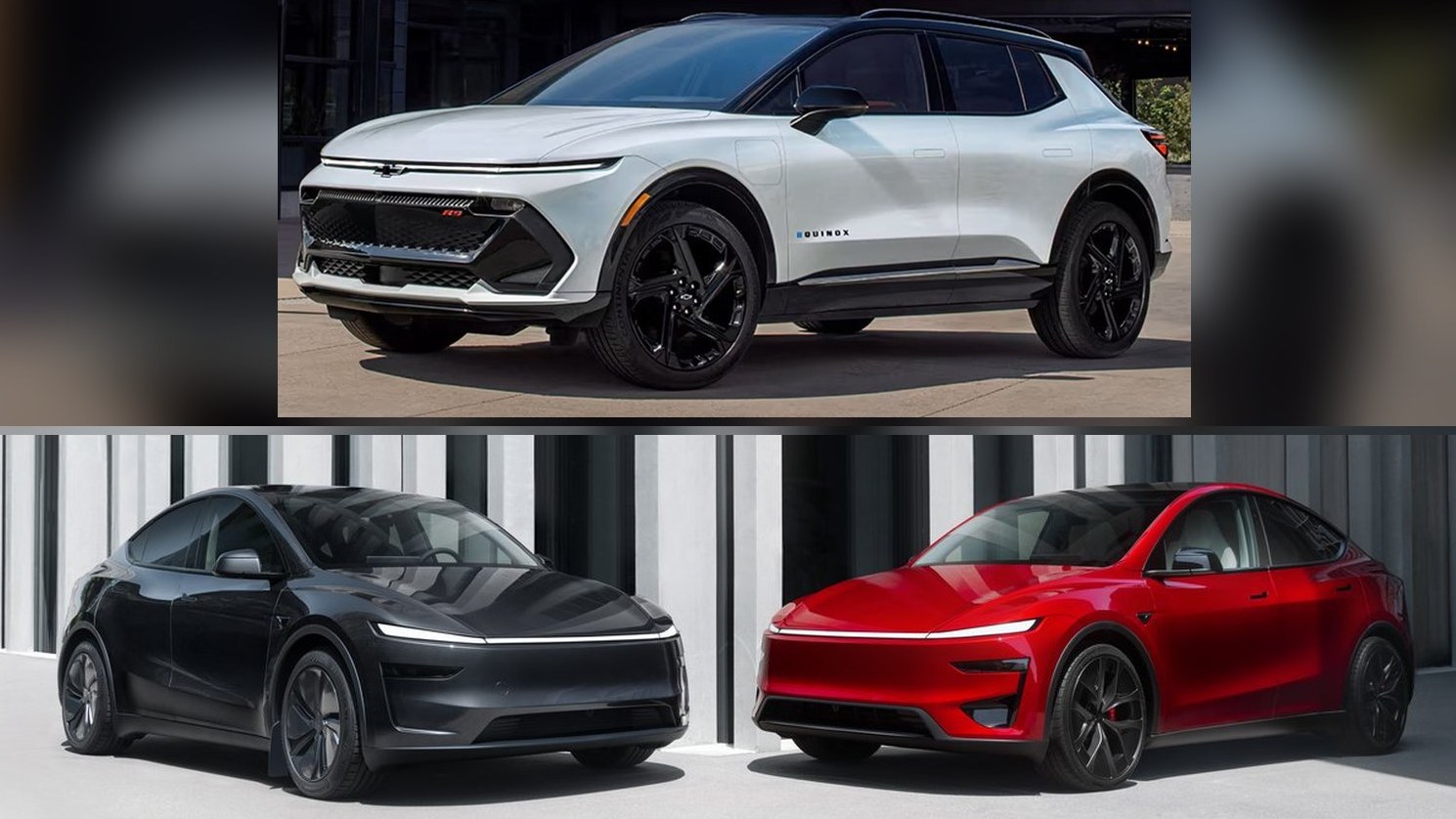
The clearest single example is the Chevrolet Equinox EV. A year ago it was the best-selling EV not made by Tesla. In the third quarter, its new sales fell 92% to an estimated 1,905, as our ranking of Q3's best-selling EVs shows. In September, used Equinox EV sales rose 41.9% from August, among the fastest gains Cox recorded. The car didn't change. The buyer who stretched for a $35,000 crossover with $7,500 off now buys a two-year-old one instead.
That buyer is paying more for the privilege than a year ago. The used EV premium over a comparable gas or hybrid listing has roughly tripled, from $679 to $2,137, and used EVs now turn in 35 days against 46 for everything else. Demand is outrunning supply, which is the opposite of what a dead market looks like. Whether that premium still pays for itself depends on gas prices and where you charge, and Daniel Reeves ran the used EV payback math at today's gas prices.
There is an irony in the supply. Many of these cars are 2023 leases, the first year the $7,500 credit could be passed through to lessees, now coming back at the end of three-year terms. Cox expects EVs to rise from about 10% of off-lease supply in the first half of this year to about 16% in the second. The credit is gone, but it is still stocking the used lot.
Stream two: automakers move the money
Manufacturers read the same numbers and are spending accordingly. In October alone, GM said it will prepare its Lansing Delta Township plant for hybrids, using a $500 million federal grant originally meant for EV retooling, and booked a $238 million EV realignment charge in its third quarter. Hyundai put about $450 million into its Alabama plant, partly for hybrid and extended-range engine variants. Mercedes gave its smallest gas engine an electric turbo for its next compact hybrids. I made the broader case earlier this month in why Q3 settled the hybrid argument for Detroit.
None of this means the EV programs are gone. It means the next marginal dollar is going to hybrids, because that is where new-car buyers paying full price are going.
Stream three: what it means for new EV prices this winter
The intuitive conclusion is that weak new-EV sales force big discounts. The supply numbers argue against it. New EVs had 68 days of supply in September, 10 fewer than gas and hybrid vehicles. Automakers have kept new-EV output close to demand rather than letting cars pile up on lots. Incentives fell to 11% of the transaction price from 14.2% a year ago. Tesla ended its quarter with 11 days of global supply and a higher car margin, 18.1% excluding regulatory credits.
Discounts are also expensive for the companies that would have to fund them. Ford's Model e unit lost $1.1 billion in the third quarter on 34,000 wholesale vehicles and $1.2 billion in revenue, as our report on Ford's Q3 results showed. That works out to roughly $32,000 of loss per vehicle shipped by our math, though the figure includes spending on future platforms, not just today's cars. A business losing that much per unit can't buy volume with deeper cuts.
My bet is that this winter's new-EV deals stay targeted: finance and lease offers on slow sellers and leftover 2026 stock, not across-the-board price cuts. For a shopper whose budget sits near $35,000, the most attractive EV this winter is likely to be a two- or three-year-old one.
The case against this reading
The new-car side isn't uniformly shrinking. New EV sales rose about 6% from the second quarter to the third on Cox's corrected count, and share climbed to 6.5% from 5.8%. Toyota's EV sales rose 328% year over year in the third quarter, Rivian's 45.7%, and Subaru's 31.5%. In September alone, Cadillac's EV sales rose 21.5% from August and Kia's 21.8%. Where automakers launched new products at the right price, buyers showed up.
The growth is also concentrated. Tesla took 55.8% of new EV sales in September, so "the new EV market" increasingly means one company plus a handful of fresh nameplates. And the used surge has a ceiling set by supply: once the 2023 lease cohort clears, the pipeline thins again, because leasing fell after the credit ended.
What we don't know yet
- October figures. Cox's October EV Market Monitor is due around mid-November and will be the first month compared against a year without the credit.
- How much of the used supply is lease returns. Cox reports off-lease shares for the whole market, not the share of used EV sales that came off lease.
- Real used EV prices. Cox publishes listing prices for used EVs, not transaction prices, so the $2,137 premium is what dealers ask, not necessarily what buyers pay.
- The two-year baseline. Our September 2024 figures are derived from Cox's published growth rates, and Cox revises its monthly data.
The bottom line
"EV winter" is an accurate headline for new-car sales and a misleading one for demand. Fewer Americans are paying sticker for a new EV, and the used lot has not replaced all of last year's deadline rush. But measured against a normal year, more Americans bought an electric car this September than two years ago. They bought it with a few thousand miles on it.